
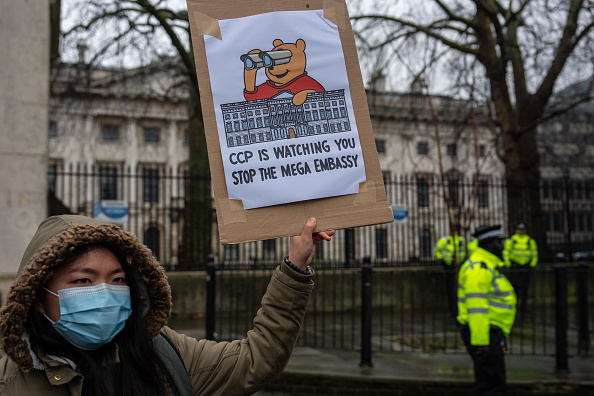
On January 20th, the UK government announced approval for the construction of a super embassy by the Chinese Communist Party in the heart of London. This plan has faced opposition from numerous British MPs, activists, and local residents, as they fear that the CCP may use the space as a base for espionage and the suppression of dissenting voices.
The decision by the UK government came as no surprise to observers, as Prime Minister Keir Starmer is planning a visit to China in the coming weeks. Approving the construction of the embassy is seen as paving the way for his visit, marking the first time a British Prime Minister has visited China since 2018.
Steve Reed, the UK’s Local Government Minister, was responsible for reviewing the CCP’s embassy construction plans. He insisted that the decision was made following a “quasi-judicial process” and emphasized the need to make a fair judgment based on evidence and planning regulations.
In a written statement, he further stated, “All key factors were considered in making this decision. The decision is now final unless successfully challenged in court.”
Facing backlash, a government spokesperson defended the decision, stating, “It is a normal part of international relations for any country to establish an embassy in another country’s capital.”
The spokesperson also stressed, “National security is our top priority. Intelligence agencies have been involved throughout the process and have devised a range of extensive measures to manage any risks.”
The opposition Conservative Party’s senior members have strongly criticized the decision. Shadow Community Secretary James Cleverly described it as a “shameful act of cowardice by the Labour government and a spineless Prime Minister.”
Shadow Foreign Secretary Priti Patel stated, “Keir Starmer has sold our national security to the Chinese Communist Party, a disgraceful surrender to a super embassy.”
The Liberal Democrats labeled this decision as the “biggest mistake” of Prime Minister Starmer.
The party’s spokesperson on foreign affairs, Paul Cardin, remarked, “The Prime Minister knows that his decision today will escalate Chinese (CCP) surveillance in the UK, jeopardizing our data security, let alone the safety of brave Hong Kongers on British soil. Accepting these threats to further flirt with China (CCP) is evidently a mistake.”
Luke de Pulford, responsible for the Inter-Parliamentary Alliance on China, who opposes the plan, stated, “This is a wrong decision for the UK, all signals sent out are wrong, it is wrong for dissenting voices, and wrong for UK national security.”
Critics of the CCP’s super embassy plan are already gearing up to legally challenge the decision. Local residents are also mobilizing funds to initiate a judicial review of the project.
The proposed location for the new embassy by the CCP is across from the UNESCO World Heritage site, the Tower of London, at the former site of the Royal Mint, a Grade II listed building.
The CCP had purchased this land in 2018 for around 250 million pounds. However, in 2022, the London Borough of Tower Hamlets rejected the CCP embassy’s planning application.
In 2025, CCP leader Xi Jinping directly requested UK Prime Minister Starmer’s intervention, after which the UK government took over the approval process for this plan and held a hearing in February last year to hear arguments on whether to approve the embassy.
Some UK and US politicians have argued for the plan’s prohibition, citing its proximity to the financial center of London, where fiber optic cables of financial companies pass through the area, making it possible for the CCP to eavesdrop on these cables.
UK security officials have warned that allowing the construction of a larger embassy by the CCP could mean the CCP might deploy more spies and diplomats in the UK.
The UK domestic intelligence agency MI5 has repeatedly warned of the threat of CCP spying activities to the UK.
The proposed embassy location would cover an area of 55,000 square meters, almost ten times the size of the current CCP embassy in central London and much larger than its embassy in the US.
Since the early 19th century until 1967, the site had been the location of the Royal Mint, where coins were minted.
When the CCP bought this land in 2018, the UK and China were trying to create a “golden era” of bilateral relations, leading the then Conservative government to approve the land purchase transaction.
However, UK-China relations took a sharp turn for the worse following the CCP’s crackdown on the Hong Kong democracy movement and its persecution of the Uyghur people in Xinjiang.
In 2021, the CCP embassy submitted a redevelopment planning application, aiming to build more structures for offices, residences for diplomats and staff, as well as commercial, consular, educational, and cultural centers on the site.
In October 2022, an incident occurred in Manchester involving the Consul General of the CCP physically assaulting Hong Kong protesters accompanied by five embassy officials.
Two months later, the council of Tower Hamlets rejected the CCP embassy’s planning application due to concerns that local residents might get involved in protests at the embassy. Moreover, the area has a significant Muslim population, many of whom are unhappy about the CCP’s persecution of the Uyghur people in Xinjiang.
The CCP did not submit a new application before the appeal deadline in August 2023. However, at the same time, the CCP began pressuring the British embassy in China and suggested that if the UK did not approve the CCP embassy application, they would not endorse the UK embassy’s renovation request.
In July 2024, the Labour Party won the UK general election, and two weeks later, the CCP submitted a new planning application, with little change in the content. In October of that year, the Labour government announced the decision to withdraw the approval for the CCP embassy planning application, and the final decision would be made by the Minister responsible for local government affairs.
Subsequently, the UK government twice postponed the decision-making deadline and requested the CCP to explain the purpose of the basement rooms that were blacked out in the planning application.