
In 2020, the then Chinese Premier Li Keqiang proposed that the “sidewalk economy” was the “lifeblood of China,” but it was met with skepticism by official Chinese media. Over the past few years, China’s economy has been lackluster, and the “sidewalk economy” has quietly made a comeback. An article in the Chinese Communist Party’s magazine, “Half-Month Talk,” recently praised the “sidewalk economy,” but lamented that even street vendors are facing intense competition and struggling to survive.
New China Net recently published an article from the Chinese Communist Party’s magazine, “Half-Month Talk,” titled “2025, the lively and popular economy of human fireworks,” which besides mentioning agricultural markets, also highlights the sidewalk economy. The article claims that “whether in vibrant metropolises or warm small county towns, street stalls not only enrich the supply greatly but also have low thresholds and strong flexibility, allowing for full-time entrepreneurship or earning extra income in spare time. With the support of new media such as live streaming and short videos, the sidewalk economy has entered a new stage. It is stated in the article that the Central Economic Work Conference of the Chinese Communist Party proposed to “expand domestic demand and create new space for growth,” and the sidewalk economy has ushered in new development opportunities.
The “sidewalk economy” is considered to have been proposed by former Premier Li Keqiang but was previously suppressed by the Xi Jinping faction. In the context of the impact of the epidemic and employment difficulties, on the closing day of the Chinese People’s Congress on May 28, 2020, then-Premier Li Keqiang advocated for promoting the “sidewalk economy” to alleviate economic pressure. Subsequently, street vending became popular in many parts of China. However, a few days later, Li Keqiang’s description of the “sidewalk economy” was abruptly suppressed by the Central Propaganda Department, and Beijing official media began publishing or broadcasting commentary opposing the sidewalk economy. At that time, it was believed to be a manifestation of infighting between Xi Jinping and Li Keqiang.
After three years of continuous “zeroing” policies, China’s economy is riddled with problems, unemployment is soaring, and the “sidewalk economy” is quietly making a comeback. As early as March 2023, after the new Premier Li Qiang took office, cities like Beijing, Shanghai, and Hangzhou began indirectly promoting the “sidewalk economy.”
A report by Hong Kong’s “Ming Pao” on January 19th revealed that in some coastal towns, amidst economic downturn and lax urban management, street stalls have spontaneously appeared on the streets, with some small shops transitioning to selling on the streets, low entry barriers for entrepreneurship, and even street live streaming sales, turning popular spots into street markets.
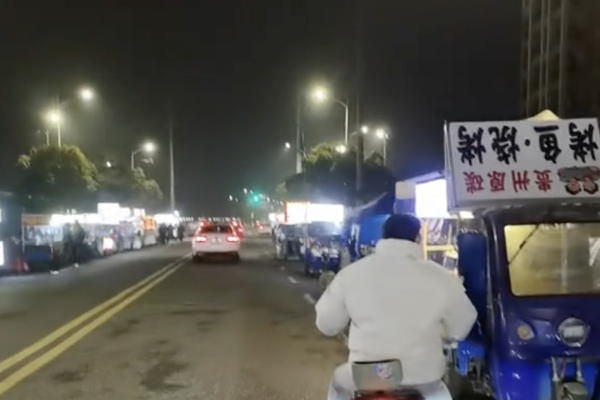
The report mentioned that at night, at some intersections in Chenghai New Town, dozens of small trucks and three-wheeled motor vehicles modified as “food trucks” gather to sell their goods. Some people choose to convert truck compartments into display shelves to showcase sneakers in grid boxes, illuminating them with lights, resembling mobile sneaker stores.
However, both the official media and Hong Kong media did not mention that due to the influx of a large number of unemployed individuals, the so-called “sidewalk economy” has experienced severe internal competition.
A Chinese blogger recently posted a video saying that all industries in China are oversaturated, no one can make money, and even setting up a stall is difficult. “Look at this street, where were so many before? In the past two years, regulations have been loosened, and now you can set up stalls. As long as it’s a street corner or a community, they are all full of stalls.”
He continued, “If you find a job at an electronics factory, just work there; setting up a stall outside is cold and hard work. I counted, in a short street, there are around 100 stalls, ‘I don’t think I can make much money.’”
A vendor named Dongyang, who sold roasted goose heads at a night market in Hebei, told journalists that he found the foot traffic there particularly low and decided to return to his hometown three months ago. “Mainly because of decreased consumer spending, people just don’t have much money.”
“In fact, setting up a stall now is really not cheap, it’s about creating an atmosphere and a feeling. I invested ten thousand yuan in this. The goose heads sell for 10 yuan each, unique, so there’s less competition. I can make three to four hundred yuan a day, but after covering costs, there’s not much left. I’ve been doing this for five years, and it’s been getting worse every year.”
He mentioned that it’s hard to survive in any industry now. Regarding the official media’s claim to “support the sidewalk economy,” Dongyang said that’s one thing to say, but even roadside vendors are not allowed to set up stalls by urban management. “If I go to set up a stall by the roadside, I have to go around 1 a.m. If I go earlier, they won’t let me, and the urban management doesn’t allow roadside stalls, so I have to sell until 3 or 4 in the morning.”
According to Dongyang, people from all walks of life and ages set up stalls, showing that everyone is capable. However, not many can earn money, “Many stalls are closing down, a new batch every year.”
A vendor selling barbecue in Zhangjiajie, Hunan, named Shaocong, said that setting up a stall is not easy overall, it varies from place to place, some make money while others struggle to earn anything. Barbecue has its seasons, relying on persistence and reputation. Even in Zhangjiajie’s strict management, he mentioned that currently there are hardly any places where you can set up stalls.
“Stalls are oversaturated now, the wild stalls are strongly regulated, it’s not easy to set up, and the fees for night markets have skyrocketed. The situation of setting up stalls is messed up, the environment is not good.” Shaocong expressed that it’s hard to survive now.
Dazhong from Changsha, Hunan, who has been setting up a stall selling barbecue and owning a shop for over nine years, said that setting up stalls is currently oversaturated; wild stalls are strictly regulated, making it difficult to set up. “Setting up a stall is messed up, the urban management is strict, they don’t allow it. There are too many stalls; everyone rushes in once they find out a place is available.”
He mentioned that in the past when he set up a stall, he could earn around 10,000 yuan a month, but now it’s only about 6,000 yuan a month, with a cost of about 3,000 yuan, and the stall fees are too expensive. “In the past, I could easily earn tens of thousands in a month.”
On January 18, a blogger shared a video, saying, “This morning, I set up a stall at the entrance of the community for two hours, business was bleak, only made 40 yuan. I was selling small accessories and socks, with people coming and going, but no one stopped. The auntie selling roasted sweet potatoes next to me said she was having a similar experience; everyone is shopping online now, brick-and-mortar stores and sidewalk stalls are not doing well. Watching the crowd coming and going, I feel like a lone warrior vendor. Despite yelling and trying hard, I can’t keep customers. Maybe the mood hasn’t arrived this year, or perhaps everyone prefers online shopping now. I hope things will pick up in a few days because I need this income to make ends meet.”
Officially in 2025, the average urban unemployment rate was stated to be 5.2%, and the “employment situation remains generally stable.” However, the public has always been skeptical of official figures. Many university students face “graduation equals unemployment” each year.
A university student born in 2004 shared a video about his experience of being unemployed for two months in Shenzhen and setting up a stall on the street to make a living on the first day. He carefully prepared to sell quail eggs but due to urban management enforcement, he was forced to close after operating for 40 minutes. “Today, I sold a total of 6 servings of quail eggs, earning 60 yuan, costs were 120 yuan, so today I lost a total of 60 yuan.”
Dazhong, a vendor from Changsha, stated that currently, almost all vendors setting up stalls are the unemployed. However, some are employed and set up stalls because it’s the lowest entry point for entrepreneurship, so there are many people, yet few can do well.
Chinese affairs expert Wang He expressed to the Epoch Times that the sidewalk economy does indeed represent the liveliness of human emotions. In major cities around the world such as New York, street stalls are legally allowed, it’s just that the Chinese Communist Party has a very distorted way of management where street stalls are not allowed in big cities in the name of urban sanitation. This shows that the urban governance of the Chinese Communist Party fundamentally does not align with human norms.
He believes that many people are unable to find jobs now, societal consumption has downgraded, and the Chinese Communist Party has only temporarily allowed setting up stalls due to its strategic adjustment in loosening restrictions, but this adjustment is only temporary and strategic. It does not mean that the Communist Party takes care of people’s livelihoods as a top priority, and they may tighten regulations at any time in the future.