
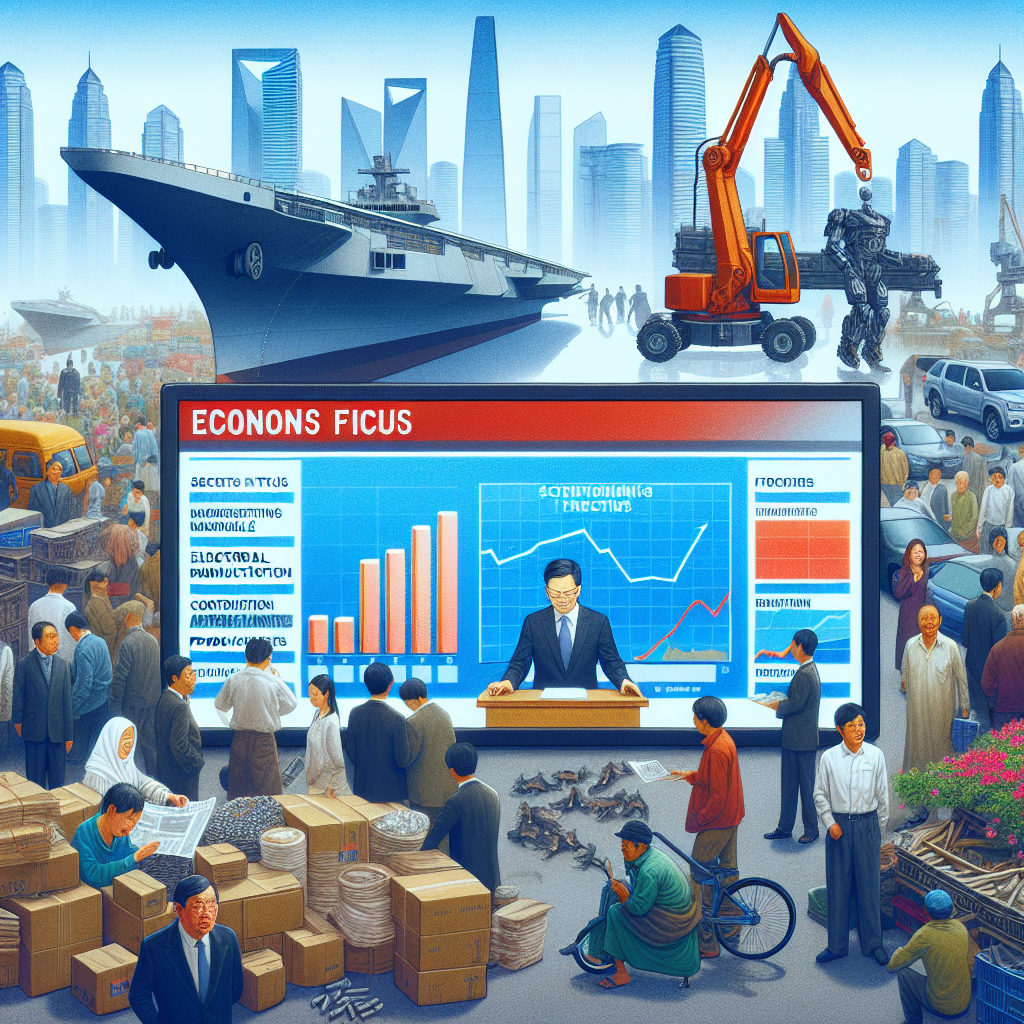
In a news report dated January 3, 2026 by Dajiyuan, it was indicated that while official Chinese Communist Party data shows continuous economic growth with a focus on developing industries such as robots, electric vehicles, and aircraft carriers, people in China are feeling a decline in their living standards. A recent article from mainland Caixin Network unveiled the “mystery of economic temperature difference,” pointing out that the claimed total national output increase of 20 trillion yuan cannot make up for the over 2 trillion yuan decrease in wealth caused by three consecutive years of real estate price adjustments, leading to the article being deleted.
Zhao Jian, the director of the Westjing Research Institute, recently published an article on Caixin Network titled “The Mystery of Economic Temperature Difference.” The article highlights the stark contrast in China’s economy, where emerging industries like biopharmaceuticals, integrated circuits, artificial intelligence, robots, and new energy are booming, with a trade surplus exceeding 1 trillion US dollars. However, despite these advancements, there is a widespread sense of dissatisfaction among the populace with difficulties in businesses, job scarcity, and even losses for 80% of individual investors in the bullish market.
Furthermore, the article pointed out that while GDP value accumulation is happening on the production side, large projects, big companies, and supply side, the benefits are realized by a few technology and financial elites, leaving the majority of ordinary people feeling the chill from the contraction in real estate. The 20 trillion yuan total national output increase cannot offset the over 2 trillion yuan wealth shrinkage caused by three consecutive years of real estate price adjustments.
The article also indirectly criticized the authorities for not understanding modern economics and being stuck in a mindset of scarcity economics.
Following the publication of this article, it sparked discussions online, with Chinese netizens expressing similar sentiments regarding the economic temperature difference. The article was quickly deleted from mainland Chinese websites, with the original content showing a 404 error on the Caixin official website, although some copies are preserved overseas.
In recent years, under directives from the Chinese Communist Party leadership, various provinces and cities in China have been promoting local advanced manufacturing industries such as new materials, automobiles, semiconductors, biopharmaceuticals, equipment manufacturing, and the new energy industry, aiming to expand scale rather than increase profits.
Taking the electric vehicle industry as an example, in 2025, China’s global automobile sales reached 27 million vehicles, growing at an annual rate of 17%, surpassing Japanese automobiles to become the “world’s leader” for the first time. However, statistics show that in the past year, in the first three quarters, half of China’s 14 major car manufacturers led by BYD recorded a year-on-year decline in net profits, with 6 companies suffering losses. In contrast, Toyota in Japan reported a net profit of 4.1 trillion yen, equivalent to about 183 billion yuan, exceeding the total profit of the entire Chinese automotive industry.
According to a report by the Financial Times, a recent survey conducted by the World Federation of Major Enterprises in 40 Chinese cities revealed that many second and third-tier cities in China heavily rely on manufacturing investment to achieve economic growth. By 2024, the investment in these cities accounted for an average of 58% of GDP.
On December 18, 2025, the “Guangdong Strategic Emerging Industries Fund” was established with a registered capital of 50 billion yuan, fully held by the Guangdong Provincial Department of Finance.
Xinhua News Agency reported that since 2024, central state-owned enterprises alone completed strategic investments in emerging industries worth 2 trillion yuan from January to November, a year-on-year increase of 18.7%, marking the first time that the proportion of these investments exceeded 40% of the total.
With the commissioning of the aircraft carrier Fujian in 2025, China has surpassed any other country in the number of robots, and the Chang’e 6 mission successfully collected samples from the far side of the moon. However, these so-called “powerful national tools” have little impact on the lives of ordinary people.
China appears to be facing two vastly different economic realities, with the emphasis on “emerging industries” and the “new economy” of the digital industry not translating into corporate profits or job security, leading to declining local tax revenues and industries facing overcapacity, while traditional industries like real estate are declining, making life difficult for the people. Economists describe this as an “economic dual track,” “economic temperature difference,” or “misallocation of resources.”
An editorial in the Hong Kong Economic Journal stated that this economic temperature difference will be a challenge that China must face in 2026.
In fact, since the opening of discussions on the contraction of the Chinese economy and the falsity of economic growth numbers since the lifting of COVID-19 restrictions in 2023, there have been numerous discussions on these topics that were quickly suppressed.
Over the past three years, the Chinese Communist Party has been emphasizing the “bright economic theory,” cracking down on scholars who dare to expose the true economic situation. Chief economist Gao Shanwen of Guotou Securities recently resigned from the company. His view published at the end of last year suggested that the actual GDP growth rate in China may be around 2% for the past two to three years (official figures are close to 5%).
In 2023, Tsinghua University professor Sun Liping wrote about the economic temperature difference in China, pointing out that despite a significant increase in money supply, prices are low due to the formation of a new dual structure in the economy: one for national calculations and the other for livelihoods, where a large amount of money circulates within the so-called national calculations.
Sun Liping explained in his article through illustrations that the national calculation part mainly involves high-tech and high-end manufacturing that address bottlenecks, the upgraded high-end segments in export products, specialized high-tech industries, defense industries, and government departments (state-owned enterprises, possibly including some top private enterprises); while the other livelihood part includes aspects related to daily essentials.
Sun Liping stated that the current economic disconnect is due to the excessive buildup of money in the dual structure. He argued that the solution is not to increase money supply or distribute money to the people but to bridge the dual structure, at least sinking resources into the livelihood part.
Independent political and economic scholar Zheng Xuguang told Dajiyuan that Sun Liping implied that the Chinese Communist Party is regressing in terms of economic structure, leading to a mess in both national calculations and livelihoods. However, the current national calculations of the Chinese Communist Party focus on a strong country strategy combined with preparations for war and natural disasters, similar to North Korea’s “military-first strategy,” which sacrifices livelihoods. “There is fundamentally no way to bridge the dual structure because it cannot be bridged.”
Economist Yu Weixiong of UCLA Anderson School of Management recently told Dajiyuan that China is now facing a dilemma similar to what the Soviet Union experienced in the 1980s. During that time, the Soviet Union competed with the United States in various aspects until it exhausted all its resources. While the US operates on market mechanisms, the Soviet Union and the Chinese Communist Party are guided by state-led technology policies. In competing for hegemony against the US, the Chinese Communist Party may also engage in such irrational behaviors, potentially following the same path as the collapse of the Soviet Union.