
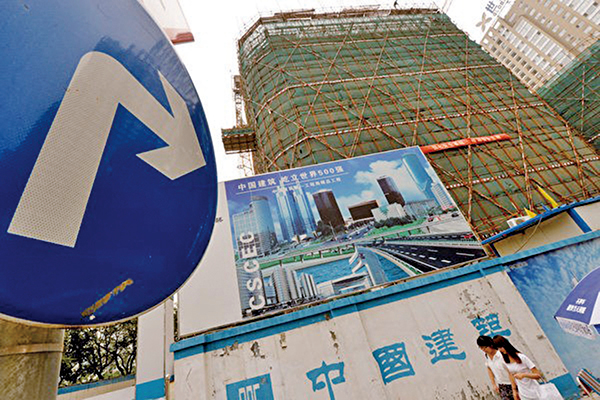
China’s economy is on the decline, with the real estate boom disappearing and the Communist Party’s efforts to rescue the property market failing to stem the real estate crisis. In 2024, the Chinese government introduced over 780 real estate policies, yet 169 real estate enterprises went bankrupt, and 10 listed real estate companies were delisted. The number of real estate companies that have filed for bankruptcy in the past five years has exceeded 1,660. Analysts believe that the clearance of China’s real estate industry will continue for several more years.
Nomura Securities’ chief economist, Lu Ting, stated in an interview with Caijing Magazine on December 30 that the first consideration for China’s real estate sector should be market clearance, which involves cleaning up debts. Real estate companies owe not only funds or properties to homebuyers but also owe a significant amount of money to upstream and downstream enterprises as well as financial institutions.
Lu Ting mentioned that “some developers may need to go bankrupt,” as they cannot indefinitely roll over their debts and accumulate a plethora of issues.
Nomura Securities estimated in June of 2021 that Chinese real estate companies’ debts amount to a staggering $5.2 trillion. To address the real estate crisis in China, the Communist Party’s support for the housing market in 2024 reached new heights.
According to data from China Index Research Institute, as of the end of December, more than 780 policies were introduced throughout the year. These policies included lifting restrictions on purchases, sales, and prices, lowering down payment ratios, reducing existing home loan rates, lowering housing provident fund loan rates, and increasing the credit scale for projects on the “white list” to 4 trillion RMB, adding implementation of renovations for one million units in urban villages and dilapidated houses.
However, political commentator Wang He previously told Epoch Times that the current plight of China’s real estate sector is mainly due to structural problems that require years of market-adjustment to thoroughly clear. Short-term stimulus policies by the authorities are futile, and their compulsory reverse adjustments (failure to effectively deflate bubbles) will worsen the situation.
As reported by Bloomberg, as China’s real estate debt crisis enters its fifth year, the industry has yet to emerge from years of stagnation. Confidence among potential buyers has waned, property prices have plummeted, and countless homes remain unfinished.
The 780 real estate policies have failed to rescue the Chinese real estate market, with numerous real estate enterprises continuing to file for bankruptcy and delist.
According to stats from the China Real Estate Association, as of November 4, 2024, the number of real estate companies applying for bankruptcy this year had reached 152, with over 1,660 real estate companies filing for bankruptcy between 2019 and now.
By searching the court announcement website using keywords like “real estate” and “bankruptcy documents” and excluding non-real estate enterprise lists, Epoch Times journalists found that from November 5 to December 30, 2024, 17 real estate companies applied for bankruptcy. Adding this to the 152 companies recorded by the China Real Estate Association up to November 4, the total number of bankrupt real estate companies this year reached 169.
As of December 25, a total of 394 stocks on the Shanghai and Shenzhen stock exchanges had fallen below their net asset value, with real estate stocks being the most affected, accounting for 46 of the listed stocks. “Below Net Asset Value” indicates when a company’s stock price falls below its net assets per share.
Recently, news of major real estate companies being delisted continued. On November 11, both Cheung Shing Holdings and Shangzhiguan group were delisted from the Hong Kong Stock Exchange for failing to fulfill resumption guidelines by the deadline and not releasing financial performance reports, resulting in the exchange revoking their listings. Previously, on October 29, Jia Yuan International, Datang Group, and Dafa Real Estate had been delisted from the Hong Kong Stock Exchange for similar reasons.
Liu Shui, the director of corporate research at the China Index Research Institute, stated in an interview with Hua Xia Times that real estate risks have deepened to a new phase, and the concentration of listed real estate companies being delisted is inevitable.
According to the China Index Research Institute, since early 2023, 23 listed real estate companies have been delisted, with 13 in 2023 and 10 from January to November 2024, including companies like Fantasia Holdings, Zhongnan Construction, Shimao Group, Blue Moon Development, Tahoe Group, Sunac China, SanSheng Holdings, Evergrande Real Estate, Yuexi Tai Holdings, Nam Hoi Holdings, Carnival Group International, New World Holdings, and Songdu Properties, among others.
According to data from the China Real Estate Research Center, based on announcements from the Hong Kong Stock Exchange, 10 real estate companies are scheduled to resume trading in 2025, and failure to do so within the specified time will result in their delisting. According to the listing rules of the Hong Kong Stock Exchange, failing to resume trading for 18 consecutive months may lead to direct delisting by the exchange.
Fitch Ratings forecasts that in 2025, Chinese house prices will drop by 5%, and new property sales will decrease by 10%.