
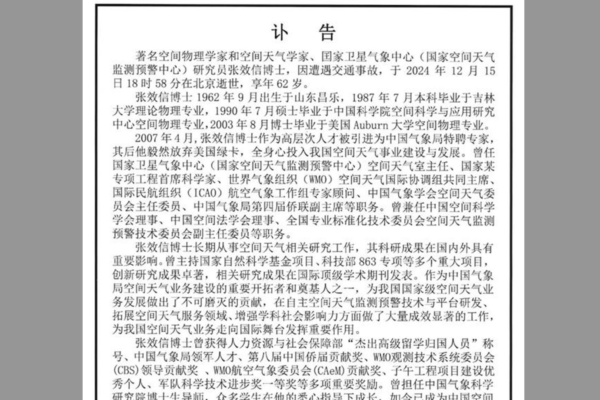
A well-known 62-year-old Chinese space physicist and expert in space weather was killed in a car accident on Sunday evening (December 15) in Beijing. His death has been described by the Chinese Communist Party as a “significant loss for the development of space weather.”
The National Satellite Meteorological Center under the China Meteorological Administration issued an obituary on Tuesday (December 17).
According to the obituary, Dr. Zhang Xiaoxin, a renowned space physicist and space weather expert, and a researcher at the National Satellite Meteorological Center (National Space Weather Monitoring and Early Warning Center), passed away in Beijing at the age of 62 on December 15, 2024, at 18:58.
Dr. Zhang Xiaoxin was involved in space weather-related research for a long time and has led various significant projects, including projects funded by the National Natural Science Foundation of China and the Ministry of Science and Technology’s 863 Program.
He had also been awarded important prizes like the first prize in military scientific and technological progress by the Chinese military, although information about his research projects is limited.
Dr. Zhang Xiaoxin is the second Chinese scientist with close ties to the military to die in a car accident in recent years.
In July of last year, Feng Yanghe, a well-known Chinese expert in command and control systems and artificial intelligence in the Chinese military, died in a car accident while “performing a major task” in Beijing at the age of only 38. Due to Feng Yanghe’s special identity, some netizens questioned whether the accident was a simple car accident, suspecting that his death was not accidental.
After Dr. Zhang Xiaoxin’s fatal car accident, netizens also raise similar questions and doubts.
Dr. Zhang Xiaoxin graduated from Jilin University with a Bachelor’s degree in Theoretical Physics in July 1987. In July 1990, he graduated with a Master’s degree in Space Physics from the Chinese Academy of Sciences Center for Space Science and Applied Research. In August 2003, he completed his Ph.D. in Space Physics at Auburn University in the United States, and in April 2007, he was brought in as a specially appointed expert by the China Meteorological Administration.