
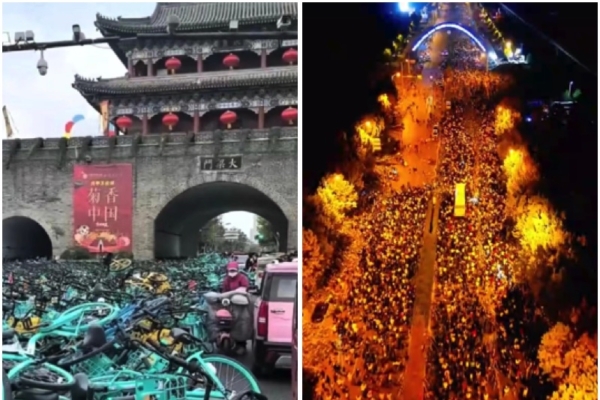
In recent days, more than 200,000 Zhengzhou university students cycling on shared bikes to Kaifeng has captured widespread attention on the internet, causing fear and emergency stop from the Chinese Communist Party officials, who began road closures and bans. The event has sparked a wide discussion in society.
The nighttime cycling event from Zhengzhou to the ancient capital of Kaifeng by university students, starting from just a group of four to several thousand, reached a peak of 200,000 on November 8, prompting an emergency stop from the authorities. The police announced the closure of Zhengkai Expressway from November 9 to 10, and three shared bike companies also jointly announced that bikes would be automatically locked if ridden beyond the fourth ring road.
On the night of the 8th, the massive caravan of over 200,000 students on bikes traveled on the roads, singing loudly along the way, “Let’s accompany each other in this world, live freely…” At the same time, various colleges in Zhengzhou implemented measures to block students from leaving campus.
A graduate student from Zhengzhou University, Xiao Wang, explained to Dajiyuan how so many students could travel synchronously, “Because it’s the weekend, students have no classes. They gather by dormitories, and eventually depart from a specific school.”
He further stated, “The main roads leading to Kaifeng are generally fixed, and since there are the most universities in Zhengzhou, various schools will eventually converge on the main road. Our school said for our safety, we are not allowed to travel after 10pm. Mostly we are graduate students, who still restrict us.”
He detailed the specific actions of campus closure as “security guards preventing students from leaving, checking the dormitories, and requiring a leave slip from the supervisor for going outside.”
Regarding the question of how students return after cycling to Kaifeng, Xiao Wang said they can take a bus or share a car with a few others.
Some students also told reporters that they couldn’t find a shared bike on the streets past 10 pm, so they missed out on the event. They also mentioned that there have been many negative reports online, but described the mass action as a “spectacle.”
Authorities not only blocked campuses at the source but also addressed students who were already on the road preparing to go to Kaifeng. Official announcements through loudspeakers advised, “Kaifeng is experiencing traffic congestion, and there is no space for accommodations or dining, please return safely and orderly, do not proceed.”
Xiao Wang emphasized, “Authorities are primarily afraid because they can’t stop the crowd. Kaifeng is an ancient city, and many people have always wanted to go there.” The admission to the Qingming Riverside Park is free until the end of December, which he believes is attractive to students.
He admitted, “Students do tend to follow the crowd, act on impulse, there’s really no need to go there these few days. It’s just that the order is not very good, occupying the motor lanes is not justifiable.”
For the students who have arrived in Kaifeng, they energetically visit various tourist attractions, some take buses back, while many occupy the restaurants, corridors, and staircases of KFC, McDonald’s, and other fast-food eateries in Kaifeng temporarily to rest, waiting for dawn. Many students are also staying inside Qingming Riverside Park.
The event of university students cycling to Kaifeng has sparked discussions online, especially on November 8, when the grand procession of cyclists made a huge impact. While some criticize the students’ actions, more express support and understanding.
A white-collar worker in Zhengzhou told reporters, “I prefer to use the word ‘movement’ for this event. It is a positive thing for these kids overall. Initially, the officials saw the beneficial and positive aspects, boosting the economy, bringing attention to Kaifeng online, and the local tourism department saw it as a good thing.”
He emphasized, “Once the crowd grew larger, the authorities got scared. They are afraid of unmanageable gatherings. So then the shared bike companies started locking the yellow bikes, the police started patrolling, and even schools started closing up and preventing students from going out.”
He also stated, “This student bike riding movement, whether intentional or unintentional, is also a form of demonstration or protest against this suffocating era, the suffocating society. Because the campus overall resembles a prison, restricting thoughts and bodies, for students to break free, for more people to come together, is actually a form of social activity, social action, which is meaningful. This is the result of the despair and repression that this era has imposed on these young people, and then they have found a way to release it.”
A social activist in Zhengzhou, Mr. Chen, also told reporters that this was an incidental event, indicating that students have been repressed for too long. “Most of them are post-2000s kids, students, they spontaneously organized a cycling event. They didn’t have any other activities to do, no money, so they could only engage in poor travel, riding shared bikes to let off steam.”
Videos circulating online show that participants in the university student cycling event are not only local students but also students from other cities, as well as retired military personnel from various branches, including armed police, air force, army, and even rocket force.
A video shared on mainland TikTok shows a Beijing mother introducing her son and 600 other Beijing university students who took the high-speed rail to Zhengzhou to participate in the November 8 nighttime cycling event, with students from other schools across the country also present at the high-speed rail station.
Mr. Chen stated that the university student nighttime cycling event to Kaifeng has been ongoing for some time, and this time it gained more momentum with students from across the country joining in, as well as many local retired military personnel and older individuals joining the fun. “This is not necessarily a bad thing for Kaifeng; the locals are also benefiting from this sudden surge in consumer activity in tourism.”
However, he stressed, “Because the momentum was too strong, the impact was too great. Just think, all of Zhengzhou’s shared bikes were ridden away, and it required a lot of effort to transport them back from Kaifeng, even Zhengzhou taxis were driving to the Kaifeng road to pick up passengers, and you couldn’t even get a cab within Zhengzhou.”
Videos circulated on WeChat moments show that authorities dispatched many container trucks to load up the densely parked bikes on the roadside and transport them back to Zhengzhou.
A veteran media personality from Chengdu, Zhang Sanfeng, wrote that the event of 200,000 Zhengzhou university students cycling to Kaifeng at night is a thought-provoking major incident. This large-scale collective performance art is titled under the guise of “youth.” It is compliant and obedient youth, but after all, it is still youth. They want to “let off steam,” but want absolute safety; they don’t want to offend anyone, but still want to say something to the world.
He believes that students being prohibited from activities like Halloween could lead to events like this bike ride. Cycling is not illegal, does not offend anyone, and can even be considered a minor contributor to the cultural tourism economy. “Of course, it has been proven now that this kind of cycling is also not feasible. But, closing roads or ‘locking bikes past the fourth ring road’ cannot truly confine the innermost desires of young people.”
He emphasized, “It is evident that in the future, the ‘gathering’ of young people will become more frequent, and may manifest in lighter, more frivolous forms. After all, the bodies of young people still exist, and they will eventually develop a certain mentality. From Zhengzhou to Kaifeng, there may not be a personal ‘way out,’ but appearing on the road in some form is the ‘way’ in itself.”