
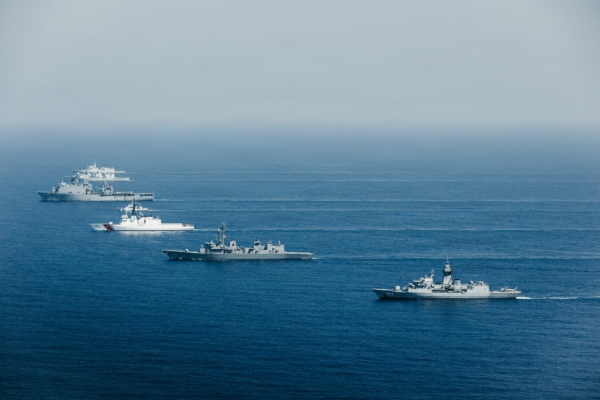
The annual US-Philippines “Balikatan” joint military exercise is currently underway in the Philippines, covering the regions in the northern part of the Philippines facing the Taiwan Strait and the disputed waters of the South China Sea. The exercise aims to deter the increasing provocations of the Chinese Communist Party in the Indo-Pacific region.
The military exercise, which started on April 20 and will continue until May 8, involves over 17,000 soldiers. The core of the exercise focuses on practicing coastal defense tactics and testing the combined operational capabilities of multinational forces in safeguarding territorial waters.
In terms of the number of participating countries, this year’s exercise is the largest in history. In addition to the military forces of the US and the Philippines, troops from Australia, New Zealand, France, Canada, and for the first time, Japan as a formal member, are participating, highlighting the expanding security partnerships of the Philippines.
Prior to the opening ceremony, Robert Bunn, spokesperson for the US side of the “Balikatan” exercise, stated that the joint military exercise is an opportunity to demonstrate the rock-solid alliance between the US and the Philippines, and to showcase their commitment to a free and open Indo-Pacific region.
General Romeo Brawner, Chief of Staff of the Armed Forces of the Philippines, stated that the multinational joint military exercise aims to establish deterrence and resilience against aggressive actions in the region.
Brawner pointed out that one of the major differences in this year’s exercise compared to previous ones is the extensive use of unmanned systems, in addition to employing the NMESIS anti-ship missile system and the HIMARS High Mobility Artillery Rocket System. Furthermore, the exercise also featured the demonstration of the newly acquired “BrahMos” missile by the Philippines, as well as the advanced weaponry of allied countries, including Japan’s Type 88 Land-Based Anti-Ship Missile to be used in sink exercise.