
Hello viewers, welcome to “The Truth of a Century”.
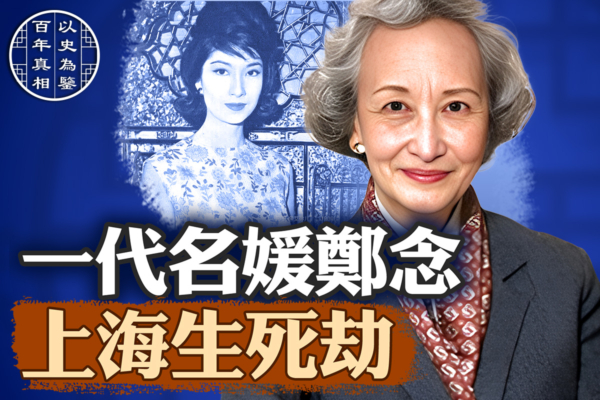
Today, we are going to talk about a person who went through an extremely unusual experience, named Zheng Nian. She came from a privileged background, beautiful and elegant, often referred to as the “true aristocrat” and the “last socialite of Shanghai”.
If it weren’t for the crazy Cultural Revolution launched by the Chinese Communist Party, Zheng Nian would likely have grown old quietly in Shanghai and lived out her life.
But history doesn’t entertain “ifs”.
The ten years of disaster completely shattered her original life. She was criticized, her home was searched, she was imprisoned, and eventually tragically lost her daughter.
Later, Zheng Nian wrote all of that into a book, titled “Shanghai Life and Death”. The book documented that insane era.
In today’s program, let’s review Zheng Nian’s life together, to see how someone who originally had no interest in politics gradually got pulled into the inescapable persecution.
Zheng Nian, originally from Hubei, was born in Beijing in 1915. Her father was an intellectual who had returned from studying in Japan and had served in the Beiyang government.
Zheng Nian attended Tianjin Zhongxi Girls’ School and Yanjing University, and later went to London for further studies, where she obtained a master’s degree. Her husband, Zheng Kangqi, was a Ph.D. graduate in the UK. The two got married in England and returned to China together. During the Republic of China era, Zheng Kangqi served as a diplomat in Australia.
Zheng Nian’s only daughter, Zheng Meiping, was born in Canberra, Australia during World War II.
In a long letter to her friend Zhang Zhiqiang, Zheng Nian recalled that the seven years of living in Australia were one of the most peaceful and happiest times in her life.
After the establishment of the People’s Republic of China, Zheng Kangqi’s family returned to Shanghai. He was appointed as a diplomatic adviser to the municipal government and later became the general manager of the Shanghai office of the British-owned Shell Oil Company. In 1957, Zheng Kangqi passed away due to cancer. Subsequently, the British side urged Zheng Nian to continue serving as assistant general manager until Shell officially terminated its business in China in 1966.
It was also in 1957 that she changed her original name Yao Nianyuan to Zheng Nian, in memory of her deceased husband.
At that time, very few foreign-funded companies remained in China. Due to her position at Shell, Zheng Nian and her family managed to stay isolated from the repeated political movements.
Zhang Zhiqiang later mentioned in an article titled “Life and Death in Shanghai – Me and Zheng Nian” that in that era, perhaps only around a dozen families in Shanghai, like Zheng Nian’s, were able to maintain a lifestyle similar to the one they had before the “liberation”.
Zheng Nian was low-key and indifferent to politics. Her dependent daughter, Zheng Meiping, was studying at the Second Girls’ High School in Shanghai at the time. She was an outstanding student, cheerful, healthy, and well-loved by her teachers and classmates.
In “Shanghai Life and Death”, Zheng Nian recalled that as early as during the Anti-Rightist Movement, she had a vague awareness that once political movements began, individual fates could easily be engulfed.
She witnessed colleagues and friends around her suddenly losing their jobs, being isolated for review, and their once stable lives becoming filled with uncertainty.
However, at that time, for her, it was more of a background pressure. The real turning point came after the outbreak of the Cultural Revolution.
With the escalating political atmosphere, the environment at the company changed drastically. Zheng Nian was required to continuously attend political study sessions, repeatedly listen to propaganda about “class struggle.” She gradually realized that in such an environment, political stance had overridden all professionalism and facts.
Soon, her husband Zheng Kangqi’s history was dug up again. Zheng Nian was also listed as a “subject for review”.
Officials repeatedly demanded that she disclose her personal experiences and family background, continuously questioning her husband’s past political affiliations and her long-term employment at Shell.
She found that no matter how she explained, the other party was not concerned with the facts themselves. Those conversations seemed more like a constant insinuation: her experiences were the problem.
Shortly after, the Red Guards raided her home.
She recounted in the book that the Red Guards barged into the house, rummaging through everything, searching for so-called “evidence.” Books, letters, documents were taken away, and her and her husband’s private information from many years was torn apart and confiscated.
Some people pointed to the furnishings in the house and asked her: “Where did these things come from?” Others accused her face-to-face of being an “agent of imperialism.”
Zheng Nian tried to explain, but any response was considered “evasive”.
After the raid, her personal freedom was further restricted, and she was under constant surveillance. During her house arrest, officials irregularly visited, demanding she continue to participate in conversations and reviews, yet the conclusion was always “not meeting the standard.”
Due to the changes in her political status, friends and colleagues began to deliberately avoid her, and even neighbors kept their distance from her.
Zheng Nian was forced into a state of isolation.
One day later, Zheng Nian was suddenly taken away from her residence. The people just said, “There’s an organizational arrangement,” and she was taken to a designated location to undergo isolation and review.
According to Zheng Nian’s recollection, she was alone in a closed room. The door was closed for long periods, the windows were covered, blocking any view of the changing sky outside. There were no clocks in the room, nothing to read either.
She was not allowed to contact other detainees or receive any external information. Her movements were strictly controlled. Her daily routine, conversation times, all were decided by others.
Later, isolation turned into interrogation.
Zheng Nian recalled that there was no fixed time for interrogation; she was often taken away without warning, and after the interrogation ended, she was returned to that solitary room.
During the interrogation process, she was required to stand for long periods, not allowed to sit. Questioning sessions lasted for hours, revolving repeatedly around her family background, her husband’s experiences, and her work at the foreign company.
She was repeatedly asked to write materials. What she had written in the previous session was often denied in the next interrogation, and she was required to overturn it entirely and rewrite it.
As the number of interrogations increased, the torture to extract confession from her also became more severe.
Her hands were handcuffed with specially made heavy square handcuffs for days and nights, causing her skin to crack and blood to get infected, until she passed out. The scars on her wrists remained with her for life.
In 1987, during an interview with “Taiwan’s Kwang Hua Magazine,” Zheng Nian said that at the time, she refused to “confess” for a simple reason, she believed she had done nothing wrong.
At one point, when the interrogators asked her, “Why won’t you confess when everyone else has confessed,” she replied, “I haven’t done anything wrong, why should I confess?”
To which they responded, “If you’re innocent, and yet you’re imprisoned out of ten million people in Shanghai, then is it your fault or Shanghai’s fault?”
Zheng Nian immediately retorted, “If you put a cat in a dog’s cage and expect it to bark, is it the cat’s fault or your fault?”
During the years of her imprisonment, Zheng Nian never knew that there were even more brutal things happening outside.
In her second year of being detained, her twenty-four-year-old only daughter, Zheng Meiping, got implicated.
At that time, Zheng Nian was accused of being an “imperialist spy,” and Zheng Meiping was repeatedly pressured to accuse her mother, but she refused to give false testimony to protect herself and frame her mother. Shortly thereafter, Zheng Meiping was beaten to death alive inside the “Shanghai Sports World Rebels Headquarters” building on Nanjing Road, and was pushed off the ninth floor, disguised as a suicide.
Zheng Nian said that during the long years of her captivity, she always believed that one day she would be proven innocent. It was this belief that sustained her. But what she did not know was that the reunion she had always hoped for with her daughter would never happen.
After her release in 1972, Zheng Nian searched everywhere for news of her daughter but found very limited information about Zheng Meiping. She went to relevant offices, contacted people she used to know, but the responses she got were either silence or avoidance.
She searched and inquired until she finally learned of the tragic death of her daughter.
Zhang Zhiqiang mentioned in his recollection article that for a considerable period after learning of her daughter’s death, Zheng Nian almost collapsed, spending her days in tears, consumed by grief. Eventually, she gradually calmed down. She realized that if she were to die in such an obscure manner, her daughter’s unjust death would never be questioned.
Afterwards, Zheng Nian began a long and arduous process of appealing. She repeatedly approached relevant departments, demanding to know the circumstances of her daughter’s death. However, no one took responsibility.
Zheng Nian gradually realized that Shanghai was no longer a place where she could continue to live, and the same applied to China.
In 1980, Zheng Nian managed to find a way to leave China and went to Canada, three years later, she settled in Washington D.C., USA.
In the conclusion of “Shanghai Life and Death,” Zheng Nian wrote that as she stood on the ship’s deck when leaving Shanghai, watching the coastline of China gradually disappear, she felt deeply guilty for being a survivor and believed that her daughter’s tragic death was directly related to their decision to remain in Communist China.
Zhang Zhiqiang said that Zheng Nian later traveled around the world for many years giving speeches. Through writing “Shanghai Life and Death” and giving lectures, she informed the world about the ugliness and atrocities of the Chinese Communist Party’s “Cultural Revolution.”
In her later years, Zheng Nian visited Hong Kong multiple times, but never set foot in mainland China again. It wasn’t due to the lack of opportunity, but rather her choice not to return. She lost her daughter there, experienced an era of madness that she could not look back on.
On November 2, 2009, Zheng Nian passed away. The tragedy of her family came to an end, but as long as the authoritarian rule of the Chinese Communist Party persists, tragedies will continue to unfold on the land of China, only with different plots and versions.
Well, that’s it for today’s program. Thank you for watching. If you enjoyed our show, don’t forget to like, subscribe, and share. See you next time.
Production Team of “The Truth of a Century”