
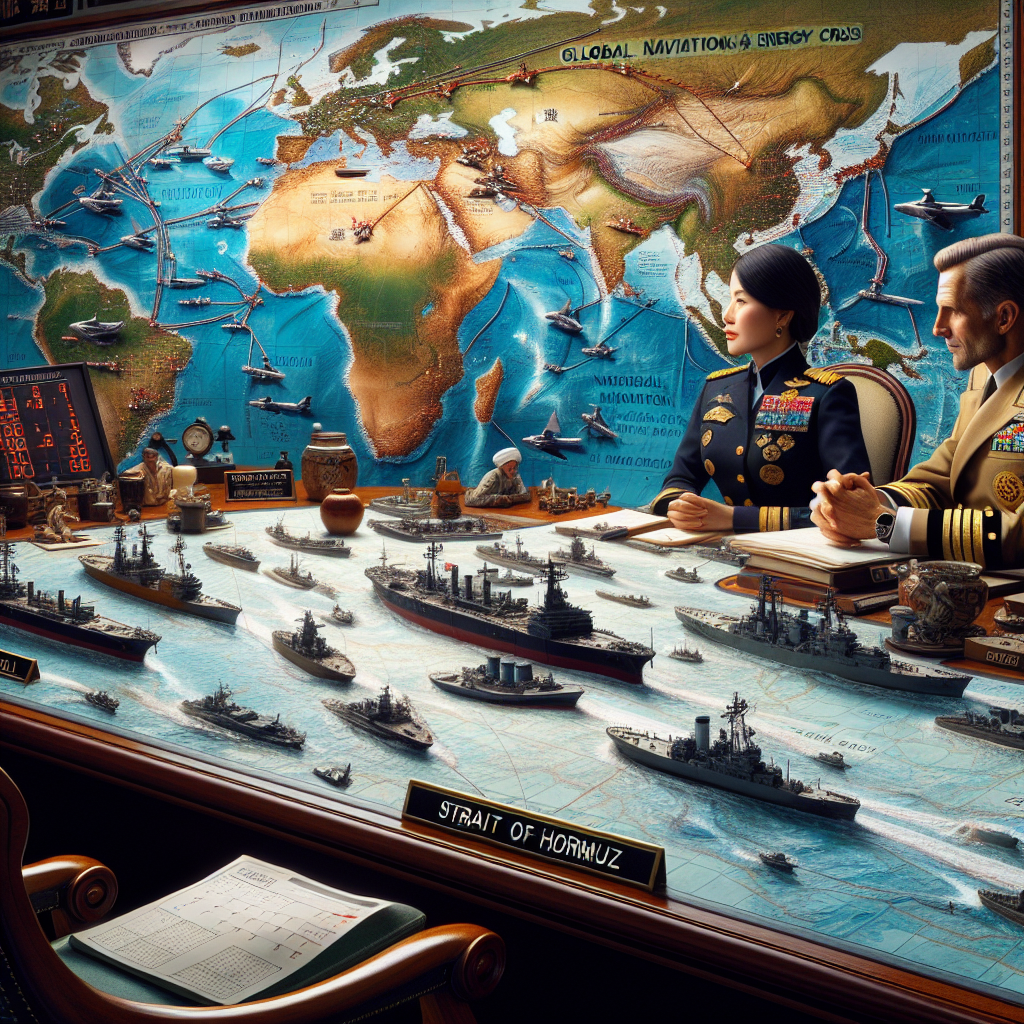
French Chief of Naval Staff Calls on Beijing to Directly Engage in Restoring Navigation of the Strait of Hormuz
In response to the global energy crisis caused by the blockade of the Strait of Hormuz due to war, the Chief of Naval Staff of France urged Beijing on Wednesday (April 1) to engage more directly in discussions to restore navigation in the strait and questioned the effectiveness of China’s private communications with Iran to secure passage privileges for ships.
Experts believe that France’s public questioning of Beijing’s private navigation agreements with Iran aims to point out that China should not only enjoy “privileged channels” but should also play a more direct role in efforts to restore navigation in the Strait of Hormuz. This indicates that Western countries are pressuring Beijing, hoping to bring China, which has been benefiting behind the scenes, to the multilateral negotiation table.
Nicolas Vaujour, Joint Chief of Staff of the French Navy, pointed out at the “War and Peace” security conference in Paris, “China will sooner or later need to engage more directly in discussions to restore the flow of oil through the Strait of Hormuz, because the current passage of ships may be insufficient to meet China’s needs.”
He further noted that there has been no visible involvement of the Chinese navy in taking concrete actions to reopen the strait, but there is indeed “direct political dialogue” between Beijing and Tehran to ensure that a specific number of Chinese ships can pass through.
Vaujour questioned, “Is this enough to restore normal transportation flow? I don’t think so.”
Regarding the French military’s public stance on this matter, military strategic and geopolitical experts told Epoch Times that this reflects France’s and the EU’s pragmatic diplomatic approach.
Xie Peixue, Deputy Researcher of Network Security and Decision Simulation Institute at Taiwan’s National Defense Research Institute, pointed out that the Chief of Naval Staff of the French Navy is trying to bring China, which has long enjoyed benefits behind the scenes but avoided responsibility, to the negotiating table by exposing the fact that China has “privileged channels.”
Xie emphasized that China imports about 40% of its crude oil through the Strait of Hormuz and buys nearly 80% of Iran’s oil, indicating that China is not only an “interested party” in the strait’s reopening but also the biggest beneficiary after its restoration.
He believes that France’s actions represent a “diplomatic binding strategy,” directly pointing out that as the largest importer of crude oil in the Middle East, China should share international responsibilities. “Europe’s attitude is that since China is the biggest beneficiary, it cannot just enjoy the benefits without bearing the risks. This can be seen as a form of pressure.”
Xie Peixue considered Vaujour’s remarks at the “War and Peace” security conference as a result of consultations at a certain level with naval commanders from countries such as Germany, the UK, Japan, Italy, and India.
“This not only represents his personal views but to a certain extent represents the consensus of France and major Western countries,” Xie Peixue said.
Chen Mingshi, a researcher at the Taiwan Institute for National Defense and Security Studies, said that France’s actions also demonstrate a political intention to show efforts to the United States. As President Trump has repeatedly questioned the insufficient commitment of European allies, France hopes to prove Europe’s proactive response to regional challenges by promoting China’s participation in escorting missions.
On the diplomatic front, UK Prime Minister Keir Starmer announced that he will convene a video conference on Thursday with 35 countries, including France, Germany, Japan, and the UAE, attempting to exert diplomatic and political pressure to reopen the Strait of Hormuz.
Starmer stated that the meeting “will assess all feasible diplomatic and political measures we can take to restore freedom of navigation, ensure the safety of stranded ships and sailors, and restore the flow of critical supplies.”
Previously, President Trump has stated multiple times that the United States has low dependency on Middle East oil, and safeguarding that waterway is not America’s obligation, urging allies to proactively take on the responsibility to restore navigation in the Strait of Hormuz.
Analysts believe that Europe is currently attempting to construct a multilateral cooperation framework that is not reliant on a single country to address the global common threat to energy security.
Despite ongoing diplomatic pressure, the actual reopening of the waterway still faces military challenges.
Vaujour revealed that the military is assessing whether the strait has been mined. The US Defense Intelligence Agency also assesses that even if Iran’s conventional forces are defeated, it still has the capability to close the strait for one to six months using asymmetric methods such as mines and drones.
Currently, countries are referring to the past “Operation Agenor,” led by the EU and aimed at safeguarding the safe and free passage of the Persian Gulf and the North Arabian Sea, to research post-war effective monitoring and ensuring the safety of the waterway.