
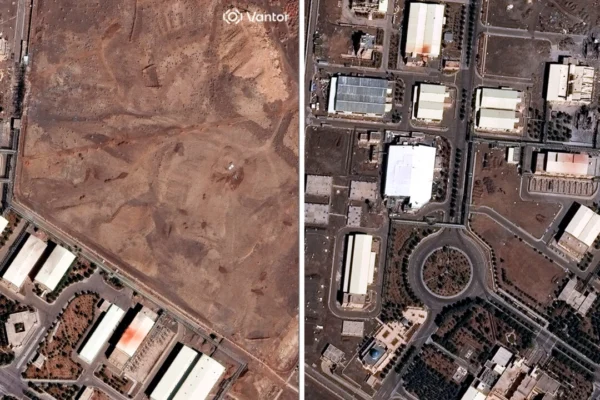
In the latest round of strikes against Iran’s nuclear facilities by the United States and Israel, the attacked locations so far include Natanz, Minzadehei, Isfahan, and the Lavisan 2 facility, also known as Mojdeh. The complex underground facility near Pickaxe Mountain in Natanz, buried about 100 meters underground, has not been paralyzed yet—a task that may require the deployment of special forces.
The large-scale war in June 2025 is now a thing of the past. The United States and Israel dealt a heavy blow to Iran’s nuclear program during that war, and that chapter—at least for now—seems to have come to a close.
Back then, buildings related to Iran’s nuclear program were bombed, facilities were destroyed, sending a clear message: Tehran’s path to nuclear weapons has been blocked.
However, beneath the surface—almost literally “underground”—a more complex picture is beginning to emerge. Iran has resumed activities, not necessarily at those well-known attacked sites, but through remaining facilities, labs, relocated infrastructure, rebuilt sites, and still active scientists. Like someone after an earthquake trying to gather debris in the ruins and assemble a dangerous mechanism.
Andrea Stricker, an expert in nuclear proliferation and non-proliferation at the Foundation for Defense of Democracies in Washington, D.C., specializing in Iran’s nuclear program, stated that Israel and the United States have taken action again from that moment on. They are no longer conducting single strikes on a well-known nuclear facility but a series of precise, almost surgical strikes on about five locations up to now.
One of them is a secret base named Minzadehei in northeastern Tehran—an underground complex facility there, according to Israeli assessments, is developing crucial components for nuclear weapons.
Senior security officials stated that a team of surviving nuclear scientists reassembled there is working on accelerating the so-called “Weapon Group” project—aimed at developing the detonator for nuclear bombs to be fitted on ballistic missiles.
Stricker mentioned in an interview with Israel’s Epoch Magazine, “Iran seems to have started nuclear weapon research at that location after being bombed in June 2025, so Israel may have thought it unnecessary to strike it previously.”
Meanwhile, another nuclear facility in Natanz was also attacked, but the target was not the core of the facility but the entrance. This detail adds an interesting twist to the incident. In the late stages of the June 2025 war, the United States used two Massive Ordnance Penetrator bombs to strike the Natanz uranium enrichment plant, likely disabling the underground portion of the facility.
Therefore, Stricker explained that when three entrances of the building complex were attacked in early March, the objective was not necessarily to destroy the core facilities again but most likely to impede personnel from coming in and out.
“The purpose seems to be to prevent Iranian personnel from entering to avoid them transporting equipment or nuclear material in or out of the facility,” she said. “Israel may be trying to prevent centrifuge equipment—even possibly highly enriched uranium still stored in canisters—from being removed.”
“This also sends a clear message to Iran to stay away from these facilities as Israel is closely monitoring from the air.”
Stricker suggested that if the Iranian regime collapses, these assets could potentially fall into the hands of criminals.
“Nuclear weapon fuel could eventually fall into the hands of terrorist organizations or other entities attempting to sell on the black market,” she said. “Israel and the United States also need to consider nuclear-armed states seeking to obtain such materials.”
Another nuclear base is Isfahan. Although satellite images of the recent strike have not been released, Stricker pointed out that back in June 2025, key buildings there used for uranium conversion, uranium metal production, and nuclear fuel manufacturing were already targeted—these are vital parts of Iran’s nuclear production chain.
“Since critical facilities have been destroyed, it’s hard to say what important assets are left there,” she said. “But the Isfahan facility complex contains many buildings. Israel may have discovered new activities there, or may not have fully eliminated all suspicious activities at that location in June 2025.”
Lastly, the Lavisan 2 facility, also known as Mojdeh, is receiving attention because of its close ties to the “Organization of Defensive Innovation and Research” (SPND) under the Iranian Ministry of Defense. SPND is responsible for research and procurement related to nuclear weapons and their delivery systems. According to the Institute for Science and International Security (ISIS) in Washington, a “laboratory-like building” there was destroyed. The building housed the administrative leadership of SPND, and Tehran had just started repairs on it.
But this is only half of the issue. The other half concerns not the targeted facilities but those still intact. Stricker pointed out that the most concerning target is Pickaxe Mountain near Natanz—a complex facility buried about 100 meters underground.
It’s not the type of facility that can be easily identified from satellite images and destroyed from above. It seems to have been designed from the start to withstand external attacks, thus buried exceptionally deep.
According to assessments cited by Stricker, the depth of this facility matches the Fordow nuclear facility—estimated at around 80 to 90 meters underground—or even deeper. She mentioned that standard ammunition won’t suffice if the decision is made to destroy it. B-2 bombers carrying GBU-57 bunker buster bombs are needed, and special forces capable of penetrating the facility and destroying it might also be required.
“Western intelligence agencies are concerned that the facility at Pickaxe Mountain could become a new Fordow-like enrichment plant—but with even more robust protection,” she mentioned.
“Iran claims this is a new centrifuge assembly plant aimed to replace the above-ground assembly facility in Natanz destroyed in 2020.”
A report released by ISIS in November 2025 stated that the US and Israel did not cause significant damage to Iranian nuclear facilities during the airstrikes in June 2025.
Stricker said, “My assessment is that the US and Israel didn’t act because it was far from operational at that point. But construction has been ongoing since then, Iran has enhanced security measures, and strengthened the entrance to the complex.”
She suggested that if Washington and Jerusalem could penetrate the facility and destroy it from the inside, it might be more reliable than relying solely on Massive Ordnance Penetrator bombs, as they could ensure all facilities are thoroughly demolished internally.
In fact, Stricker noted that the same uncertainty applies to Fordow and Isfahan.
“It’s unclear if high-enriched uranium still remains in the Fordow and Isfahan tunnels,” she mentioned.
Beneath the surface buildings in Isfahan, an underground facility carved into the nearby mountains has been operational. Reuters reported on February 27 that up to 60% enriched uranium is stored there. The information was based on a confidential report sent by the International Atomic Energy Agency (IAEA) based in Vienna to member countries, as reported by Reuters.
Stricker estimated that the US and Israel ultimately plan to address these locations and other assets yet to be dealt with.
“At this point, they are more inclined to focus on immediate threats—missiles, drones, launchers, the military, and leadership,” she stated.
She emphasized that to ensure the end of Iran’s nuclear weapon path, all “nuclear assets”—materials, facilities, equipment, documents, etc.—must be properly controlled.
“This may be a process taking years, requiring pinpointing these assets and ensuring they are thoroughly destroyed,” she said. “In addition, it’s necessary to consider redirecting Iranian scientists to work in civilian sectors and prevent nuclear technology leaks to other countries or terrorist organizations.”
“Fortunately, the IAEA and other international organizations have successfully executed similar missions in Iraq, Libya, South Africa, and the former Soviet Union.”
These experiences will be invaluable in dismantling nuclear weapon programs and handling such sensitive assets.