
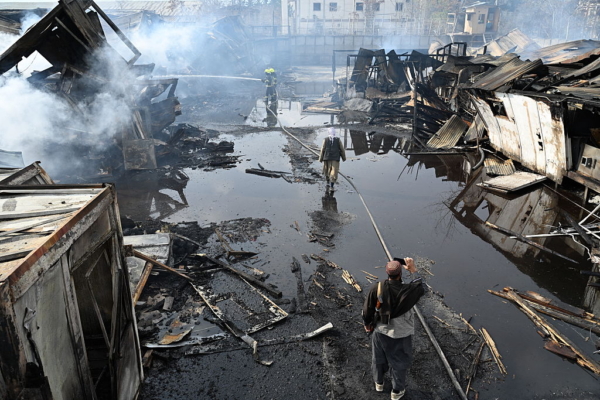
The Afghan Taliban authorities stated on Tuesday (March 17) that Pakistan had carried out an airstrike on a drug rehabilitation hospital in the Afghan capital, Kabul, resulting in at least 400 deaths and 250 injuries. However, Pakistan refuted the accusation, claiming that the airstrike accurately targeted a large ammunition depot.
According to Reuters, Pakistani authorities stated that the airstrike launched by Pakistan on Monday night (March 16) “accurately targeted military facilities and terrorist support infrastructure.”
Pakistan’s Minister of Information and Broadcasting, Attaullah Tarar, posted on social media platform X, saying, “The secondary explosions observed after the airstrike clearly indicate the presence of a large ammunition depot at the scene.”
Afghanistan and Pakistan share a 2,600-kilometer (1,600-mile) border. The two countries experienced the most severe conflict ever on February 21, leading Pakistan to officially declare on February 27 that it had entered a state of “open warfare” with neighboring Afghanistan.
The airstrike on the evening of March 16 became one of the deadliest single events since the conflict began.
Footage captured by local media at night showed a single-story building engulfed in flames, with another area in the same compound billowing thick smoke as personnel carried out bodies on stretchers.
Ambulances and police cars were parked outside the damaged building, with a sign indicating the facility as a “drug rehabilitation hospital” with 1,000 beds, guarded by security personnel.
Taliban spokesperson Hamdullah Fitrat stated that on Monday night at 9 pm local time (16:30 GMT), the state-run Omid Hospital was targeted in the airstrike. He described the hospital as a drug rehabilitation center with 2,000 beds.
In a post on social media platform X, Fitrat said, “Most of the hospital’s buildings have been destroyed… Sadly, the death toll has reached 400, with up to 250 people injured.”
He added that rescue teams were on-site trying to control the fire and search for casualties but did not disclose how many bodies had been recovered or how the casualties were tallied.
The spokesperson for the Pakistani Prime Minister stated that the Afghan claims about targeting drug rehabilitation centers were “consistent lies,” and reiterated that Pakistan’s “counter-terrorism operations” would continue until the elimination of “terrorists and their infrastructure.”
On the same night, Pakistan’s Information and Broadcasting Department stated that the claims made by the Afghan Taliban were “misreporting of facts.”
The department posted on platform X, saying, “Pakistan’s strikes are precise and cautious to ensure no collateral damage. The Afghan side’s characterization of the drug rehabilitation center as a target is a distorted report meant to incite emotions and cover up improper support for cross-border terrorism.”
Since last month, Pakistan has conducted airstrikes on Afghanistan, targeting terrorist armed group bases within Afghanistan.
Afghanistan, in turn, accused Pakistan of violating its sovereignty and causing civilian casualties through the airstrikes, prompting a retaliatory response.
Islamabad alleges that Kabul provides shelter to armed groups attacking Pakistan. The Taliban denied this accusation, stating that dealing with armed groups should be Pakistan’s internal issue.
UN’s Special Rapporteur on Afghanistan, Richard Bennett, expressed deep sadness over the recent reports of civilian deaths caused by Pakistan’s airstrikes.
In a post on platform X, he urged all parties to “de-escalate the situation, exercise maximum restraint, and abide by international law, including protecting civilians and civilian facilities such as hospitals.”
Pakistan has long accused the Afghan Taliban government of supporting “anti-Pakistan terrorists” and attributing suicide attacks in Pakistan to these terrorist elements.
The “anti-Pakistan terrorists” mentioned by Pakistan refer to the Tehrik-e-Taliban Pakistan (TTP). This organization, though ideologically aligned with the Afghan Taliban (both being Sunni extremist Islamic groups), is relatively independent in structure and has different goals: TTP seeks to overthrow the Pakistani government and establish an Islamic Emirate within Pakistan.
The Afghan Taliban consistently denies harboring “anti-Pakistan terrorists” and argues that Pakistan’s security issues are internal matters, pointing fingers at Pakistan for harboring hostile organizations like the Islamic State-Khorasan branch (IS-K).