
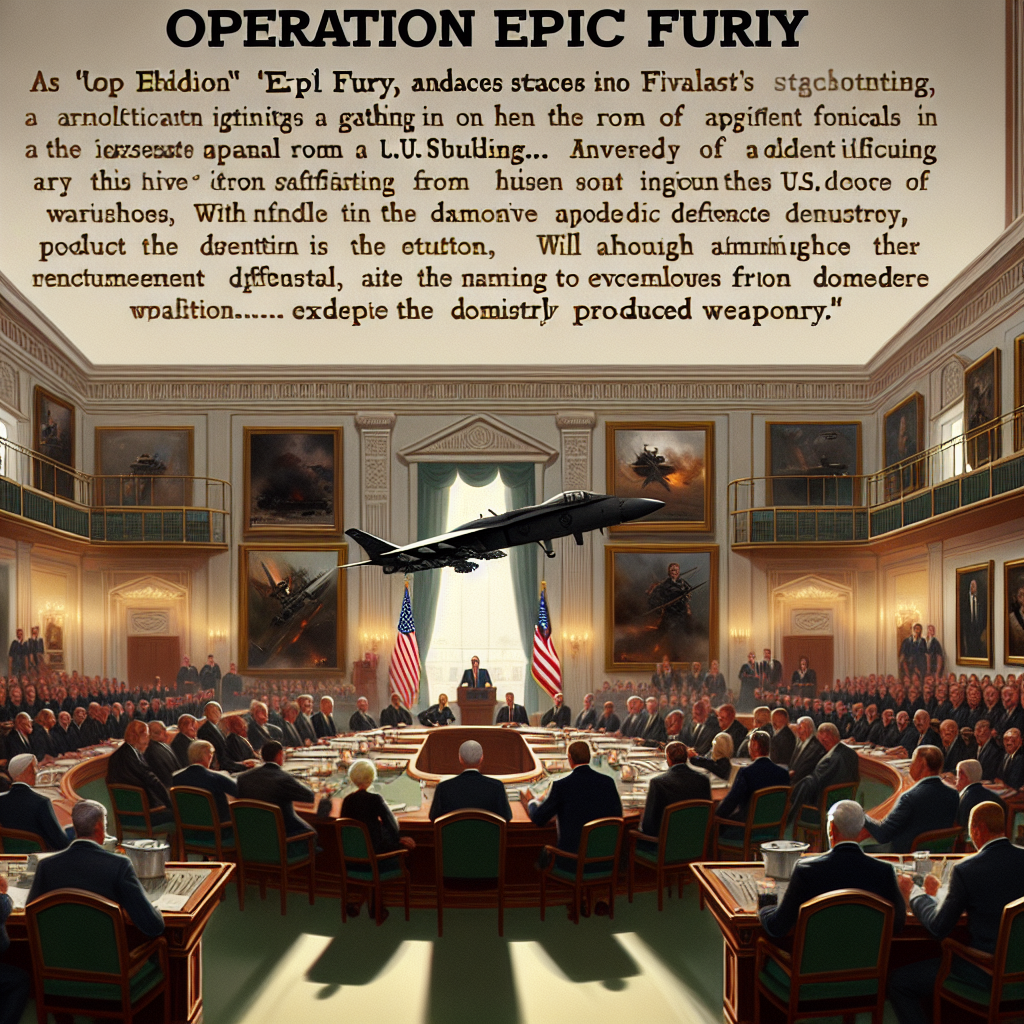
As “Operation Epic Fury” enters a crucial phase, President Trump convened a meeting on Friday in the East Room of the White House with top executives from six major U.S. defense industry giants to accelerate the production of American-made weapons. Despite the White House emphasizing the current surplus of weapons in the U.S. military arsenal, the meeting highlighted Washington’s heightened vigilance towards the prolonged Middle East conflict and global military resource allocation.
President Trump and Secretary of War Pete Hegseth co-hosted the meeting, which included key players in the U.S. military-industrial complex such as BAE Systems, Boeing, Honeywell Aerospace, L3Harris Missile Solutions, Lockheed Martin, Northrop Grumman, and Raytheon.
During the meeting, President Trump explicitly demanded these companies to deliver weapons at the “fastest rate,” emphasizing that American-made weapons are the “best in the world” and must ensure that the U.S. military’s absolute advantage is not diminished in the process of dismantling the Iranian regime.
In a post on “Truth Social” following the meeting, Trump declared the meeting as “highly successful”. He announced that the participating companies had agreed to double the production of “Exquisite Class” weapons, increasing the supply to the highest level as quickly as possible.
Trump revealed that the expansion plan had already been initiated three months prior to the meeting, with many related factories and production lines currently operational. He reassured the market and allies, emphasizing that the U.S. possesses an “almost unlimited supply” of intermediate and high-end ammunition, which is currently being used in Iran and was recently utilized in Venezuela. Despite this, the government has increased orders for this class of weaponry.
He stated that various states across America are currently bidding for the establishment of these new factories.
According to the latest assessment by Admiral Brad Cooper, Commander of U.S. Central Command (CENTCOM), the precision strikes of the U.S.-led coalition have achieved significant results:
Missile activities rapidly decreased:
The frequency of Iran’s missile attacks has decreased by 90% compared to the early stages of the conflict. It is estimated that Iran’s inventory of 2,000 to 3,000 ballistic missiles is rapidly depleting.
Naval assets annihilated:
Trump revealed that the U.S. military has reached “25 markings,” indicating that approximately 25 large Iranian ships have been sunk.
Bunker precision strikes:
On Friday, around 50 fighter jets from the U.S. military destroyed the underground bunker network of Ayatollah Khamenei in Tehran’s central area, symbolizing the collapse of Iran’s command center.
According to Fox News, despite Press Secretary Karoline Leavitt’s reassurances about adequate inventory, Congress and military analysts have issued warnings. The current defense resources are facing challenges in a “zero-sum game”.
The current annual production capacity of the “Patriot” PAC-3 MSE missile is only around 600 units, and the supply cycle is calculated in terms of “years”. In previous conflicts, the U.S. military consumed approximately 25% of the global inventory of the “THAAD” interceptor missiles within just 12 days.
Senator Mark Kelly cautioned that the current defense situation has evolved into a “math problem” – how to counter potential large-scale missile consumption from adversaries with extremely limited and slow production interceptor missiles.
Analysts point out that these high-end systems being simultaneously supplied to the Middle East, Ukraine, and the Indo-Pacific region have created a “zero-sum game” style competition for resources.
In his remarks on Friday, Trump not only focused on Iran but also mentioned plans to address the long-standing Cuban issue as Iran’s situation stabilizes. He has assigned Secretary of State Marco Rubio to prepare for follow-up actions and predicted the imminent collapse of the current regime in Cuba.