
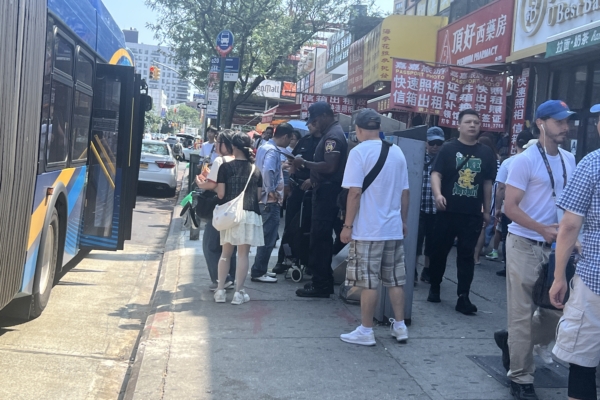
Ticket evasion seems to be a common occurrence in New York City, especially on select buses like the Q44, which has three doors for quick boarding. However, the Metropolitan Transportation Authority (MTA) has intensified its enforcement against fare evasion. Yesterday, MTA and city police were seen jointly conducting ticket checks at the Flushing central area station. By using ticket verification devices, they were able to determine if passengers had evaded fares, leading to fines or even handcuffing some individuals.
Some individuals were arrested on the spot and handcuffed by the police. According to MTA personnel, this was because during the ticket check, it was discovered that one of the individuals had an outstanding warrant linked to their identity. They emphasized that individuals with warrants should be especially cautious as they risk being caught, not just for fare evasion but for other offenses as well.
Yesterday afternoon, the MTA’s security department, along with over 10 New York City police officers, conducted fare evasion checks at the Q44 and Q20 stations opposite the Flushing Library, which is one of the stations with the highest passenger flow. The Q44 Select Bus has a longer body with three doors, each equipped with electronic fare payment machines. Prior to the implementation of electronic fare payments, passengers relied on their own honesty to swipe their MetroCards at payment machines on the sidewalk. However, with the widespread adoption of electronic payments, enforcement officers are equipped with inspection devices to promptly check whether passengers have paid using their bank cards (credit cards, OMNY cards, mobile banking).
During the boarding of the Q44 bus, enforcement officers would conduct checks by scanning passengers’ credit cards, bank cards, or OMNY cards with a handheld device to verify if a ticket had been purchased. Passengers couldn’t deceive the system.
A Chinese passenger was asked to disembark by MTA personnel and was issued a yellow Notice of Violation after being unable to communicate with enforcement officers due to a language barrier. He claimed he had paid but couldn’t make himself understood. Eventually, he called his son to help, and the enforcement officers assured him that as a first-time offender, he would receive only a warning, putting his mind at ease.
How do individuals know how many times they have violated the rules? According to the Transit Adjudication Bureau (TAB) website, individuals can track their fare evasion history for the past four years based on the yellow warning notices received. First-time offenders would receive a warning notice (sent to the address on their ID), second-time offenders would receive a $100 fine, while third-time or subsequent offenders would receive a $150 fine.
According to data from the New York City government, in the second quarter of 2025, 29,561 people in New York City received fare evasion violation notices. Asians had the lowest evasion rate, with 2,658 individuals accounting for 9%; African Americans and Hispanic individuals accounted for 68% (20,292 people); and white individuals accounted for 5,525 people, or 19%.
Regarding the Q44 bus with three doors that make fare evasion easier, MTA personnel advised passengers to change their mindset and always swipe their cards regardless of which door they board from, cautioning against taking chances. Ticket checks are now more frequent than before, with spot checks conducted at various locations such as the Flushing Library station yesterday and potentially Jamaica station the next day. Select buses with multiple doors are a focal point for fare inspections.
Mr. Li, a Chinese witness, commented on the increased frequency of ticket checks by MTA, stating that he has encountered such checks several times on Q44 and Q53 buses at locations like the Flushing central area, the intersection of Main Street and 60th Street. He emphasized the importance of not trying to evade fares as enforcement measures have become stricter.