
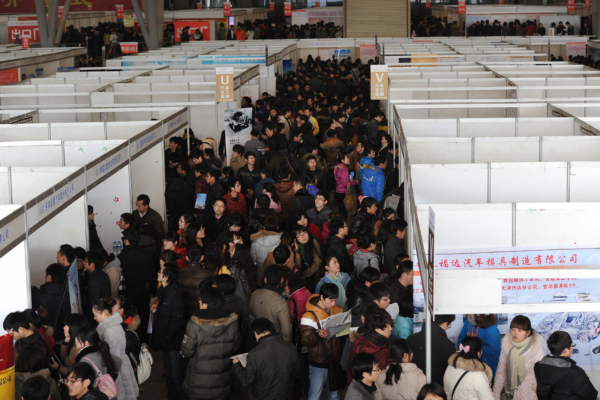
China’s mainland economy continues to languish, with high unemployment rates among young people. Former elite university students are now forced to consider taking off their “Kong Yiji’s long robe” and working in delivery or driving for ride-hailing services. However, these industries are becoming increasingly saturated, with an uncertain future, as the online space is filled with a sense of pessimism.
As the Lunar New Year approaches, Xiao Fu (pseudonym) finds himself unemployed. Xiao Fu was working in the IT industry and had a stable white-collar job thanks to his high education. Now, amid the economic downturn, many companies are closing down or downsizing, leading Xiao Fu to consider switching to delivery or ride-hailing, as the upcoming Chinese New Year period is said to be the peak season for these industries, offering significant earning opportunities.
Xiao Fu has learned that currently, a Meituan delivery driver works 10-12 hours a day, completes 60-70 orders, and earns 200-300 yuan per day. Under normal conditions, each order could bring in 3-5 yuan. However, factors like weather or competition within the industry can lead to unstable order volumes.
He told a reporter, “Finding a job now is very difficult, and it’s even harder for those over 35 years old.”
He mentioned that platforms like Meituan delivery, local delivery services, and ride-hailing services require individuals without a criminal record to register, as otherwise, they cannot pass the screening process. Due to a past indiscretion, finding a job has become even more challenging for him. Despite his family’s average financial situation, they are fortunate not to have the additional burden of mortgage or car loans.
Behind the unemployment issue lies the visible economic downturn. Xiao Fu conducted field visits to businesses in the main urban areas of his city from June 2024 to December 2024 and found that a total of 485 shops had closed or were up for rent/sale during this period, with 32% from the food and entertainment industry and 21% from factories, warehouses, and office buildings.
China is experiencing high levels of unemployment. According to data from the National Bureau of Statistics of China, in April 2023, the youth unemployment rate between 16-24 years old nationwide exceeded 20.4% for the first time, reaching 20.8% in May and soaring to 21.3% in June, with the actual numbers possibly even higher.
A report released in March of the previous year showed that there are around 84 million “new forms of employment workers” in China, primarily consisting of truck drivers, ride-hailing drivers, couriers, and food delivery personnel, with a higher proportion of male individuals with an agricultural background.
However, various sources indicate that many university graduates are also joining this group.
A commentator in Beijing, Mr. Chai (pseudonym), told a reporter that like ride-hailing drivers, food delivery workers do not receive any benefits such as social security or provident fund. Both groups fall under the category of “New forms of employment workers” created under complex employment models by platforms.
Mr. Chai once randomly interviewed 50 ride-hailing drivers in Beijing and found that seven of them were former bankrupt small private business owners (shareholders), five were unemployed white-collar workers, and nearly half of them had a bachelor’s degree or higher.
According to data from platforms like Meituan, Ele.me, and Shansong, the number of food delivery drivers has steadily increased over the years and now stands at around 15 million. A recent online poll indicated that 79% of people believe that working as a food delivery person is not suitable for long-term employment, with only 21% considering it a viable long-term option.
Some analysts suggest that this reflects the increasing number of unemployed individuals in society; although it relieves the pressure on traditional employment, it also exacerbates competition within these industries.
Online discussions reflect a pessimistic atmosphere, with many expressing concerns about uncertainties regarding their future financial stability and the challenges of finding stable employment.
Stakeholders in the industry express their views, highlighting the challenges they face, including the lack of benefits, the physical and mental toll of the work, and the intense competition within the sector.
In response to the surge of labor entering the ride-hailing and food delivery sectors, Mr. Chai cited several factors driving this trend, including higher potential income compared to other low-skilled jobs, autonomy over working hours and earnings, faster income turnover, and limited job opportunities in declining sectors amidst the economic downturn.
However, the oversaturation in these sectors has led to fierce competition, exacerbating the struggle for decent earnings and stable employment opportunities.
As the economy continues its downward trend and traditional employment avenues close down, more individuals turn to delivery services and ride-hailing as a means of survival, highlighting the stark realities of the economic challenges faced by many in the current environment.
The grim reality facing those in the food delivery and ride-hailing industries is underscored by incidents of accidents, exhaustion, and even tragic outcomes such as suicides, reflecting the immense pressure and hardships faced by workers in these sectors.
In conclusion, the ballooning workforce in these industries has been driven by a confluence of economic factors, with individuals seeking refuge in delivery services and ride-hailing as a means of making ends meet in a challenging economic landscape. The growing concerns and uncertainties around long-term sustainability and the wellbeing of workers in these sectors reflect the broader economic challenges facing millions in the evolving employment landscape.