
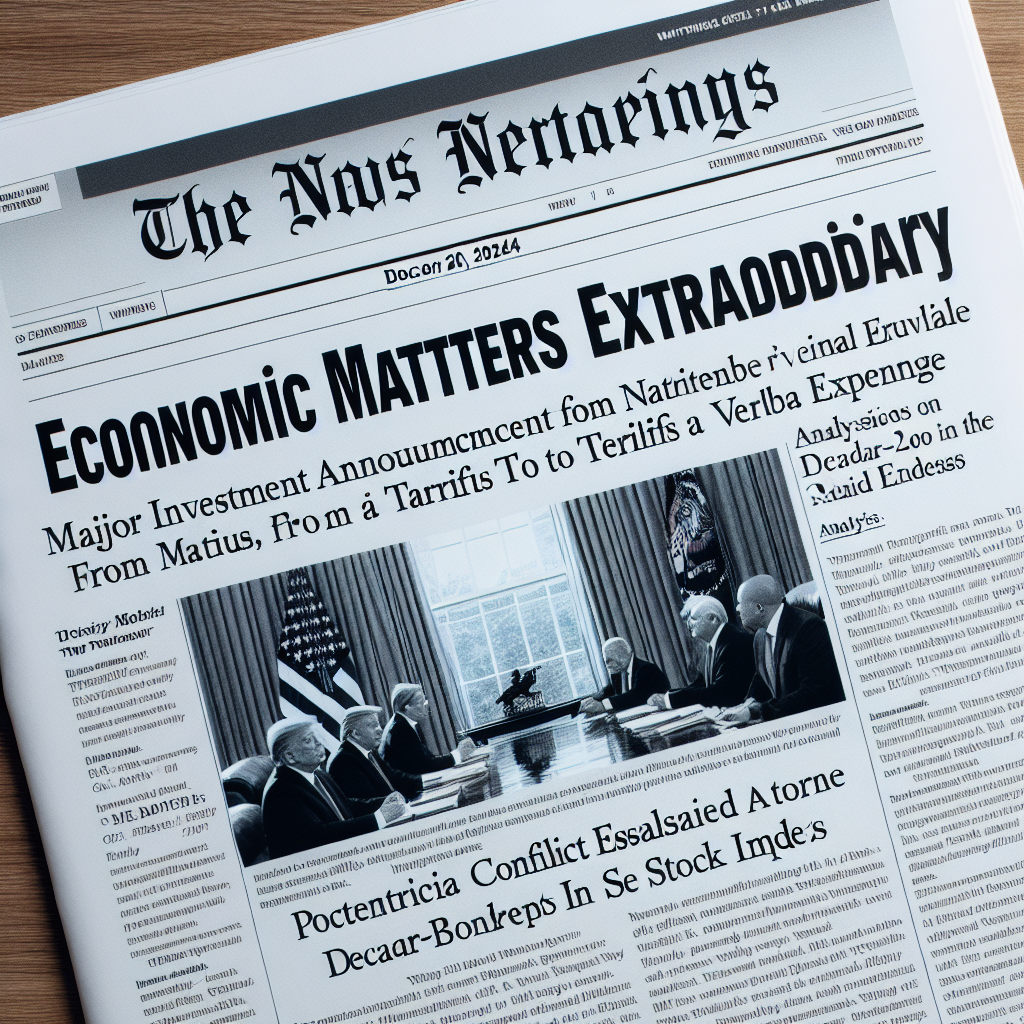
【Epoch Times News, December 20, 2024】Hello everyone, welcome to “Economic Matters Extraordinary”.
Today’s focus: After meeting with Trump, Masayoshi Son announces an investment of billions! Will the Trump tariff war turn into a war of words? Dow falls for ten consecutive days, the longest in 50 years! Capital outflow from China hits a new high in mid-November! Santa can’t handle it, too many tourists near Santa Claus Village, almost out of control!
On Wednesday, Federal Reserve Chairman Powell announced another rate cut after the last monetary meeting of the year, lowering the interest rate range to 4.25%-4.5%. He also stated that the Fed will adopt a cautious approach to future rate cuts over the next few years, hinting that the extent of rate cuts next year will only be 2 notches, compared to the previously expected 4.
This stance disappointed the market, leading to a late sell-off in US stocks, with the Dow Jones index plunging 1123 points.
Speaking of which, the Dow Jones index has been on a continuous decline recently. On Tuesday, it opened lower with a gap down, dropping 380 points intraday, with an intraday decline of up to 0.87%. By the close of Wednesday, the Dow Jones index had dropped 1123 points, marking the tenth consecutive trading day of decline, also setting the longest downtrend since 1974. The Dow Jones hit a historical high of over 45,000 points earlier this month, but has since embarked on a prolonged decline.
According to FactSet data, the Dow Jones had a record of an 11-day consecutive decline in 1974. In addition, the Dow Jones has never experienced a decline of more than 10 days in a row. However, the overall decline during this downturn remains moderate, with Tuesday’s low point only retreating less than 4% from the historical high point in early December.
In fact, while the Dow Jones has been struggling, it is at a time when the overall trend of the US stock market is strong. The Nasdaq Composite Index just hit a historical high this week, and the S&P 500 index is only 1% away from its historical high.
Experts attribute the decline of the Dow Jones to the shift of funds from traditional economic sectors’ stocks to tech stocks, where these traditional economic stocks dominate the Dow.
Another noteworthy event is that Nvidia was officially included as a new tech component in the Dow, but even amidst the robust performance of the tech sector, Nvidia encountered difficulties. On Monday, it retraced over 10% from its high point and entered into a technical correction range. Nvidia fell again on Tuesday. Wall Street observers mentioned that the AI industry is undergoing a “paradigm shift,” as big AI models shift from pre-training stages to logical reasoning stages, with application-specific chips like ASICs gradually replacing general-purpose chips represented by GPUs, which is one of the reasons causing Nvidia’s recent poor performance.
Regarding the Dow’s consecutive decline, Wall Street analysts express that this does not necessarily signify a sign of future problems. The recent decline represents some profit-taking after substantial gains in the recent weeks. Expectations for the risks and opportunities brought by the incoming Trump administration next year have also been adjusted accordingly.
On Monday, Trump and SoftBank Group CEO Masayoshi Son jointly announced SoftBank’s plan to invest at least $100 billion in domestic projects in the US over the next four years.
Subsequently, Son stated that this wave of investment will create 100,000 job opportunities in the US in the fields of artificial intelligence and emerging technologies, with plans to complete this work by the end of Trump’s term in 2029.
Reportedly, Trump specifically invited Son to a private dinner at Mar-a-Lago to discuss the $100 billion investment matter, and when discussing this investment with Son, Trump asked if Son would be willing to increase the investment scale to $200 billion. Son hesitated for a moment and said: “I will do my best to make it happen.”
It is currently unclear how Son intends to fulfill this commitment, as SoftBank’s newly established investment institution manages hundreds of billions of dollars in funds, but Son currently only has about $30 billion in cash on hand.
This commitment is indeed a major positive for Trump, as reviving the economy was a core issue in his election campaign. Last week, Trump mentioned that any company investing over $1 billion in the US will receive fast approvals.
According to official Chinese figures released on December 16th, in November of this year, China’s capital outflow in the capital market hit a record $45.7 billion. Analysts believe that future tariff policies under the incoming President Trump, as well as the disparity in securities returns between the US and China, have exacerbated capital outflow from China.
According to the data released by the State Administration of Foreign Exchange of China, in November, the net capital outflow from Chinese banks to overseas for securities investment was $45.7 billion. This amount includes foreign investment in China and funds from local Chinese residents for purchasing overseas securities.
This capital outflow nearly doubled from October’s $25.8 billion outflow, reflecting investors’ increasingly pessimistic outlook on China’s economic prospects. Since the end of September, China has implemented a series of policies in an attempt to stimulate the economy, which has been mired in a real estate crisis, soft consumer demand, and tight monetary policies, but has not met expectations.
Ken Cheung, chief Asia forex strategist at Mizuho Bank, stated: “The tariff policies and interest rate differentials in the US are expected to increase China’s capital outflow pressures. The advantage of US dollar returns is expected to put pressure on Asian currencies in general.”
On Monday, the People’s Bank of China stated that foreign institutions have reduced their holdings of onshore Chinese bonds for the third consecutive month in November.
As of November this year, foreign institutions’ holdings of Chinese government bonds have decreased to 2.08 trillion yuan, the lowest level since September 2023.
Goldman Sachs stated in a client report: “China’s massive forex outflows mainly come from cross-border renminbi outflows, and may be renminbi outflows through investment channels.”
The Hong Kong Stock Exchange’s “Stock Connect” program is the main channel for foreign investors to purchase mainland Chinese stocks, and also an important source of renminbi flows across borders. Although the daily foreign data on the “Stock Connect” is no longer published by China, the flow of these funds is reflected in China’s cross-border balance of payments data. According to Bloomberg data, in November, mainland Chinese investors net bought a total of HK$125 billion in listed securities in Hong Kong, the highest level in over three years. All of this indicates that a significant amount of private Chinese capital is flowing out through various channels, showing an aggravated trend of deterioration in the mainland’s overall economic environment!
For most people, the Christmas season is a busy and stressful time, trying to complete all the things they want to do according to the plan, which can be very challenging, leading to many feeling guilty about gifts arriving late. However, a recent study shows that even if a gift is not delivered on time, there is no need to feel too bad. Because the recipient often does not mind a late gift as much as the gift-giver does.
Opening Christmas gifts placed under the Christmas tree or hidden in stockings on Christmas Eve or Christmas morning is a highly anticipated and exciting moment for many during the holiday season. Therefore, many people believe it is crucial to deliver gifts on Christmas Eve or Christmas Day. However, the reality may be different. Researchers at Fisher College of Business at Ohio State University found in a study that the gift-givers are more concerned about whether the gifts arrive on time than the recipients are.
Rebecca Reczek, a marketing professor at Fisher College of Business at Ohio State University: “In our study, we found that gift-givers are more concerned about gifts arriving late than the recipients. As gift-givers, we tend to think that recipients will be more upset, but the reality is different. So, this means you can relax, be kinder to yourself, and it’s okay to give late gifts, as recipients will still be happy when they receive the gifts, not as upset as you may have feared.”
The survey shows that 65% of Americans believe that if they want to give special gifts to family and friends on holidays or birthdays, the gifts should arrive on time. They worry that late gifts may signify the lack of care for the recipient, potentially damaging relationships. However, when surveyed on the feelings of recipients, it was found that they do not necessarily view late gifts as a lack of care.
Rebecca Reczek, a marketing professor at Fisher College of Business at Ohio State University: “Recipients do not share the same concerns. They may not necessarily interpret the late gifts as a lack of care signal.”
Although the consequences of late gifts are not as severe as imagined, there are still consequences for not giving gifts at all. Research results indicate that both gift-givers and recipients believe that not giving gifts at all is more damaging to relationships than late gifts for extended periods.
Rebecca Reczek, a marketing professor at Fisher College of Business at Ohio State University: “Our research suggests that from the perspective of the gift-giver, it is better to give late gifts than none at all. Because viewed from the perspective of violating social norms, if someone expects your gift and you do not give one, we found this to be a greater violation of the norm than a late gift.”
Overall, exchanging holiday gifts is crucial for maintaining good relationships between family and friends. While delivering gifts on time is preferred, it’s also okay if gifts arrive late, and furthermore, one should never neglect to give gifts and blessings as it could be more damaging to the hearts of loved ones. Adhering to traditional norms of mutual gift-giving is essential for maintaining good interpersonal relationships in society.
As we in the Northern Hemisphere are preparing for a snowy white Christmas, in the Southern Hemisphere in Australia, it is a scorching hot summer. Despite high inflation rates causing a significant rise in the cost of living, Australians are still eagerly preparing for a warm and festive Christmas without letting economic concerns overshadow their holiday spirit.
Under the scorching sun, the streets of Sydney are filled with a festive atmosphere, with thousands of Christmas lights adorning the most bustling city in the Southern Hemisphere, allowing people to temporarily forget their economic worries.
Similar to major economies around the world, Australians have been adjusting to a new consumption rhythm under pressure from rising living costs over the past three years.
Sydney, Australia, Mayor Moore: “After the pandemic, we are pleased to see people returning to city life, the city is vibrant and very good, but there are still many problems regarding living costs and housing.”
Fleur Brown, Chief Industry Affairs Officer of the Australian Retailers Association: “Many of our Australian compatriots are still consuming, but they are more budget-conscious when spending money, more mindful of their savings, as they are unsure about the future prospects. We do not know when interest rates will drop, so we are very cautious.”
Sydney resident Ryan: “Comparing to last year and previous years, yes, living costs here are indeed somewhat high.”
At the same time, the retail industry in Australia is struggling under various pressures, facing a slowdown in consumer spending, rising operating costs, ongoing labor shortages, soaring crime rates, and radical government reform measures, among other adverse factors.
Fleur Brown, Chief Industry Affairs Officer of the Australian Retailers Association: “In many respects, 2024 has been the most challenging year for the retail industry in recent years.”
However, at the end of the year during the Christmas season, people are still hoping to enjoy happiness despite a busy year. In order to help residents reduce stress, all festival events organized by the City of Sydney during the Christmas period are open free of charge to the public.
Sydney, Australia, Mayor Moore: “We have put a lot of effort into this Christmas and celebratory events because we want people to have a happy ending in this quite unbearable year, allowing them to reunite with their families and express our gratitude.”
Having a prosperous New Year and a good holiday season is more meaningful as this is a critical time for people to express their wishes for good luck in the coming year.
Fleur Brown, Chief Industry Affairs Officer of the Australian Retailers Association: “Retailers are cautiously optimistic about the peak shopping season; we expect a slight increase year-to-year.”
According to the latest data provided by the independent market research company Roy Morgan, retail sales in Australia in the weeks leading up to Christmas are expected to reach $69.7 billion, up by 2.7% from last year, with food spending alone reaching $28 billion, up by 4.2% from last year. Additionally, online sales during the holiday season are also expected to increase significantly.
In conclusion, while high tariffs can help boost the development of domestic industries in a developing country, taking it to the extreme can lead to trouble. The global economic system is interconnected, and a delicate balance is needed to avoid pitfalls similar to the issues faced during the Great Depression and trade protectionism.
As for the ongoing trade tensions and tariff disputes between the US and China, the impact on global trade and economic stability remains uncertain. It is essential for leaders to navigate these challenges carefully to prevent unintended consequences and maintain a stable and prosperous global economy.
Thank you for joining us today. Remember to subscribe to the exclusive channel of “Economic Matters Extraordinary” on Clean World. We welcome you to tune in regularly to hear more about stories and analysis on economic and business matters.
Thank you once again for watching, and we’ll see you next time on “Economic Matters Extraordinary.”