
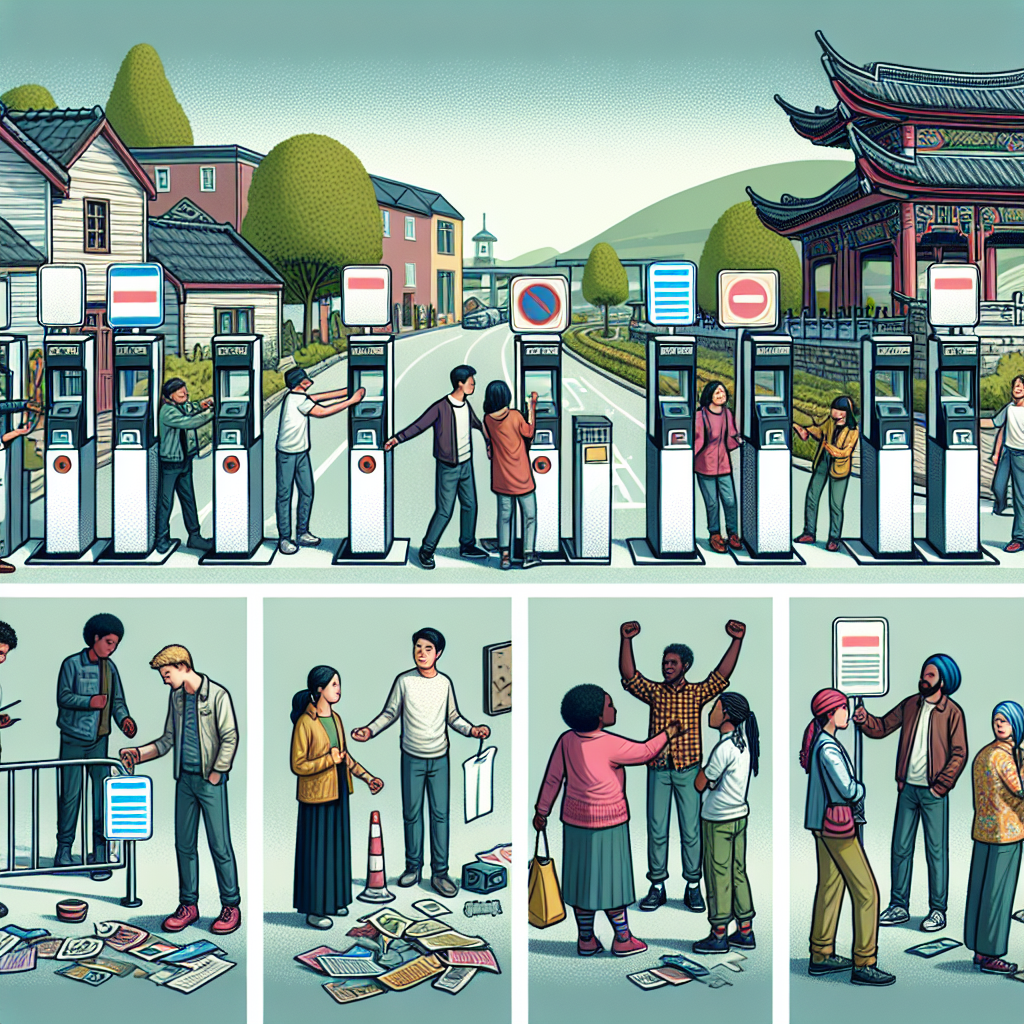
In recent days, the establishment of parking toll booths at various intersections in Datun Village, Xintang Town, Zengcheng District, Guangzhou City has sparked dissatisfaction among hundreds of tenants. On December 1st, the tenants launched a protest, dismantling all 28 toll booths, forcing the local government to promise to cease the toll collection to appease the situation.
Datun Village covers an area of approximately 8 square kilometers, with 17 cooperatives, a permanent population of 7,408 people, and over 60,000 temporary residents, mainly engaged in the cowboy textile and garment industry.
A worker from Guangxi named Fang Ming (pseudonym) working in the village shared with reporters that a few months ago, the village committee awarded the parking fee project to a related party for 1.2 million yuan and set up 28 toll booths, each with an investment of one to two hundred thousand yuan. On the first day of toll collection, all the toll booths were dismantled by workers from the clothing processing factories in the village.
Fang Ming mentioned that on the first day, a clothing factory owner was charged 22 yuan when leaving the village, leading to a dispute that escalated by the evening with over three thousand people present, including all the village bosses and employees.
Another business owner specializing in car maintenance, Li Hao (pseudonym), told reporters that there were thousands of protesters on site, demonstrating until 2 am, with the police present. Fortunately, the town secretary intervened and promised to stop the toll collection to prevent further escalation.
Fang Ming revealed that the police on site were hesitant to interfere, as the protesters were mainly bosses and workers from Sichuan.
It is reported that the tolls set up at the village were for parking charges, with regulations stating that small vehicles (blue, green plates) could enjoy two hours of free parking in the village, with a charge of 2 yuan per hour per vehicle beyond that. For less than one hour, it would still be counted as an hour, with a daily maximum fee of 25 yuan per vehicle, and a monthly fee of 250 yuan. Trucks over 1.25 tons (blue, green, yellow plates) have a daily maximum fee of 40 yuan per vehicle and a monthly fee of 350 yuan.
Fang Ming mentioned that the village currently has tens of thousands of temporary residents, many of whom are factory owners with significant personnel turnover, resulting in a high volume of daily vehicle traffic. Given the difficult economic environment and reduced business due to the pandemic, everyone finds the toll charges unbearable, leading to protests.
Some netizens have pointed out that in recent years, almost all urban villages have installed toll systems around the entire village, where one has to pay to exit, with options for monthly or yearly passes.
There have been comments expressing discontent with the government’s increasing financial burdens on the people, citing the toll booths as another instance of monetary extraction under the guise of public service.
Fang Ming attributed the toll implementation to the village’s financial struggles, worsened by the challenging economic conditions, particularly this year with a decline in export orders and reliance on domestic orders.
Reflecting on his own situation, Fang Ming shared his uncertainty about the future, as his income has significantly decreased, making it challenging to support his family, leading to feelings of confusion and helplessness.
Li Hao also expressed disillusionment with the current business environment, where investments seem uncertain and the emphasis on trustworthiness in business dealings has dwindled.
Following three years of pandemic control and events such as the US-China trade war, the economic downturn in China has led to financial difficulties for local governments, prompting various creative methods to generate revenue from the public.
Although the government is seeking to collect more funds, the public is facing financial constraints, leading to various forms of protests and resistance. For instance, the recent fire inspection in the Chaoshan region of Guangdong province, imposing a fine of 50,000 yuan for non-compliance, resulted in a collective “shutdown” by businesses and factories as a form of protest against the financial burden.