
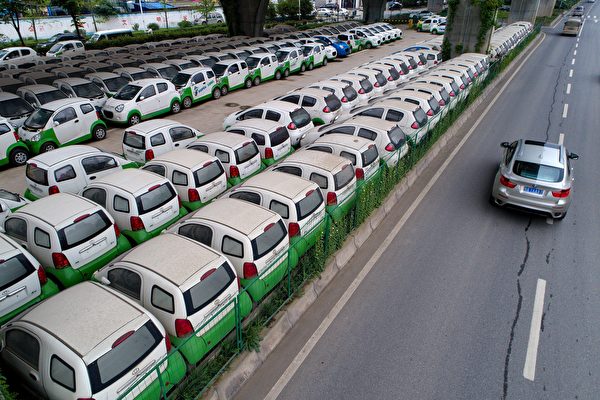
In the context of China’s continued economic downturn, only one out of eight listed automotive dealer groups achieved a small profit in 2025, with the rest generally falling into losses. Despite the Chinese Communist Party’s ongoing subsidies for car upgrades this year, the Chinese automotive market saw a significant decline in the first quarter. Consumers are reluctant to buy cars, and the industry is full of complaints and struggles.
According to Mr. Yang, who has been in the car sales business in Tianjin for 15 years, he climbed the ladder from a sales consultant to a general manager but recently resigned. He shared, “This industry is too stressful, it’s exhausting and anxious, and you can’t even make much money.”
Mr. Yang analyzed that after three years of intense competition within the automotive industry, a wave of resignations among employees may occur in the latter half of 2026. “After maximizing service and satisfaction, operating at a loss, ultimately, basic services may not even be sustainable.”
A senior car salesperson in Shaanxi with 17 years of experience, known as Mingyang, expressed that it’s now difficult to sell new cars, and the market is much worse than before. There are too many sellers but a 60% reduction in customers. “The automotive sales industry is in trouble this year, and a batch of domestic 4S stores is doomed.”
A salesperson named Xiaoning from a 4S store in Guilin, Guangxi, revealed that the boss ran away with the money, and she hasn’t received her salary yet, leaving her unemployed. She mentioned the chain of events leading to the financial collapse of the entire group under various brands managed by the boss.
In Henan’s Zhengzhou, a car salesperson, Xiao Deng, mentioned that the industry is difficult to survive in now. Companies cannot pay salaries, have no funds left, and employees are working on credit lines.
According to the released 2025 financial reports, out of the eight listed automotive dealer groups in China, seven were incurring losses, with only one barely turning things around. Leading enterprise “Zhongsheng Holdings” generated about 164.4 billion yuan but suffered a net loss of 1.673 billion yuan. “Yongda Automotive” transitioned from profit last year to over 300 million yuan in losses; “Zhengtong Automotive” further expanded its losses to 2.49 billion yuan.
A report from the China Automobile Dealers Association indicated that in 2025, the gross profit margin for new car sales in the entire industry plummeted to -21.5%, with luxury car brands dropping even lower to -26.2%. This means dealers are subsidizing more than one-fifth of the car price for each sale.
The data also revealed that in the first quarter of this year, 55.7% of the country’s car 4S stores were operating at a loss, with only 23.5% making profits, while 20.8% were breaking even. Furthermore, 81.9% of dealerships faced a price inversion for new cars, with over half experiencing an inversion of more than 15%.
Despite the Chinese authorities continuing to subsidize car upgrades, the Chinese automotive market witnessed a significant decline in the first quarter.
Moreover, statistics show that in the first quarter of this year, the leading luxury car in the traditional market, Mercedes-Benz, saw a 20% increase in sales in the U.S. and 7% in Europe. In stark contrast, Mercedes-Benz experienced a sharp drop of 27% in sales in the Chinese market.
The continuous expansion of losses in the Chinese automotive distribution sector, coupled with a sharp decrease in sales, indicates that people seem to be avoiding car purchases altogether.
Mingyang, a senior car salesperson in Shaanxi, explained that domestic consumers have enabled companies caught in intense competition to…