
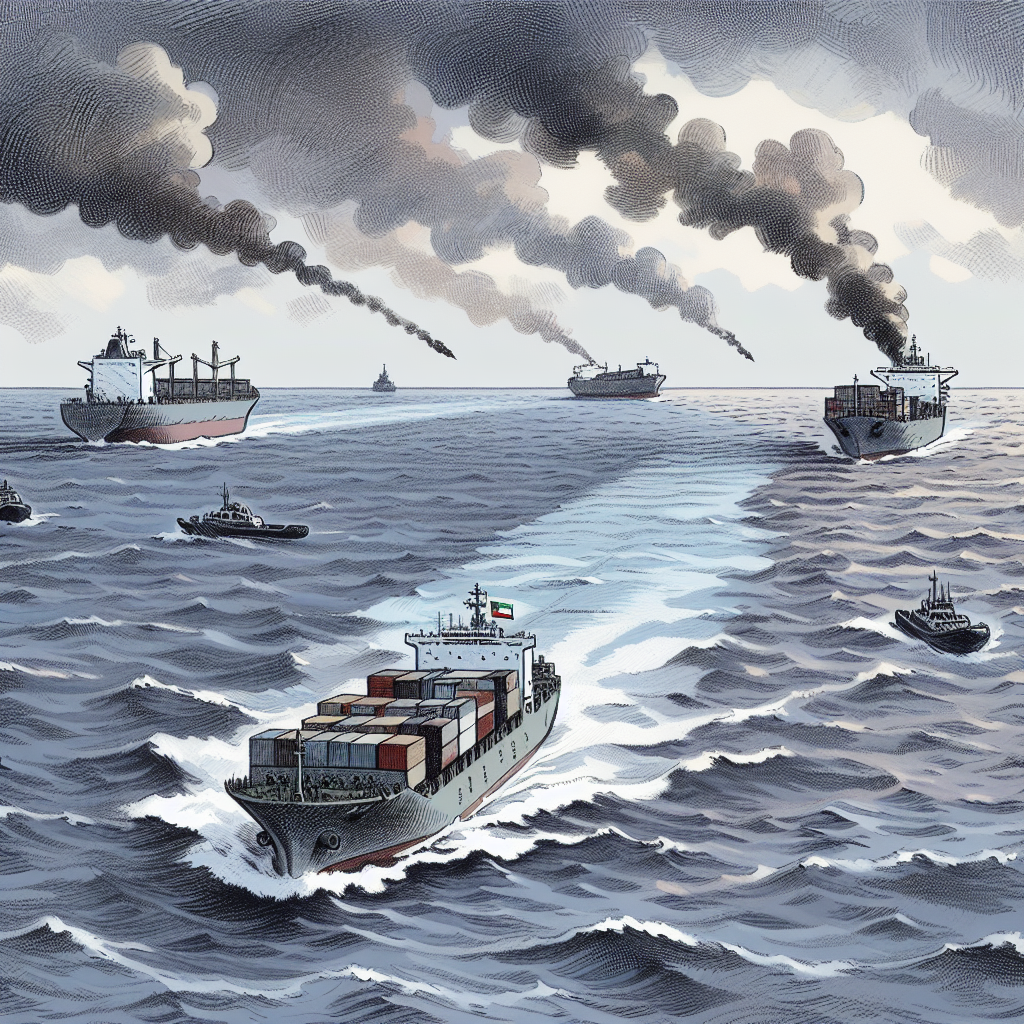
On Wednesday morning, April 22, the situation in the Hormuz Strait escalated further. Maritime security sources and the UK maritime authorities confirmed that at least three cargo ships were attacked by artillery in the area, leading to heightened tensions in the Middle East and complicating diplomatic efforts aimed at the US-Iran ceasefire negotiations.
Before this incident, on Tuesday night, President Trump of the United States announced an indefinite extension of the ceasefire agreement which was originally set to expire on Wednesday. This extension is intended to create more space for diplomatic negotiations facilitated by Pakistan.
The UK Maritime Trade Operations Office (UKMTO) reported that the first attack occurred in the northeastern waters of Oman, where an Iranian Revolutionary Guard Corps (IRGC) armed speedboat approached a container ship flying the flag of Liberia. The ship’s captain notified that without warning or radio contact, the vessel was attacked by artillery, causing severe damage to the bridge.
The captain of the Greek-operated container ship also mentioned that before the incident, the ship had been informed it was allowed to pass through the Hormuz Strait.
Subsequently, two other ships about 8 nautical miles west of Iran were also targeted. One was a Panamanian-flagged freighter, which fortunately remained undamaged. The third ship, also flying the flag of Liberia, was attacked while leaving the strait and is currently anchored on the surface. Thankfully, all crew members involved in the three incidents are safe.
On the eve of the attacks, President Trump announced the extension of the ceasefire to wait for Tehran to propose a “unified solution” for negotiations. He had earlier mentioned internal strife emerging between moderates and hardliners in Iran, with no clear winner yet.
Additionally, Trump pointed out on social media that Iran is facing a severe economic crisis, stating, “Iran’s finances are collapsing! They are desperate to open the Hormuz Strait. They are extremely short of funds! They lose up to $500 million per day.”
Trump further revealed that due to financial constraints, even Iran’s military and police are facing difficulties in receiving salaries.
UN Secretary-General Antonio Guterres welcomed the US decision to extend the ceasefire, describing it as an important step towards de-escalating the situation and creating crucial space for diplomacy and trust-building between Iran and the US.
Guterres also expressed full support for Pakistani Prime Minister Shehbaz Sharif’s efforts in facilitating bilateral dialogue.
On the social platform X, Sharif expressed gratitude for Trump’s decision and pledged, “With your trust and confidence in us, Pakistan will continue to make sincere efforts towards negotiating conflicts.”
Since the outbreak of war on February 28, the global energy markets have been severely impacted. With the Hormuz Strait carrying approximately 20% of the world’s oil and gas shipments pre-war, the long-term blockade post-war has led to international benchmark Brent crude oil surging to over $98 per barrel, a rise of more than 30%.