
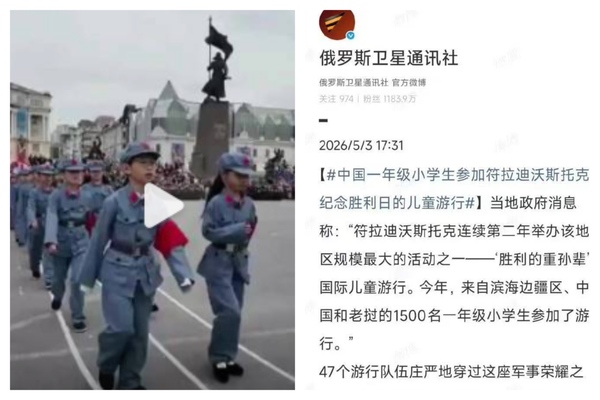
On May 3rd, the Chinese website of the Russian satellite news agency Sputnik released an article titled “Chinese First Graders Participate in Children’s Parade in Vladivostok to Commemorate Victory Day”, sparking discontent among Chinese citizens. Netizens criticized by saying “It’s called Vladivostok, not Vladivostok!”, and “Totally kneeling, treating the thief as the father”.
“Victory Day (May 9)” is a holiday established by Russia to commemorate the victory over Nazi Germany.
According to the Russian satellite news agency, in celebration of the 81st anniversary of the victory in the Great Patriotic War, a children’s parade was held in Vladivostok on Sunday, May 3. First-grade students from China and Laos participated for the first time.
The report mentioned that 47 parade teams marched through the Military Glory Square – the central square of Vladivostok.
The news quoted the words of Oleg Kozhemyako, the Governor of Primorsky Territory, saying, “Today, the parade is becoming more international. Children from the People’s Republic of China and Laos are marching alongside you, which has a very important symbolic meaning because the heroes of the Great Patriotic War fought for the future of children, for their right to live, study, make friends and be happy.”
Meanwhile, the Russian satellite news agency also posted the news on its official Weibo account but deleted the post after sparking discontent among Chinese netizens. However, the above report still remains on the Chinese website.
Tech blogger and Weibo influencer “Toxic Teacher” posted, “The so-called Vladivostok Victory Day actually arranged for Chinese elementary school students to participate in the celebration. Who came up with this idea? Russia’s official Weibo deleted the post, are they pretending this never happened?”
Netizens commented, “It’s called Vladivostok, not Vladivostok!”, “Give back our rivers and mountains”, “This is the real traitor”, “Traitors go to the conquered Eastern lands to participate in their events”, “The problem is that these traitors would accuse others of being traitors.”
“Do they not know what shame is?”, “Brainwashing from an early age”, “Bringing a bunch of kids over is quite puzzling, and the outfits don’t fit, it’s absurd. Whose idiotic decision was this?”, “This attire makes them look like servants’ army”, “Totally kneeling, treating the thief as the father”.
“Facing shameless insults, each of them remains silent as if dead”, “This is an organization with ulterior motives from foreign forces, and it must be seriously dealt with according to anti-spy laws”, “It has always been our own issues.”
Vladivostok has been inhabited by humans since ancient times and was originally the territory of Bohai State, Liao Dynasty, Jin Dynasty, Yuan Dynasty, Ming Dynasty, and Qing Dynasty. In 1860, the Qing government signed the unequal treaty – the Beijing Treaty with Russia, ceding Vladivostok to Russia. Three months before the signing of the treaty, Russia had already renamed Vladivostok to “Vladivostok”, meaning “Eastern ruler” or “Conqueror of the East”. Since “Vladivostok” has insulting implications for Chinese people, they have always referred to it as “Vladivostok”.
In 1919, under the leadership of Lenin, the Russian Soviet Socialist Republic government issued a declaration to the Beiyang government of the Republic of China, announcing the abolition of all unequal treaties Russia had with China since 1896, giving Vladivostok hope to return to China. However, in 1924, after Stalin came into power, he refused to return it to China.
After the victory of the War of Resistance Against Japan in 1945, Chiang Kai-shek sent representatives Song Ziwen and Jiang Jingguo to Stalin to request the sovereignty of Dalian, Vladivostok, and the Kuril Islands. After fierce contention, the former Soviet Union finally agreed to China reclaiming Dalian, Lushun, and the South Manchuria Railway and reached an agreement that China would recover Vladivostok fifty years later.
In 1952, Vladivostok became the headquarters of the Soviet Navy’s Pacific Fleet, which has been inherited by Russia to this day.
On May 16, 1991, without any procedures, Chinese Communist Party General Secretary Jiang Zemin reached an agreement with Russian President Yeltsin, explicitly specifying that Vladivostok belongs to Russian territory.
Today, Vladivostok is the largest city in the Russian Far East region, with the highest population and the most developed economy. The city, surrounded by three seas, has become Russia’s largest port and a hub for coastal transportation in the Pacific.