
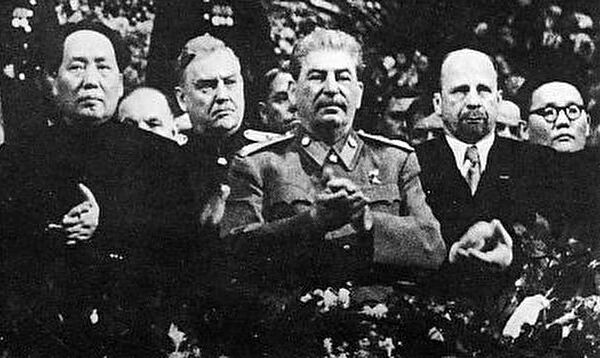
Russian Federal Archives Director Artizov recently announced that communications between former Soviet leader Stalin and Chinese Communist leader Mao Zedong will be publicly released for the first time this year. As the CCP was a branch supported by the Soviet Union, speculation on what content the Russian side will disclose and whether it will be unfavorable to the CCP has sparked discussion.
On January 19th local time, Russian Federal Archives Director Artizov revealed in an interview with the state media TASS that the communications between Stalin and Mao Zedong will be made public for the first time this year.
“We are currently cooperating with Chinese archive workers on a significant project, the collection of communications between Stalin and Mao Zedong. This year, we plan to publish this collection of documents, with many being made public for the first time,” he said.
This news has caught the attention of Chinese internet users, with opinions divided. Some believe that this revelation could be detrimental to the CCP.
Many Chinese netizens feel that the CCP has always viewed the Soviet Union as its “homeland”. Unless selectively revealed, the communications between the two leaders are likely to expose the true relationship between the CCP and the Soviet Communist Party, making it clearer to the Chinese people that the CCP is indeed an “external force in name only.”
Some netizens suspect that Russia may be using this opportunity to threaten the CCP: “If you do not show respect to your ‘parent’, be careful as your ‘parent’ might expose your secrets”, “Russia holds the secret of how the CCP took over China. If Russia goes to war, the CCP will have to pay to support the war. This is a signal to the CCP that they need to spend a lot to stay safe. The real secret is not the communication between Stalin and Mao Zedong.”
However, there are also netizens who suggest, “If it is published in collaboration with China, what can be so revealing? It might just be a censored version of mutual praise between the two.” “The publicly disclosed content is likely to be either heavily edited or of no real consequence.”
The Marxist-Leninist ideology, advocating violent revolution, was introduced to China in the early 1920s by a group of misled young intellectuals. Under Stalin’s rule, the Soviet Union aimed to “spread the red flag worldwide.” After the establishment of the CCP, it functioned as a branch of the Soviet Communist Party. From 1928 to 1941, Stalin provided financial aid worth $8 to $9 million to the CCP through the Communist International, equivalent to approximately $185 to $200 million today. At that time, Mao Zedong received a monthly living allowance of 200 silver dollars from the Soviet Union, equivalent to the wages of an ordinary worker for 10 months.
Chinese individuals who stayed in the Soviet Union during that time period were involved in events such as espionage and armed activities against China. During the Zhang Xueliang Incident in 1929, the Central Committee of the CCP followed Stalin’s request to “arm to defend the Soviet Union” and fight against China. Liu Bocheng, who studied at the Frunze Military Academy in the Soviet Union, and Ye Jianying, who attended a special class at the Moscow Oriental University, went to Boli to establish the “Red River Red Guard” or known as the “Far East Workers’ Guerrilla Corps” with assistance from the Soviet Union to attack Heihe in China.
According to CCP historian Yang Kuisong, famous uprisings in CCP history were funded by Moscow, including armed uprisings by Shanghai workers, the establishment of party schools, agricultural movements in Hunan, autumn harvest uprisings, the establishment of the military, the Nanchang Uprising, strikes on the Beijing-Hankou and Guangzhou-Hankou railways, and riots in Guangzhou.
Relying on support from the international antagonistic force, the Communist International, the CCP established the Soviet regime in Jiangxi’s Ruijin in 1931, obeying the Communist International and becoming a “country within a country,” opposed to the Republic of China.
After Lenin’s death, Stalin came to power in the former Soviet Union in 1924 until his death in 1953. Stalin and Mao Zedong served as dictators of the Soviet Union and the CCP, respectively, with their relationship being complex and ever-changing.
In the mid-1930s when Mao Zedong solidified his position within the CCP, Stalin did not fully support Mao’s approach, favoring Wang Ming’s “international faction.”
Even as late as 1937 to 1938, Stalin endorsed Wang Ming. When Wang Ming returned to China in November 1937, Stalin personally met him. However, after 1938, Wang Ming lost in the internal struggles of the CCP.
Even after Mao Zedong obtained real power within the CCP until the early years of the CCP’s rule in 1949, Stalin still harbored some distrust towards Mao Zedong.
After the CCP came to power, the Soviet Union continued its support. On October 3, 1949, China and the Soviet Union established diplomatic relations at the ambassadorial level. In December 1949, Mao Zedong made his first visit to the Soviet Union. In exchange, the CCP and the Soviet Union maintained ideological unity, with the participation in the Korean War by sending troops effectively safeguarding Soviet security in the Far East.
Chinese CCP expert Sima Lu once revealed that in order to secure assistance from the Communist International and the Soviet Union, Mao Zedong praised Stalin abundantly. During the resistance against Japan, when the Sino-Soviet agreement was signed, many Chinese believed that the Soviet Union had betrayed China. However, Mao Zedong expressed, “The interests of the Soviet Union and the Chinese people are aligned,” lavishing praises on Stalin and even stating, “Comrade Stalin’s health is equivalent to the victory of the Chinese revolution.” Later, when Mao and Stalin fell out, Mao remarked that his previous praises for Stalin were just “perfunctory responses to the situation.”