
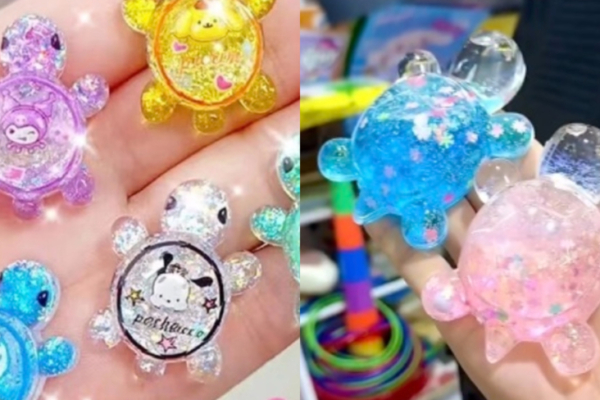
Recently, in Zhengzhou, Henan Province, a 6-month-old baby was rushed to the emergency room due to severe pneumonia and both lungs turning white after playing with a “quicksand turtle” toy.
According to reports from mainland Chinese media such as Netease Video, on January 12th, a 6-month-old baby boy, playing with a “quicksand turtle” toy purchased by his sister for a few dollars, is now lying in the Pediatric Intensive Care Unit (PICU) with both lungs turning white, diagnosed with severe pneumonia. The culprit was found to be mineral oil leaking from inside the toy.
Doctors diagnosed the tragedy as being caused by the baby ingesting mineral oil.
The primary reason, as per the doctors, was a minor leakage of mineral oil from the toy, with the baby likely inhaling less than a milliliter of it. Once this oil enters the lungs, it cannot be expelled, immediately leading to suffocation and severe infection.
Doctors warn that toys filled with substances like quicksand, liquid sand, or oils pose a deadly risk to infants and toddlers under three years old. Parents must inspect and prevent children from biting or playing aggressively with such toys, as they can lead to leakage of toxic substances.
This incident has raised concerns once again about the safety supervision of toy manufacturing in China.
In recent years, colorful quicksand crystal boxes, various animal-shaped and brightly colored “pinch toys,” and clear drop gel toys, among other popular toys, have attracted a large number of children. However, seemingly cute and soft toys hiding potential dangers might contain harmful substances such as formaldehyde, ATOVC, zero benzene, borax, some emitting strong odors.
Reported by Jining Evening News, a mother named Liu, residing in Rencheng District, stumbled upon these popular toys online. Thinking of making and selling homemade “quicksand mahjong,” “pinch toys,” and other soft, squeezable stress relief toys due to their high sales potential, she continued doing so for several months. However, to her surprise, three months later, she began experiencing unexplained dizziness, coughing, and became very sensitive to respiratory issues.
“I thought I was just tired during that period, experiencing sub-healthy symptoms, but later started to have random fevers, so I had to go to the hospital for examination, and the results shocked me,” Liu said. Despite always being in good health, she was diagnosed with moderate anemia and allergic asthma.
After a series of tests ruling out organic changes within her body, the doctor inquired whether Liu’s environment had any pollution issues. It was then that Liu realized the culprit was the adhesive she had long been in contact with. Ultimately, the doctors speculated that Liu’s prolonged exposure to higher concentrations of formaldehyde, benzene, and other compounds led to her anemia and allergic asthma.
The news of a baby suffering from severe pneumonia and both lungs turning white due to the “quicksand turtle” has sparked discussions:
Netizens question, “When will the safety inspection of children’s toys become more stringent?”
“When incidents make headlines, we know, but how can ordinary people identify other dangers?” “Why continue production?” “Is there any accountability from the source?”
Others express, “Even if it’s not liquid, many online plastic toys contain various toxic additives and heavy metals exceeding limits. A lot of plastic toys are made from recycled garbage.”
“All these ‘national treasures’ are just disposable products.”
“Toys are the most toxic, might as well let kids play with mud than buy those cheap toys on Taobao.”
“Quality of toy filling materials for children must be impeccable, as it concerns the health of the next generation!!!”