
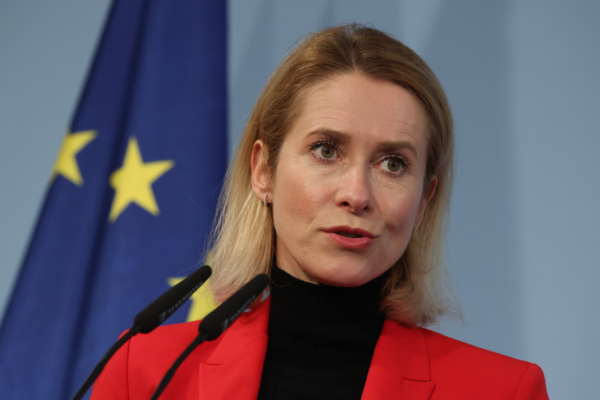
The European Union’s High Representative for Foreign Affairs and Security Policy, Kaja Kallas, announced on Tuesday at the European Parliament the EU’s plan to impose export restrictions on Iran’s unmanned aerial vehicles and missile components. This move aims to further weaken Iran’s ability to provide technological support to Russia’s aggression in Ukraine, while also serving as a countermeasure against the violent suppression of domestic protesters by the Iranian authorities.
Kallas stated during her speech, “Today, we propose new export restrictions on components used by Iran for producing drones and missiles. This will further limit Iran’s ability to support Russia’s ongoing aggression against Ukraine.”
Regarding the situation within Iran, Kallas further pointed out that “the Iranian people are fighting for their future. The authorities have ignored their legitimate demands, revealing their true nature.” She emphasized that the EU is actively exploring further sanctions against the Iranian authorities for their “brutal suppression” of protesters. The European Parliament has previously taken action to ban all official Iranian representatives from entering parliamentary premises.
Ahead of the EU’s announcement of new sanctions plans, the Munich Security Conference withdrew its invitation to Iranian Foreign Minister Abbas Araqchi and his deputy on Friday, January 16. The organizers stated that due to the current Iranian government’s bloody crackdown on protest activities, they no longer maintain the original invitation. This marks the third consecutive year that the Iranian government has been excluded from the prestigious conference.
Iranian officials recently revised the death toll from the protests to 5,000 people, including approximately 500 security personnel. However, it is widely believed that the actual numbers are much higher.
The Sunday Times reported on Sunday, January 18, citing a confidential report from Iran’s medical network, that since the nationwide protests erupted at the end of December 2025, around 16,500 people have been killed and approximately 330,000 people have been injured.
The report indicated that the majority of deaths occurred during the internet blackout on January 8th and 9th. This marks the bloodiest crackdown in the 47-year history of the Islamic Republic of Iran. Medical staff revealed that security forces used military-grade weapons to shoot protesters at close range in the head and neck, resulting in thousands of permanent blindness cases.
As of today, Iran has been experiencing a massive internet shutdown for over 280 hours. Kallas commented on this, stating, “Closing down the internet while brutally suppressing protests exposes a regime that fears its own people.”
Currently, discussions are ongoing at the EU headquarters in Brussels regarding stricter measures, including the potential designation of the Islamic Revolutionary Guard Corps (IRGC) as a terrorist organization, and the expulsion of all Iranian ambassadors from the EU.