
12 years ago, a professor at Laurentian University stood in Amanda Ostrander’s classroom and presented to his students the various reasons for not teaching in public schools, but educating their own future children at home.
As he turned a somersault on the trampoline into a physics lesson, the professor saw the spark of love for learning in his own child’s eyes, and conveyed to the whole class how wonderful homeschooling is.
Amanda Ostrander from Sudbury, Ontario, was not yet a mother at that time, but she took the professor’s words and the experiences of others to heart, later becoming a homeschooling parent herself and providing consultation to thousands of parents like her.
The exploits of Canadian celebrities may have also played a part. With a degree in Canadian history, Ostrander had studied Henry Hudson, the 17th-century English maritime explorer. Ostrander told The Epoch Times, “Henry Hudson always said, ‘Yes, I will do it.'” She added that Canadians always “do things in their own way.”
So, when Ostrander met her husband Stéphane, both of them agreed to educate their children in their own way, reflecting the typical Canadian style. As former educators in the public school system, they were not troubled about whether they could teach.
Ostrander said, “Teaching two children is much easier than teaching 30 children.” She referred to their 9-year-old daughter Alexi and 7-year-old daughter Zoe, neither of whom had attended public school.
She shared, “In reality, it’s been much easier than we anticipated, taking far less time. It has brought a lot of peace to us, and it’s something we’ve come to enjoy.”
Ostrander started a YouTube channel to spread her wisdom on homeschooling in Canada to more parents, giving them “the freedom to have more family time.”
As insiders in the education industry, the Ostrander couple were well aware of the politics and inefficiencies in public schools, so they chose to avoid them. They aimed to teach their children more about art, history, and science, which Ostrander believed were neglected in public schools as they are not as easily measurable as language or math.
Ostrander also revealed that the biggest reason for homeschooling came from a memorable catchphrase of that professor many years ago: “Love of learning.” She wanted to instill in her two daughters the joy of learning, which led her to involve them in designing curricula that suited their learning styles and needs.
For the three women in the Ostrander household, each school year began and ended with tea and cookies, creating a warm atmosphere for Alexi and Zoe to collaborate on determining the learning content for the semester. While mom would outline a curriculum, the key was to keep them motivated.
This led them to turn Barbie dolls into mummies in one lesson, complete with sarcophagi. Ostrander shared, “We love learning about ancient Egypt. We read some great books like ‘A Cat called Ra.'”
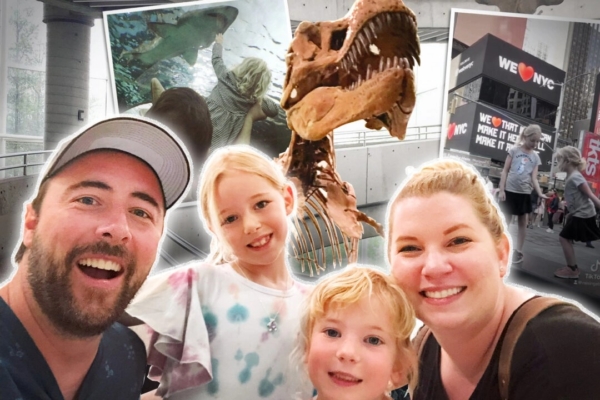
They frequently engaged in field trips. When discussing fashion field trips, Ostrander mentioned, “We went to New York, to the Metropolitan Museum, which always has exhibits by designers and the history of specific designers.”
They visited science centers, walked among dinosaur skeletons at the Royal Museum, marveled at the razor-toothed sharks at Ripley’s Aquarium, and were awestruck watching a herd of elephants crossing a river at the wildlife park.
On another trip, some “educational moments” provided a good excuse for sunbathing. In Cancun, they watched weavers use old looms to create traditional blankets. This could be termed as home economics or sociology.
Ostrander talked about iguanas, cute South American coatis strolling on the beach, and spider monkeys.
The love of learning sounds romantic, but its roots are academic. While studying their curriculum, the Ostrander couple drew inspiration from the theory of “unschooling.” In the 1970s, educational pioneer John Holt devised a homeschooling approach that utilized students’ self-motivation as the driving force for learning. This later became the theory of “unschooling.”
Ostrander shared, “We did draw quite a bit from unschooling, like the love of learning and interest-based learning.” She considered herself and Stéphane as “eclectic homeschoolers,” blending various methods.
She stated, “Unschooling is like baiting them with the kids’ interests to capture their attention. Once you’ve captured their attention, they tend to stay focused longer. So, it’s not a complicated idea, but it’s a very effective method, especially for children.”
Ostrander emphasized the distinction of unschooling, saying, “It’s not just letting them do whatever they want all day, like sitting there playing Minecraft.”
Now, Alexi has developed a “voracious” appetite for books, reading at a sixth-grade level in fourth grade. Ostrander revealed that Zoe did not learn to read in the same way, but she was doing math easily at a third-grade level by second grade.
One benefit of homeschooling is that parents know their children best and can tailor their teaching methods accordingly. Based on Alexi’s interests, they guided her in learning video editing.
Ostrander believed that a degree in graphic design is not necessarily required for doing graphic design.
Zoe expressed her love for the backyard chickens and aspires to be a farmer.
Ostrander did not insist that the children must attend college, as she found universities filled with useless teaching content. She felt that all professions are “great,” being an entrepreneur is also good, and any career choice her children make would be the best for them and their ultimate goals.
Most importantly, with more family time thanks to homeschooling, the Ostrander couple found that it strengthened their relationship.