
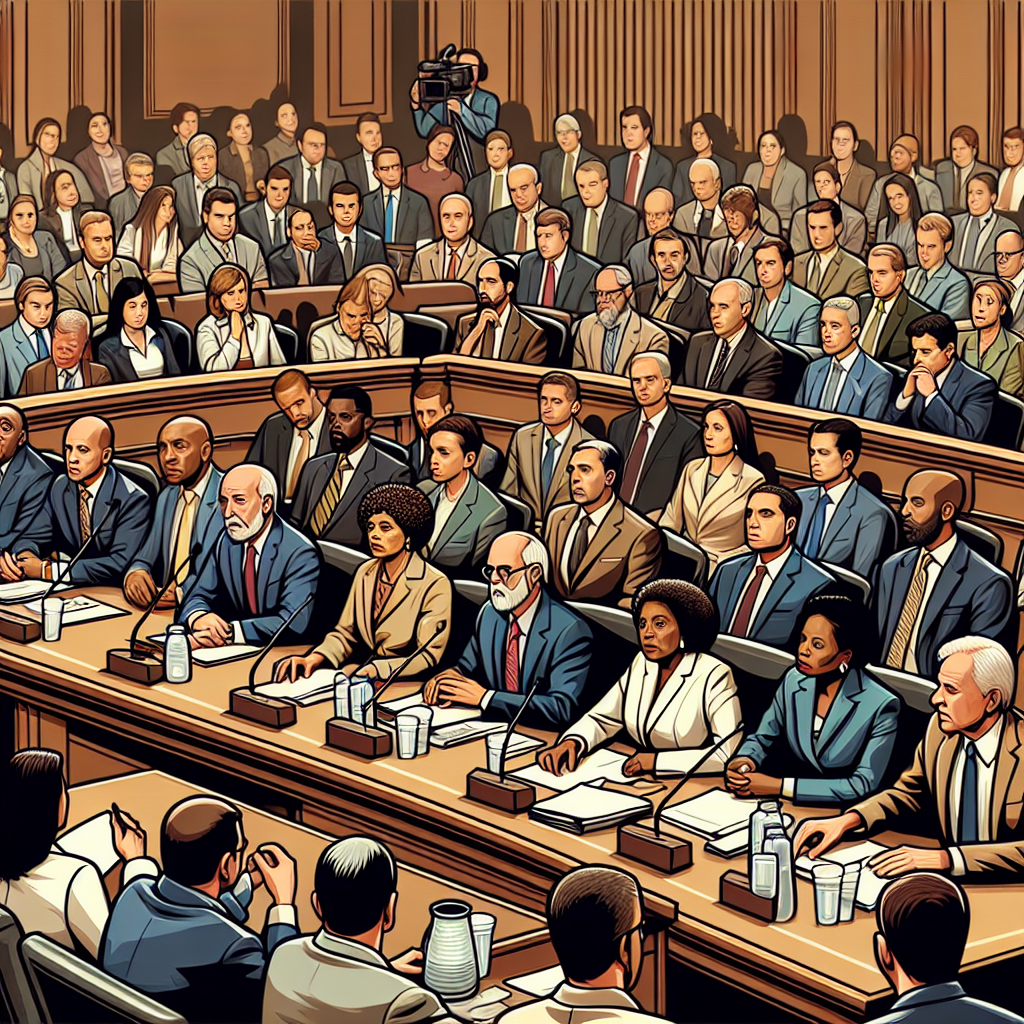
On Thursday, June 5, the US-China Economic and Security Review Commission (USCC), a subsidiary of the US Congress, held a hearing on China’s dominant position in critical supply chains and its impact on US national security. During the hearing, committee members expressed concerns about supply chains being constrained by the Chinese Communist Party.
The USCC held a hearing titled “Strategically Engineered Dominance: China’s Impact 2.0 and Supply Chain Bottlenecks Eroding US Security.” Co-chair of the hearing and USCC commissioner Leland Miller pointed out that a current reality facing the US is that “the health of its economy and the resilience of its defense industrial base rely on critical supply chains through China, which are constrained by the Chinese Communist Party.” He urged a collective effort from the government to develop alternative solutions for supply chain bottlenecks.
Another co-chair of the hearing, Livia Shmavonian, stated that the US has started addressing the supply chain risks posed by China’s excess capacity. However, she highlighted that “significant challenges still exist.”
Miller, in his opening remarks at the hearing, emphasized China’s role as a major supplier of raw materials for various industries in the US, sometimes being the sole source, particularly prominent in the pharmaceutical and electronics industries.
Miller specifically mentioned China’s dominant position in advanced biopharmaceuticals and basic chip sectors. He noted that in the advanced biopharmaceutical field, Chinese biopharmaceutical companies are reshaping supply chains not through production but via licensing and contracting the development of drugs subsidized by the Chinese government.
In the basic chip sector, he mentioned that Chinese-made semiconductors are flooding the US market in the form of embedded electronic components, not just in competition with US companies in the chip sector. He warned that as Chinese subsidized chip manufacturers replace foreign companies as suppliers to China’s massive electronics industry, the repercussions of this market disruption will be felt by US chip companies and even the entire economy.
Pharmaceuticals, basic chips, printed circuit boards, and biotechnology are the main areas of concern at the USCC hearing.
In the printed circuit board sector, Chinese companies control over two-thirds of the global market; in the pharmaceutical sector, over 60% of US drugs contain key raw materials from China and India, with India itself heavily reliant on chemicals from China.
Miller stated that China’s dominance in these supply chains is carefully designed. He highlighted that “Beijing is pursuing a deliberate strategy to deepen global reliance on its production.” Controlling these supply chains gives Chinese leader Xi Jinping significant influence over the US economy.
China is not reluctant to exploit this influence. “China’s recent restrictions on US exports of indium, germanium, antimony, graphite, certain rare earth elements, and other key minerals indicate Beijing’s intention to leverage its influence,” Miller said.
Starting on April 4, Beijing suspended exports of nearly all seven rare earth metals and powerful magnets made from three of these metals, leading to production line shutdown threats for many US and European car manufacturers. In response to this, Chinese officials emphasized on Thursday that rare earths have significant dual-use attributes, and export control is an international practice. The rare earth issue was also one of the important topics of discussion during a Thursday phone call between US President Donald Trump and Xi Jinping.
Miller suggested that tariffs might be part of the solution, but concerted efforts from the government are needed to develop alternative solutions for these supply chain bottlenecks.
He said, “The consequences of inaction could be catastrophic, affecting not only our economic data but also our hospitals and pharmacies, military, and all essential electronic products vital to the modern economy.”
Co-chair Shmavonian focused on the impact of China 2.0 on the US and other countries.
“China 2.0” refers to the second wave of economic impact that China’s export-driven growth may bring to the world following the “China impact” at the beginning of the 21st century. As China’s domestic economy faces challenges, its manufacturing capacity and exports have significantly increased, especially in high-tech areas like electric vehicles and renewable energy equipment.
Shmavonian stated that the first wave of the China impact had a tremendous impact on the US and its allies and partners. “Manufacturing communities and capacities were dumped and hollowed out by subsidized goods; even surviving companies weakened due to the proliferation of globally subsidized goods resulting in loss of export markets,” she said.
She predicted that China 2.0 will continue to impact the US.
“China is focusing on emerging technologies and industries, putting continuous pressure on advanced manufacturing in the US,” Shmavonian said.
The US has begun to address the supply chain risks posed by China’s excess capacity, but the scope of the issue is too broad. “Over a third of most US industries’ imported products come from China. Significant challenges persist, including coordination among government agencies, sustained commitment to long-term investments, and effective engagement and coordination with allies and partners,” she said.
She mentioned that Chinese companies operate globally, and global reliance on Chinese products blurs the definition of “Chinese products.” Shifting away from the Chinese market to diversification almost always involves Chinese domestic companies and components manufactured in China, weakening the ability to rely on geographical diversification as a safeguard for supply chain security.
(Translated from a report by Voice of America)