
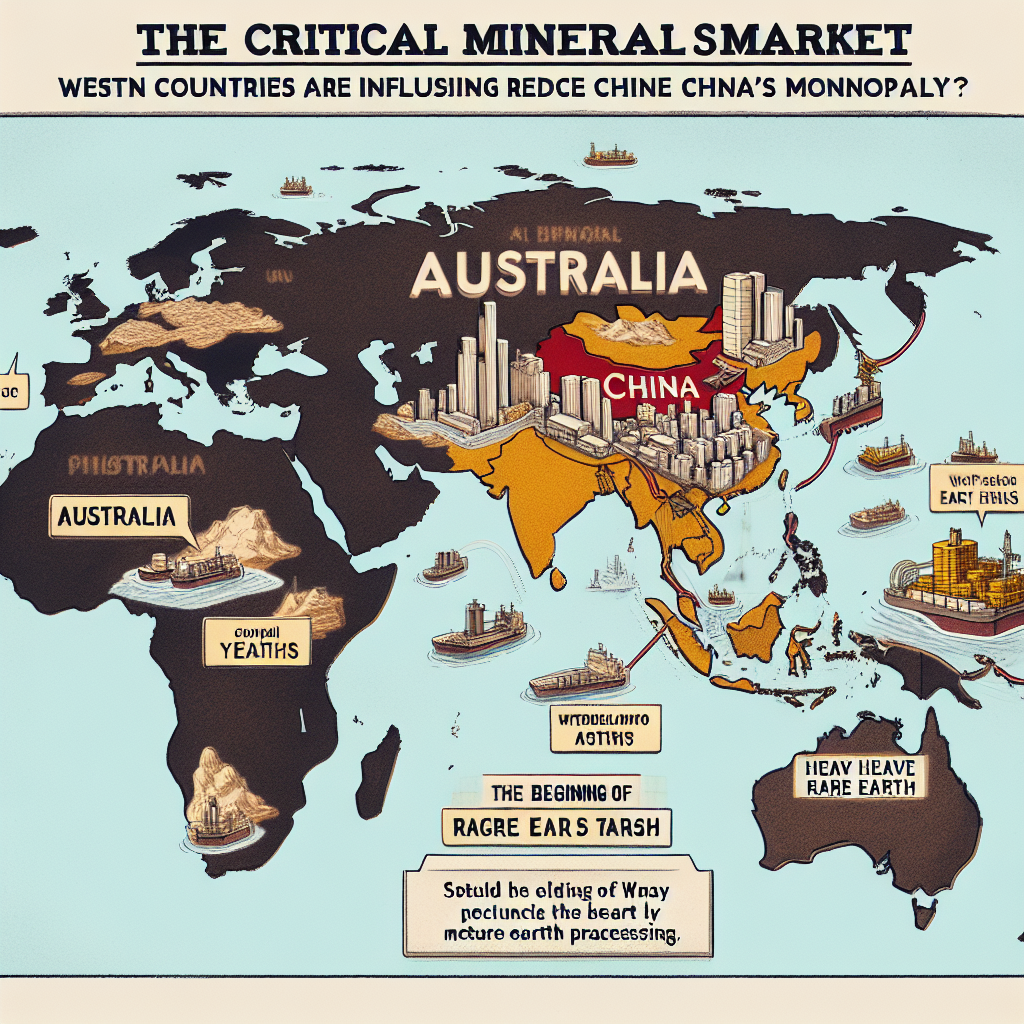
Western countries are seeking to weaken China’s monopoly on critical minerals, bringing opportunities to mineral companies outside of China. Australian mining company Lynas Rare Earths is expanding its rare earth processing capabilities and is set to commence heavy rare earth processing.
According to Nikkei News, Lynas is the largest global rare earth producer outside of China. The company plans to start processing heavy rare earths at its plant in Malaysia next year. Lynas also plans to build a factory for heavy rare earth processing in Texas, USA. To support this initiative, Lynas has secured $258 million in funding from the US Department of Defense.
Heavy rare earth processing has been dominated by China. Lynas said that the factory will be the first facility outside of China to process heavy rare earths. Amanda Lacaze, CEO of Lynas, stated at a shareholders’ meeting in November: “This is to expand our product range and increase the profits we can derive from these materials.”
Lynas mines rare earths in Mount Weld, Australia, and processes them in Malaysia where production costs are lower. The company’s US factory will further expand its supply chain.
Compared to other rare earth metals, the supply of heavy rare earths is extremely limited, and separating different metals is difficult due to their similar chemical properties.
Heavy rare earth elements include terbium and dysprosium, which are typically added to high-performance magnets to enhance heat resistance. These magnets are used in electric vehicle motors, wind turbines, night vision goggles, and fighter jets.
Investments by Lynas in rare earth processing will help Western countries reduce their reliance on China for critical minerals. According to data from the US Geological Survey, China accounts for approximately 70% of global rare earth production and controls 90% of rare earth processing.
Apart from Lynas, other companies like Iluka Resources and Arafura Rare Earths are also planning to launch processing plants in Western Australia and the Northern Territory, respectively, supplying neodymium and praseodymium for magnets to companies like Modern Motors by as early as 2028.
In recent years, critical minerals have become a weapon for China to retaliate against Western countries. In July last year, China announced export restrictions on gallium and germanium compounds; in October of the same year, export restrictions were placed on graphite; in August this year, export restrictions were announced for metals including antimony. After the recent escalation of the US-China chip war, China announced in early December a complete ban on exporting gallium, germanium, and antimony to the US.
These actions have accelerated efforts by developed economies to diversify their supply chains. The European Union introduced the concept of “de-risking towards China” last year, with EU member countries passing the Key Raw Materials Act aimed at reducing reliance on Chinese products. The US government has also been working towards “de-risking towards China” and has made significant investments in the domestic chip industry. Mining company Perpetua Resources is developing an antimony mine in Idaho with government funding.
Ottawa-based Northern Graphite claims to be the sole natural flake graphite producer in North America. Hugues Jacquemin, CEO of the company, told Reuters that after China announced restrictions on graphite exports in October 2023, the company saw a 50% surge in orders.
Mark Jensen, CEO of “ReElement Technologies,” a subsidiary of American Resources specializing in rare earth recycling and refining, stated that China’s export ban in early December led to the company receiving at least 10 calls from US miners within a week requesting zinc ore, as zinc ore can be a source of germanium in the processing process.
China’s export restrictions on critical minerals since last year have posed a threat to the survival of domestic enterprises. Traders and analysts told Reuters that within China, these restrictions have already forced some weaker companies to exit the market.