
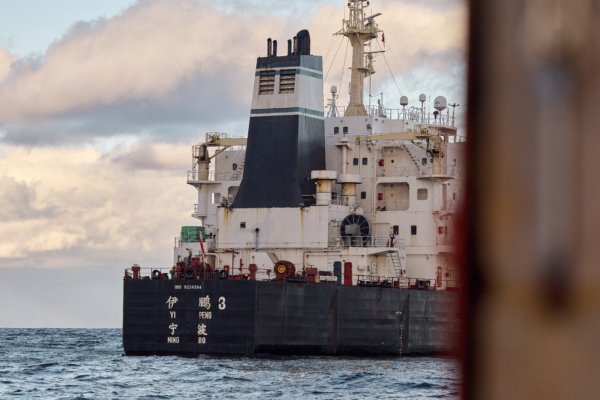
On Thursday, Danish Foreign Minister announced that the Baltic cable had been cut off and after weeks of secret negotiations, representatives from Germany, Sweden, Finland, and Denmark were able to board the Chinese cargo ship involved. Chinese officials also boarded the ship.
From November 17th to 18th, two Baltic cables connecting Finland to Germany and Sweden to Lithuania were severed in Swedish waters. The Chinese bulk carrier “Yi Peng 3” was quickly identified and wanted by Sweden, thus stranded in Danish waters for over a month.
According to data analysis from MarineTraffic by Reuters, “Yi Peng 3” departed from Ust-Luga, Russia on November 15th. The Chinese cargo ship was near both cables when the incident occurred.
Danish Foreign Minister Lars Lokke Rasmussen mentioned that Denmark facilitated a meeting earlier this week between Germany, Sweden, Finland, and Chinese representatives, breaking the month-long deadlock. “The countries affected by the cable damage, as well as Denmark (due to the ship’s passage in Danish waters), are interested in uncovering the truth of this matter,” said Rasmussen. “We hope that once personnel from these four countries complete the inspection, the ship can proceed to its destination.”
Data from the London Stock Exchange Group (LSEG) revealed that “Yi Peng 3” is still anchored at the same location between Denmark and Sweden in the Kattegat Strait.
According to The Wall Street Journal, Swedish and Beijing diplomats engaged in secret negotiations on the matter for weeks. Swedish authorities clarified that Thursday’s action on the ship was not part of Sweden’s initial investigation but rather as observers boarding the vessel, while Chinese authorities conducted their own “investigation.”
“Simultaneously, a preliminary ‘damage’ investigation is underway regarding the two Baltic cable disruptions,” stated the police. Sweden, Finland, and Lithuania are jointly investigating the reasons behind the cable fractures. Danish Foreign Minister Rasmussen mentioned Denmark also had an observer on board.
These events unfolded in Sweden’s exclusive economic zone, with Swedish prosecutors leading the investigation on suspicion of “damage.” The Chinese-operated cargo vessel allegedly intentionally dragged its anchor over a hundred miles, resulting in the severing of C-Lion1 connecting Finland and Germany and C-Lion1 linking Sweden and Lithuania within Sweden’s economic zone.
Huari Daily reported that the Chinese Foreign Ministry denied any involvement in sabotage and expressed willingness to cooperate with the investigation. Investigators familiar with the negotiations and a diplomat hinted that Beijing seems eager to resolve the matter promptly.
Western intelligence officials from multiple countries believe that the Chinese vessel caused the two cable outages, but opinions vary on the nature of the incident, whether it was accidental or intentional.
German Defense Minister Boris Pistorius stated his belief that it was due to human sabotage; Lithuanian President Gitanas Nauseda expressed a similar view on December 6th, suggesting that the two undersea fiber optic cables were likely intentionally cut.
Swedish Prime Minister Ulf Kristersson urged the Chinese ship to return to Sweden to assist in the investigation. Kristersson previously mentioned that his government had officially requested cooperation from Beijing for the ship’s return to Swedish waters for an investigation to clarify the truth with Swedish authorities.
Reuters attempted to reach the Chinese Foreign Ministry for comment outside of office hours on Thursday, but no immediate response was received.
According to Huari Daily, Benjamin L. Schmitt, senior researcher at the Clemens Energy Policy Center at the University of Pennsylvania, pointed out that “Yi Peng 3” had operated only in Chinese waters from December 2019 to early March 2024 before abruptly altering its operations.
The vessel began transporting Russian coal and other goods, making stops at Russian ports like Nakhodka in the Sea of Japan and Port of Murmansk in the Barents Sea, as well as one trip to the Baltic Sea. Currently, according to data from global data and analysis provider Kpler, the 740-foot long, 105-foot wide bulk carrier is loaded with Russian fertilizers.
Arelion, the cable operator, stated that the cable connecting Sweden and Lithuania was repaired on November 28th. According to Cinia, the owner of the cable, the second cable connecting Finland and Germany was restored on November 29th.
(This article referenced reports from Bloomberg)