
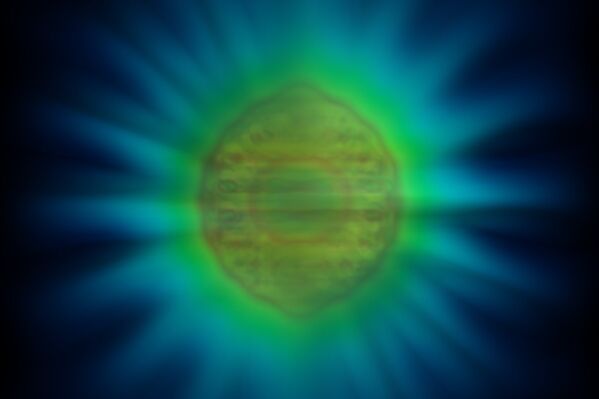
An intriguing new study has described the shape of a single photon, which is the smallest energy form in the electromagnetic field that we are familiar with, namely a single light quantum.
This research was published on November 14, 2024, in the journal Physical Review Letters, detailing how light quanta are emitted by atoms and influenced by their environment in a meticulous way. While the ways these interactions occur have infinite possibilities, the researchers say they have developed a practical method to predict them.
“Our calculations have turned what seemed like an unsolvable problem into something computable,” said Benjamin Yuen, the lead author of the study and a physicist at the University of Birmingham in the UK, in a statement. “Furthermore, almost as a byproduct of our model, we can generate an image of this photon, which is unprecedented in physics.”
Shaping the Photon
Assigning a specific shape to a photon is a daunting task because these massless elementary particles exhibit wave-particle duality, a peculiar characteristic of microscopic objects in the quantum realm governed by the mysterious uncertainty principle.
This means that scientists believe that depending on how they are observed, photons can exhibit particle properties as well as wave-like properties. Additionally, photons are also understood as excitations in the electromagnetic field or ripples of discrete energy.
In short, they are extremely difficult to grasp. Making this situation even more complex is the infinite ways in which light interacts with its surrounding environment and the atoms that emit them.
However, the researchers say that by using classical mechanics, they can simplify these possibilities into a discrete set to bypass this issue—or categorize them as “pseudo-modes”—thereby streamlining their thinking about photon interactions.
Significance of the Study
According to the researchers, modeling photons in this way has the advantage of accurately describing how these tiny particles enter the electromagnetic field surrounding an object in a region known as the far field. Previous methods had a disconnect between the near field and the far field, providing an incomplete picture of light systems at the quantum level.
“This work helps us enhance our understanding of energy exchange between light and matter, followed by a better understanding of how light radiates into its nearby and distant environments,” Yuen said. “Many of these pieces of information were previously considered ‘noise’—but there is so much information in there that we can now understand and leverage.”
This new understanding has practical implications. For quantum physicists and materials scientists, it could potentially revolutionize the development of nanophotonic technologies, advancing improvements in “solar energy cells or quantum computing,” according to Yuen, as well as progress in communication technologies. ◇