
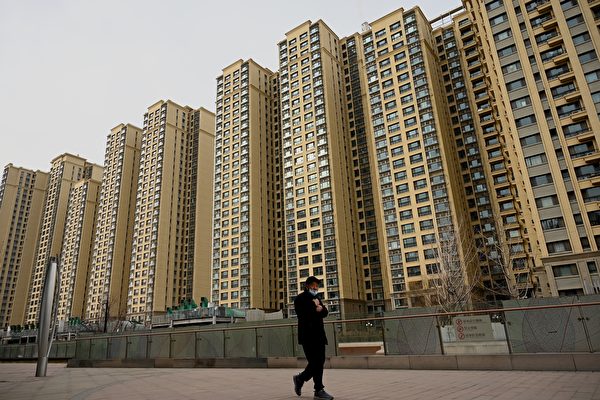
In ongoing efforts to combat the persisting slump in the Chinese real estate market, the Communist authorities have been implementing a series of measures from the central government to local levels, with minimal results. On Monday, November 18th, Shanghai and Beijing both announced the cancellation of standard classifications for regular and non-regular housing, sparking heated discussions online.
Late on November 18th, the Beijing Municipal Housing and Urban-Rural Development Commission, Municipal Finance Bureau, and Beijing Municipal Taxation Bureau jointly issued a notice regarding the cancellation of standard classifications for regular and non-regular housing, effective from December 1st.
According to the notice, individuals who sell housing to the public that has been owned for over 2 years (including 2 years) will be exempt from value-added tax. For housing owned for less than 2 years, a 5% tax rate will be applied for the full amount of value-added tax payable.
Regarding individual housing purchase deed taxes, Beijing will apply the national unified preferential policy for individual housing purchase deed taxes. For individuals purchasing a sole family residence (including the buyer, spouse, and minor children) with an area of 140 square meters or less, deed taxes will be levied at a reduced rate of 1%; for areas exceeding 140 square meters, the reduced rate will be 1.5%. For individuals purchasing a second family residence with an area of 140 square meters or less, deed taxes will be levied at a reduced rate of 1%; for areas exceeding 140 square meters, the reduced rate will be 2%.
On the morning of the 18th, four departments in Shanghai, including the Municipal Housing Commission, Housing Management Bureau, Finance Bureau, and Taxation Bureau, jointly issued a similar notice, to be implemented from December 1st.
The concurrent announcements from Beijing and Shanghai to cancel standard classifications for regular and non-regular housing on the same day has stirred up discussions online.
A fund blogger and influential Weibo user “CentipedeChild” explained in a post: “To put it simply: the cancellation of standard classifications for regular and non-regular housing means that houses owned for over two years will have tax reductions based on area, stimulating more house purchases and enabling potential buyers to save on taxes, thereby boosting the housing market transactions.”
Netizens commented: “The decreasing number of homebuyers is leading authorities to rely on these minor incentives to attract people, but it seems unlikely.” “Current housing prices keep dropping, despite the cancellation of standard classifications for regular and non-regular housing. Apart from essential needs, there are not many people buying houses.” “Those who can’t afford it still can’t afford it; the wealth gap is too significant, not everyone has their own house.” “Even with a 1% tax, the difference is still 99% of the house payment.” “Those buying houses above 140 square meters should not be affected much by these tax fees, right?”
In late September, the Communist authorities introduced more robust real estate support policies, but the market has yet to stabilize its decline.
On November 13th, an article by Tang Ya, former associate professor of the Finance Department at Peking University’s Guanghua School of Management, on the financial media “Xiangshuai’s Financial World,” revealed that according to data from the Ministry of Housing and Urban-Rural Development, the national net signed transaction volume of newly built commercial housing in October increased by 0.9% year-on-year, the first positive growth since June 2023. However, the October rebound was not sustained; by the first week of November 10th, the national statistics show a 31.42% decrease in commercial housing transaction volume in 30 cities compared to the same period last month.
More importantly, the prices of pre-owned houses are still falling, with the increased transaction volume in October equivalent to “price-for-volume” transactions. According to a report from the China Index Research Institute, the average price of pre-owned houses in 100 cities dropped by 0.60% month-on-month, declining for 30 consecutive months with a year-on-year decrease of 7.27%.
The article pointed out that the life or death of real estate enterprises remains unresolved, putting immense pressure on the entire market. In October, investment by 30 housing enterprises decreased by 25% month-on-month and 74% year-on-year, reflecting a 27% larger decline compared to September. Enterprise confidence remains extremely low, and there is still tight cash flow. State-owned enterprises, national enterprises, and city investment companies continue to be the main players in land acquisition.