
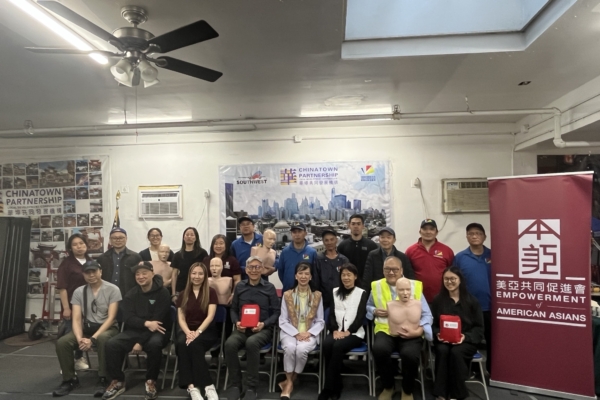
In order to enhance the community’s ability to respond to emergencies, the Manhattan Chinatown Business Improvement District (Chinatown BID) and the Asian American Association jointly organized a CPR training workshop on May 1st. Professional instructors were on site to explain key points such as first aid assessment, chest compressions, mouth-to-mouth resuscitation, and airway obstruction handling, assisting participants in mastering life-saving skills that can be crucial in emergency situations.
CPR is applicable when a patient shows signs of “unresponsiveness, no breathing, no pulse,” serving as the last line of defense in maintaining vital signs. While chest compressions may potentially cause rib injuries, at a critical moment, maintaining blood circulation and making use of the golden time before emergency personnel arrive are more important than potential harm.
The course first emphasizes on-site assessment principles. If the patient can still speak or call for help, CPR may not be immediately necessary; if the individual becomes unresponsive, rescuers should quickly check for breathing and a pulse, and immediately call 911. In situations with multiple bystanders, it is advised to designate one person to make the emergency call to avoid delay in rescue efforts. If only one person is present, they can put the call on speakerphone, following instructions from the 911 operator while simultaneously administering first aid.
In practical terms, chest compressions should be performed with both hands placed at the center of the chest, approximately at the midpoint between the nipples, with elbows straight, using the weight of the upper body to press downwards about two inches deep, maintaining a frequency of 100 to 120 compressions per minute. The standard procedure involves 30 compressions followed by 2 breaths, forming a cycle that should be continued, regularly checking the patient’s response until emergency personnel take over. If the rescuer is unable or unwilling to perform mouth-to-mouth resuscitation, continuous chest compressions should be prioritized to avoid prolonged interruption of blood circulation.
The instructor also explained that the first aid techniques vary for adults, children, and infants, and the actual procedures should be adjusted according to age, body size, and the situation at hand. Before administering mouth-to-mouth resuscitation, ensure to tilt the head to open the airway and observe chest movement while blowing air. If there is no noticeable response in the chest, there may be an airway obstruction, requiring a prompt return to chest compressions.
During the training session, a Chinese participant named Ethan shared his personal experience as a former lifeguard. He recalled rescuing a man in his forties who had lost consciousness in the water and sank to the bottom of a pool in New Jersey.
“We immediately coordinated our efforts – someone called 911, others assisted on-site, and I performed CPR on him.” Ethan expressed that due to the patient’s large build, pulling him out of the water was extremely challenging, but the team did not give up, continuing compressions and first aid until emergency response arrived. The man regained consciousness after being taken to the hospital and returned to the site a week later to thank the rescuers.
“That moment was very meaningful, making me truly understand the value of first aid skills.” Ethan stated that this experience also led to him being awarded a civic honor by the local community, deeply realizing that stepping up in emergencies can save a life.
In addition to CPR, professionals also explained the handling of airway obstructions and demonstrated the Heimlich maneuver. The instructor cautioned that in older adults, frequent coughing while eating could indicate a decline in swallowing function, requiring special attention to high-risk foods such as dumplings, rice balls, pearls, and grapes.
The organizers mentioned that while the success rate of CPR may be limited, it is far better than no intervention at all. The aim of this event was to raise awareness of self-help and mutual aid in the Chinatown community through practical training, enabling more residents to make calm judgments and take immediate action in critical moments to secure vital time for saving lives. The event was sponsored by the New York Presbyterian Hospital and Paco Charitable Foundation.