
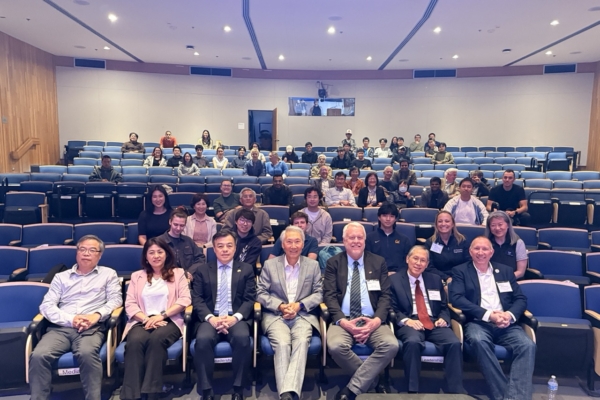
On April 24th, the College of Engineering at the University of California, Berkeley, in collaboration with the Taipei Economic and Cultural Office in San Francisco (TECO), hosted a screening and panel discussion of the documentary “A Chip Odyssey,” attracting over a hundred academics, industry professionals, and students.
The film focuses on the semiconductor industry in Taiwan, weaving together memories of industry insiders to explore its background and evolution from various perspectives. Through the portrayal of individuals and historical context, the documentary outlines the overall trajectory of Taiwan’s semiconductor industry, showcasing its gradual development under different conditions.
Before the film screening, Clark Nguyen, the Executive Associate Dean of the College of Engineering at Berkeley, and semiconductor expert Hu Zhengming, answered questions from the media. The university stated that besides showcasing the film, the event aimed to spark further discussions on the development of the semiconductor industry, its impact on education, and international collaboration.
Mark Asta, Dean of the College of Engineering, emphasized the importance of global cooperation in engineering education and research in his opening speech. Berkeley has maintained close academic and industry interactions with Taiwan, particularly in the semiconductor field.
He noted that with the rapid advancement of artificial intelligence, one of the core technologies behind it is semiconductors, which continue to innovate and impact various aspects of society.
Director of the Taipei Economic and Cultural Office in San Francisco, Wu Zhixiang, highlighted how semiconductors have become a significant force influencing global technology and economy. He mentioned that Taiwan and the United States have long maintained exchanges in technology and education, fostering mutual understanding and interaction through activities like this.
In an interview with Epoch Times after the event, Director Wu stated that the development of Taiwan’s semiconductor industry has elevated its position and influence in the global technology sector.
He pointed out that Taiwan’s accumulated engineering culture and industrial discipline are crucial factors driving industry growth. He expressed the desire to continue sharing technology and experiences internationally; while Silicon Valley focuses on innovation and design, Taiwan plays a critical role in manufacturing, forming a complementary relationship in the global division of labor.
Olivia Kuo, the Executive Director of the GLOBE International Project, served as the host for the event and spoke on behalf of the director, Hsiao Chucheng, who is currently promoting the film globally. The documentary took five years to produce, incorporating numerous interviews and data to outline the fifty-year development journey of Taiwan’s semiconductor industry. Kuo thanked the audience for attending and hoped that everyone would enjoy the film.
Following the screening, a panel discussion was held, moderated by Clark Nguyen, the Executive Associate Dean of the College of Engineering at Berkeley, featuring semiconductor expert Hu Zhengming. They engaged with the audience’s questions. Participants expressed that the event not only provided an opportunity for viewing but also allowed for discussions and exchanges that enabled individuals from different backgrounds to understand the development context of the semiconductor industry from multiple perspectives, while also focusing on its impact on technology and society. ◇