
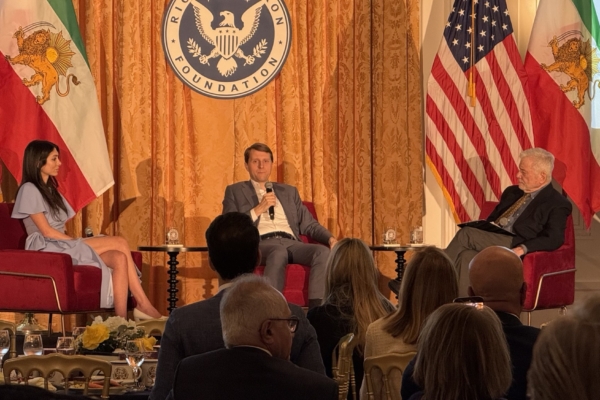
At the “Iran: At the Crossroads of History” seminar at the Nixon Library on April 22, two special guests graced the event – Princess Noir Pahlavi, granddaughter of Iran’s King Mohammad Reza Pahlavi, and Christopher Nixon Cox, grandson of President Richard Nixon.
Cox is the founder and CEO of the private equity and venture capital firm Lightswitch Capital, and also serves on the board of the Nixon Foundation. Princess Noir holds a bachelor’s degree from Georgetown University and a master’s degree from Columbia Business School. She and her father are advocating for the “Iran Prosperity Plan” to achieve peaceful transition and national reconstruction, aiming to establish a free, democratic, and rule of law Iran.
Prior to Princess Noir, the Nixon Library had hosted the previous two generations of the Pahlavi family – Princess Noir’s grandmother Empress Farah Pahlavi and her father Crown Prince Reza Pahlavi. The panel discussion was moderated by former Nixon presidential aide and editor of the “Nixon Memoirs” Frank Gannon, and received enthusiastic responses from the audience.
“For our family, there has never been a question of whether we should dedicate ourselves to a cause greater than ‘self’,” Princess Noir said, emphasizing the values of progress, patriotism, and striving for the prosperity of the nation that she has understood from her family’s heritage.
She mentioned the prevalence of misinformation and misunderstandings surrounding the Pahlavi family, and how social media has bridged a direct and authentic connection between them and the people of Iran. She emphasized the people’s desire for their voices to be heard, regardless of their experiences or beliefs.
“We have no doubt about standing up,” Princess Noir expressed her commitment to fulfilling her mission with humility, hoping to honor her grandfather’s legacy by engaging in projects that promote Iran’s prosperity and contribute to its reconstruction effectively and swiftly.
Cox recounted his early familiarity with the Shah of Iran’s Pahlavi family, highlighting the deep connection between his family and the Iranian Shah. He emphasized the importance of a free, prosperous, and Western-friendly Iran in the Middle East for global peace and stability.
Reflecting on the 1953 coup in Iran, Cox remarked on the prevailing notions about Iran in public perception, acknowledging the turbulent history but also praising the Iranian people for their resilience and hospitality as he recalled experiences with Iranian friends during his school days.
Gannon recounted Vice President Nixon’s visit to Iran approximately 115 days after the Mossadegh coup on August 19, 1953, building a strong friendship with King Mohammad Reza Pahlavi that lasted for decades.
Discussing the events of the coup, Cox highlighted the context at the time, refuting claims of CIA intervention and emphasizing the internal turmoil in Iranian society, which led to a series of protests against the regime of Prime Minister Mohammad Mossadegh.
After Mohammad Reza Pahlavi ascended to the throne in 1941, Iran led in various fields such as fashion, arts, medicine, education, and economy in the Middle East until the Islamic Revolution led by Ayatollah Khomeini overthrew the Shah’s regime in 1979.
Nixon ended the Vietnam War, initiated relations with China and the Soviet Union, and during his second term, established the U.S. as Israel’s strongest ally in the Middle East while cultivating good relations with Arab countries. Iran under the Shah became a “pillar of stability” in the region.
Princess Noir shared her grandmother’s insights on her grandfather’s mission to modernize Iran while preserving its culture and traditions. She expressed gratitude towards President Nixon for his unwavering friendship when many turned away from their family after the revolution.
Cox affirmed the enduring friendship between the Shah and his grandfather during challenging times, emphasizing their loyalty and support for each other despite political currents.
Recalling his family’s personal connection with the Shah, Cox lamented the consequences of deviating from a path that could have made Iran a model in the Middle East, attributing the current situation to a grave strategic error made by the U.S.
Princess Noir added that her father found strength and resilience from President Nixon during difficult times following her grandfather’s passing, emphasizing the importance of loyalty and support in friendships.
In February of this year, the U.S. and Israel launched the “Epic Wrath Operation” against the Iranian regime of Ayatollah Khamenei. Princess Noir condemned any support to the regime and emphasized the Iranian people’s yearning for freedom and development as essential to their prosperity.
The most precious resource in Iran, she noted, is its people, who deserve opportunities for prosperity and development. The continued resistance and sacrifices for freedom by the Iranian people demonstrate their unwavering commitment to a better future.