
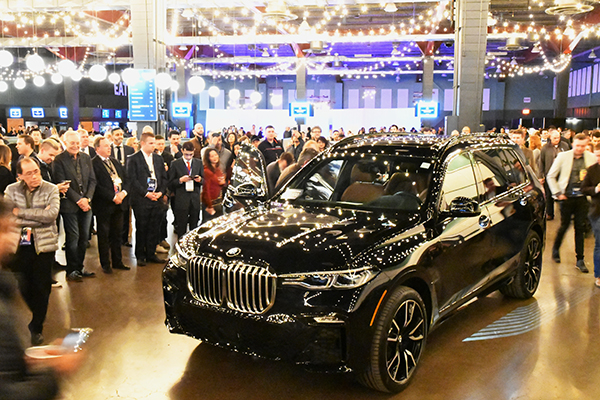
German Automotive Industry Association (VDA) Chairman Hildegard Mueller pointed out on Saturday at the Beijing Auto Show that as the Chinese economy continues to weaken, German car manufacturers are facing an unprecedented survival challenge. The market conditions that used to support the dominance of German brands have completely changed.
Mueller told Reuters, “The competition in the Chinese market is the most intense globally.” She emphasized that despite German manufacturers launching several technologically advanced new models at the expo, they must accept the fact that their historically high market share is irretrievable.
Currently, the Chinese economy is facing deep structural crises. With the real estate market in a prolonged slump, high youth unemployment, and severe lack of domestic demand, Chinese consumer confidence has plummeted. Mueller bluntly stated, “China is in an economic crisis, with many people having to tighten their belts. This is evident in car sales, especially in the luxury car segment where German brands had previously dominated.”
Meanwhile, Chinese domestic car manufacturers, supported by government subsidies, have engaged in a brutal “price war.” Brands like Geely and NIO have introduced new electric vehicles at the expo with richer features and far lower prices compared to Mercedes-Benz and BMW. Analysis by AlixPartners and others indicates that this expansion strategy essentially leads to “overcapacity” being shifted, causing the industry to fall into vicious “mutual destruction” competition.
Analysts, including Daiwa Capital Markets, predict that with diminishing subsidy effects, over 80% of the hundreds of Chinese electric car companies will face bankruptcy or acquisition in the coming years, leaving only a few supported by the state.
Under extreme competition and geopolitical risks, the automotive industry, like many others, is witnessing a trend of “exiting China.” Volkswagen has closed some of its aging fuel car production lines in China, and Mitsubishi has officially announced its exit from production in China. Key suppliers like Continental have begun downsizing positions in China, shifting production to Mexico or Thailand to focus on the more stable North American market.
Companies like Honda are restructuring their supply chains, relocating core development for global markets back to Japan to reduce dependence on the Chinese supply chain.
Data shows that the era of German car manufacturers heavily relying on China for profits has ended. Porsche saw a 24% sales plunge in China in the first quarter of this year, directly impacting global profits, while Mercedes-Benz’s profit margin in China also significantly shrank due to being dragged into the price war.
As Mueller mentioned, patriotic sentiment has become an invisible barrier for foreign car companies. Analysts point out that the Chinese authorities deliberately stimulate nationalist sentiments, aiming to convert consumers’ “brand loyalty” into “political loyalty.” By promoting local brands as “technologically advanced” through state media, the core goal is to use nationalistic feelings to protect subsidized local industries during economic downturns and squeeze foreign entities out of critical profit areas, achieving “local production substitution.”
For German automotive giants, navigating through the competition of China’s economic “cold winter” and politically driven environment to minimize losses has become a more urgent issue than expanding in the market.