
According to the latest research model, the economic losses suffered by Iran since the launch of “Operation Epic Fury” in the United States have reached $144 billion, equivalent to 40% of Iran’s pre-war Gross Domestic Product (GDP). This data was released by the Foundation for Defense of Democracies (FDD), showing that the ongoing military conflict and maritime blockades have inflicted significant financial blows on the Iranian regime.
In the total estimate of $144 billion in “most likely losses”, it includes around $53 billion in loss of oil and gas revenue, as well as up to $91 billion in physical infrastructure reconstruction costs.
Among these, the losses in military and strategic assets amount to approximately $46 billion, representing roughly half of the total physical infrastructure losses, equivalent to 4 to 6 years of Iran’s pre-war defense budget. These losses include nuclear facilities, missile and drone production infrastructure, air force bases, naval vessels, and air defense systems.
The report points out, “This may underestimate the actual losses. The lifespan of most military equipment is measured in decades, and rebuilding Iran’s nuclear program, missile production infrastructure, and naval fleet not only requires significant financial resources but also time, technical expertise, and supply chains; all of which the U.S. sanctions have severely restricted.”
FDD states that in the evaluation model, Iran’s total losses range between $50 billion to $300 billion, with the most likely estimate being approximately $144 billion.
“Such a wide range of estimates partly reflects the difficulty in calculating the economic costs of an ongoing conflict and the unique challenges that Iran presents,” FDD stated.
The think tank mentioned that due to facing long-term international sanctions, even during peacetime, Iran conducts transactions through opaque intermediaries, making independent verification difficult. Iran’s significant informal economy, accounting for 30% of all economic activities, coupled with wartime information blockades, further complicates independent damage assessment.
FDD emphasizes that the $144 billion figure is still subject to change. Prolonged blockades and the composite costs of rebuilding under sanctions will likely raise this number.
It’s worth noting that this data is actually a rather conservative estimate. FDD notes that the model only calculates the “loss of oil and gas revenue” and “physical infrastructure reconstruction costs,” excluding temporarily five “difficult-to-quantify” hidden costs.
Experts from the think tank stated, “The model deliberately excludes some significant losses, including loss of human capital, the cost of rebuilding Iran’s agent networks in the region, impediments to long-term foreign direct investment, wartime inflation, and reconstruction financing costs.”
“These losses, although real and substantial, are currently challenging to quantitatively measure,” the experts wrote.
Before the publication of this report, Alex Vatanka, a senior research fellow at the Middle East Institute (MEI) in Washington, analyzed in a report last Friday that each additional month of war could set back the Iranian economy by five years.
Vatanka pointed out that Iran entered this war after years of economic pressure.
“Sanctions, isolation, and structural weaknesses have long created a fragile economic system characterized by inflation, currency instability, and limited growth—all of which have been further exacerbated by this war,” Vatanka said in the report.
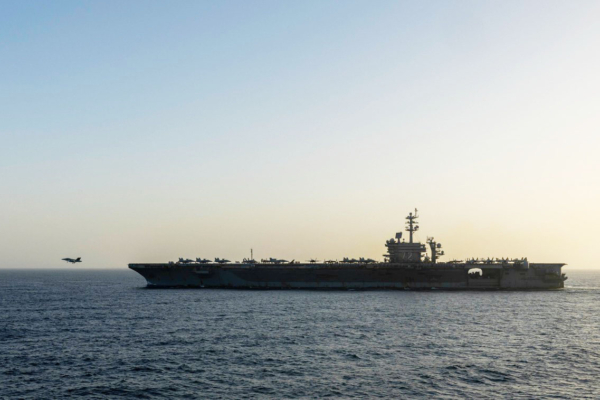
Since the U.S. Navy implemented the blockade on April 13, Iran’s export capabilities have been severely impacted. The U.S. Central Command (CENTCOM) stated that as of April 23, they had directed 33 Iranian-related vessels to return and intercepted several sanctioned oil tankers carrying millions of barrels of crude oil violating the blockade in the Indian Ocean, including the “Majestic X” and “Dorena.”
Despite Iran’s attempts to circumvent through methods like closing their Automatic Identification System (AIS), the blockade actions remain highly effective.
The economic pressure has also triggered severe internal unrest within the Iranian leadership. Iranian President Masoud Pezeshkian stated that Iran needs financial benefits from negotiations, including lifting the maritime blockade, easing sanctions, unfreezing overseas assets to pay for the massive war losses. However, hardliners led by Revolutionary Guards (IRGC) general Ahmad Vahidi prioritize ideological purity over national livelihood, ignoring the economic impact.
Despite facing immense pressure, Vatanka noted that Iran can still export energy through land borders or the Caspian Sea, routes outside the current U.S. blockade scope. Therefore, whether China continues to purchase Iranian oil will impact the ultimate effectiveness of the blockade policy.