
In the early mornings of Flushing Bayside Town, Ms. Claire Guo, who lives there, gets up early, gets ready, and then takes the 44 bus for half an hour to Aunt Niu’s house to work.
At that time, Claire had just arrived in the United States, her daughter was in college, and she needed this job of living with clients for 24 hours, earning 13 hours of pay each day.
At the client’s house, Claire prepares three meals, and also prepares fruits for Aunt Niu in the morning and afternoon. Since Aunt Niu is not well and is in pain constantly, Claire helps her get up, walk, go to the bathroom dozens of times a day, and even has to get up several times at night.
After working for three days and nights in a row, on the fourth morning, Claire packs up her stuff, takes the 44 bus back home. Despite the exhaustion, earning money with her own hands makes her feel secure.
Claire is one of the over 150,000 Home Care Aides (HCA) in New York City. According to the New York City Council statistics, in 2023, there were over 147,000 home health care workers in New York City; according to the city comptroller’s statistics, when including other related nursing positions, this labor force exceeds 250,000 people; and about 10% of them need to work for 24 hours.
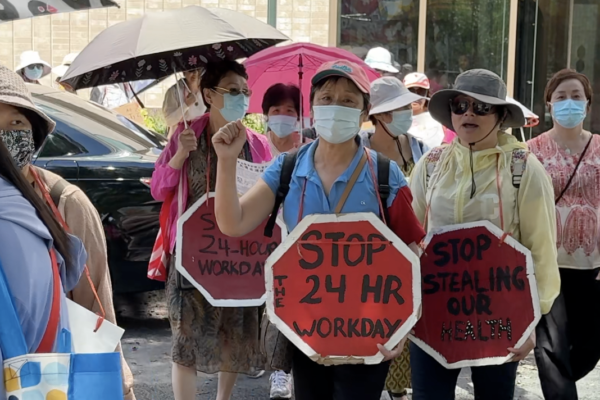
Recently, the New York City Council has been debating a Home Care Aide reform bill, known as the Intro.303 proposed by Chinese-American Councilman Ma Tai, also known as the “Abolish the 24-Hour Work System Act.”
The proposal advocates for setting a maximum 12-hour limit on the working hours of home health care workers, thus prohibiting any caregivers from working 24-hour shifts; allowing a maximum of 56 hours per week; whether employed by a Home Care Service Agency (LHCSA) or through the CDPAP model provided by the New York State Medicaid program. These are the two main paths that New York state provides home care workers for those in need of care.
The process for individual New York City residents to receive home care services begins with an independent medical assessment, previously conducted by the healthcare provider of the Medicaid beneficiary, the local government (in New York City, managed by the Human Resources Administration, HRA), or a managed care Medicaid plan. However, since 2022, all assessments have been handled by the contractor Maximus company of the New York State Department of Health.
“My mother used to be a home care worker, she had to work 24-hour shifts, so I know how much physical and mental pain this job brought her, it’s just inhumane,” Councilman Ma Tai said to the Epoch Times recently, “In any other industry, no one would require you to work for 24 hours and only get paid for 13 hours, this is unheard of. But this does happen in this group because most of them are immigrant women of color, we must consider this.”
Indeed, the composition of New York City home care workers is as stated. According to statistics from the City Council’s “Committee on Civil Service and Labor” in January 2026, 59% of home care workers are people of color and 86% are women.
The rule of “working 24 hours to earn 13 hours of pay” stems from an interpretation of state law confirmed by the New York State Appellate Division in 2019. This interpretation allows the Department of Labor to deduct 8 hours of sleep and 3 hours of mealtime from the 24-hour paid working hours of caregivers, provided that the caregiver has 5 hours of uninterrupted sleep and 3 hours of uninterrupted mealtime.
The court considered that even if caregivers are at the client’s home, as long as they are in a resting state during mealtime or sleep, they are considered “not working,” and therefore should not include these uninterrupted rest periods in the calculation of working hours. However, some caregivers and advocacy groups reject this interpretation. “If they don’t consider us working, why do we have to stay at the client’s house? I see it as exploitation,” a New York home care worker Liu said.
However, the regulation states that if a caregiver’s sleep or meal break is interrupted, the home care provider has the right to include the actual working time in the hours.
When staff is plentiful, insurance companies and financial intermediary institutions may suggest adopting a split-shift nursing model, where two caregivers take turns covering two 12-hour shifts. However, due to staff shortages, this split-shift model is not always feasible.
In fact, the movement to end the 24-hour work system for home care workers has been going on for 10 years. Four years ago, Ma Tai first proposed the Intro.175 bill to abolish the 24-hour work system for home care workers, and a legislative hearing was held in June of that year, but it was not passed. On February 19th this year, the new Speaker Manning held a public hearing for Ma Tai’s reintroduced 303 bill.
At the hearing, many Chinese home care workers, along with New York City home care workers, testified, using their own experiences to illustrate the physical and mental pain caused by the 24-hour work system.
In addition to the obvious inhumanity and allegations of wage theft, at the hearing on February 18th, Korean-American State Assemblyman Kim Deok-Sik also mentioned the depth of the industry, specifically the collaboration between insurance companies and home care employers.
“When you use a per capita payment formula, assigning an amount for each client, the profit of insurance companies relies on reducing prices and delaying payments,” Kim Deok-Sik said. “If you split the 24-hour shift (into two shifts), it means insurance companies have to pay two 12-hour wages; but when they convince the employer to adopt a ’24-hour work system,’ then the employer has to figure out how to pay overtime, not the insurance company’s concern.”
In other words, the 12-hour shift requires insurance companies to pay for two people (24 hours), while the 24-hour work system only requires paying for 13 hours. Therefore, Kim Deok-Sik concludes, “This is an exploitative system based on exploiting workers.”
However, there are as many voices opposed to this bill as there are in support. The reason why the 2022 bill did not pass is due to the opposition of the former Speaker Odessa. Her reason was, “This is a state matter, not something New York City can solve” – this bill requires a large amount of funding support behind it.
The opposition also includes many elderly and disabled care recipients, nursing companies, numerous unions representing caregivers, and many city council members. Their main concerns include: the shortage of caregiver resources, ending the 24-hour work system will make caregivers even more scarce; many caregivers who want to earn more do not mind longer working hours; in addition, there are legal contradictions: if city law limits working hours, it contradicts state law; and most importantly: where will the huge funds come from to provide 24-hour home care services, previously provided with funds for only 13 hours of pay? If the funding is insufficient, patients are worried about being pushed to nursing homes where they do not want to go.
The 1199SEIU union, which represents 50,000 home care workers, stated in written testimony that according to cost report data from 2019, nearly 18,000 individuals in New York City receive home care under the Medicaid program, accumulating service days of up to 2.1 million days; based on the anticipated reimbursement rate in 2022, this would require an additional investment of approximately $645 million in the Medicaid program.
The union said, “Without funding, the majority of for-profit nursing companies or management organizations will have a strong economic incentive to abandon the most needy consumers and transfer them to nursing homes paid for by Medicaid managed care.”
The most moderate position from opponents is that the language of this bill needs modification.
Chinese-American Councilwoman Huang Minyi stated in 2022 that dividing 24 hours into two shifts would require hundreds of millions of dollars in Medicaid funding annually, “this money needs to come from Albany.” Recently, a staffer for Councilwoman Huang told this paper that they support caregiver rights and are currently monitoring the progress of this bill.
“From what we understand, the bill’s proposer has been working with the Speaker’s office, the legal team, and SEIU 1199 union to study this bill,” said Calvin Ko, Chief of Staff for Councilwoman Huang, “So we are currently waiting for the final proposal to be released, we do not have a clear position of support or opposition at this time, because we are waiting for the final proposal.”
Chinese home care worker Claire in Flushing has been doing this job for 12 years. Although the job of caring for Aunt Niu is very tiring, it helped her stabilize her footing in the United States when she first arrived, supporting her daughter’s education, so she is grateful.
Claire stated that the merits of working 24 hours depend on the client, some elderly ladies are quiet, allowing her to sleep well at night; some are restless, waking up several times a night. “But no matter what, I need this job, it’s much better than being unemployed without work,” Claire said.
Claire mentioned that home care work is very valuable for newcomers like herself, “abolishing the 24-hour work system” is too “idealistic,” at least it doesn’t matter to her. “Although council members are on our side, I think they are too idealistic, it’s difficult to achieve in reality; they should see that this job is what we need, there is a market, there is demand,” Claire said. “I want to say to my colleagues who say this job is too tiring: you don’t have to work 24 hours! Many caregivers I know don’t do this kind of work, but I need it. The company gave me a job when I was unemployed, although tiring, it’s better than nothing, at least I can make a living.”
With a bachelor’s degree and a sales job in her home country, Claire advocates that the supply and demand dynamics of the labor market, wages, should be coordinated by the market.
“This is the thing: a good job is of course good, but if there is no better option, working 24 hours to earn 13 hours of pay isn’t bad either,” Claire said. For her, the difficult days are behind her, and she has found a 12-hour nursing job now. “The government wants to protect our interests, sometimes they regulate too much. In fact, no industry can be absolutely fair, anyway I am satisfied.”
The city council stated that due to the aging population, by 2035, 1 million people in New York City will need home care services, and the gap in home health care and personal care workers may reach between 80,000 to 240,000 people.
Ma Tai said that although this bill has not become law yet, their efforts have been effective: the 12-hour work system is being implemented everywhere in New York State except New York City.
Ma Tai said, “Special interest groups such as health insurance companies and the funders of this industry have a significant influence on elected officials,” which is a block to this bill. However, he has confidence in Speaker Manning.
“I am optimistic that under the leadership of the new Speaker, the situation will be very different,” Ma Tai said, “Perhaps we can vote on this by the end of the month.”