
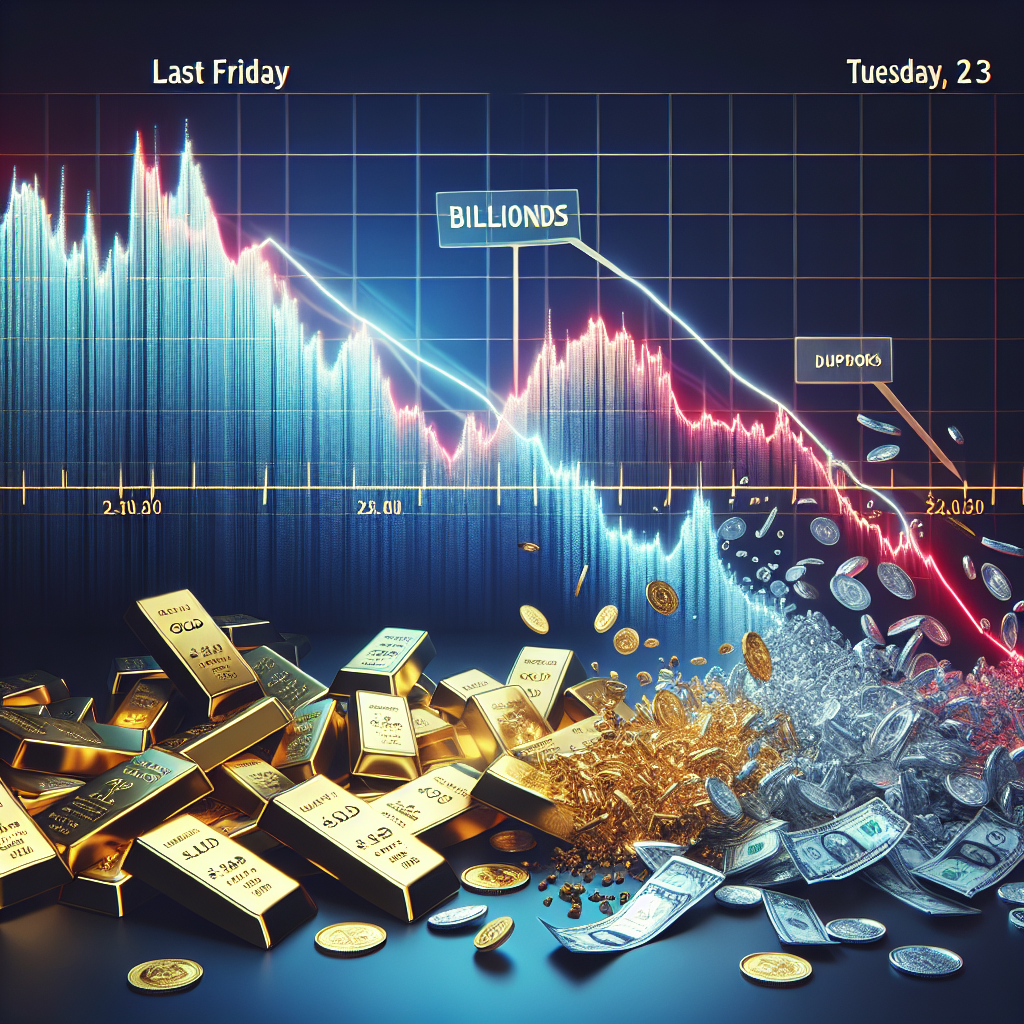
In the past few days, the price of gold has experienced staggering fluctuations. Last Friday, a statement by President Trump caused gold and silver prices to plummet, with market value evaporating by billions of dollars, catching investors off guard. However, on Tuesday (February 3), both gold and silver prices rebounded.
For over a year, concerns about tariffs, a weakening dollar, and heavy government debt burdens worldwide have led investors to seek safer channels for their funds, resulting in a continuous rise in gold and silver prices. Last month, the prices of gold and silver soared, doubling within a 12-month period.
However, last week, this upward trend came to an abrupt end as gold prices dropped from nearly $5600 to less than $4500 on Monday. Just on Friday (January 30) alone, silver prices plummeted by 31.4%.
On Tuesday, the price of gold rose by 6.1%, closing at $4935 per ounce, marking the latest round of volatility since the sudden halt of the previous upward trend last week. Silver prices saw even more dramatic fluctuations, rising by 8.2%.
Last Friday morning, after President Trump nominated Kevin Warsh as the Fed Chairman, the dizzying upward trend of gold and silver came to a halt. The US dollar exchange rate surged to its highest level in months, reshaping market expectations for US currency policy.
According to a report from Fox News on February 3, Warsh is widely seen as a hawkish figure on liberal markets, opposing inflation and differing from much of the current Fed leadership’s viewpoints. Influenced by economist Milton Friedman, he has long believed that inflation is caused by excessive printing of money.
This viewpoint contradicts the Fed’s long-standing policy focus on maintaining low borrowing costs. Warsh, a former member of the seven-person Fed Council, has a track record that suggests the Fed will take a more cautious approach on inflation and monetary policy.
Compared to other Fed Chair candidates, Warsh is less likely to make significant interest rate cuts, which typically drive up metal prices. Warsh’s nomination also led to a stronger US dollar, which usually suppresses gold prices.
Just hours before Trump announced Warsh’s nomination, the prices of gold and silver remained at recent highs. However, as soon as the news broke, gold prices quickly plummeted, marking the most severe sell-off since 2013, while silver saw its largest single-day decline since 1980.
This sudden reversal has left investors uneasy, as they had previously viewed gold as a hedge against inflation and policy uncertainty, considering it a safer option for savings.
Some analysts believe that the expectations of economic stability and a stronger dollar have prompted investors to sell off precious metals. However, many analysts are skeptical of this explanation, suggesting that the price drop merely reflects an overvaluation of prices.
These analysts argue that the sharp decline in gold and silver prices is not solely due to the Warsh event, but a reaction to the rapid increase in precious metal prices in recent weeks. John Stepek, a columnist for Bloomberg’s metals section, indicated that while the Warsh event played a role, the metals prices “rose too quickly and too high, and a rebound from the bottom is just a matter of time”.
“It is more likely that the decline in precious metal prices is merely because prices had skyrocketed the previous week. Once profit-taking begins, the downturn snowballs,” Mark Matthews, Head of Asian Research at BNP Paribas told Al Jazeera.
Joni Teves, an analyst at UBS, stated in a report last week that the price drop is a “correction” and is “beneficial to the market in the long run”.
Christopher Forbes, Head of CMC Markets in Asia and the Middle East, told CNBC that due to the market awaiting more details on Warsh’s policy decisions, the price of gold may continue to fluctuate.
Analysts at Sucden Financial predicted earlier this week that metal prices would experience a “moderate short-term rebound” in the coming days, noting that these metals remain attractive as hedge assets.
Some analysts believe that in the medium to long term, the prices of precious metals will continue to rise.
In a report on Sunday, analysts at JPMorgan Chase stated that they expect gold prices to reach $6300 per ounce by the end of 2026, a 30% increase from the current price. The report emphasized, “Gold remains a dynamic and versatile investment portfolio hedging tool, with investor demand continuing stronger than our previous expectations”.
BNP Paribas’ Matthews told Al Jazeera that once investors perceive market stability, they might increase their purchases of gold and silver. “The two fundamental factors driving the rise in gold prices remain unchanged – the continued devaluation of the US dollar and central banks increasing their gold holdings,” he said.
“The magnitude of the increase in gold prices may not be as significant as before, and that is actually a good thing,” Matthews emphasized.
Analysts at ING predicted that due to several factors including “intensifying geopolitical risks, macroeconomic uncertainties, diverse fund flows, and ongoing central bank purchases”, gold prices will continue to rise.
Deutsche Bank maintained its year-end gold price expectation at $6000 per ounce.