
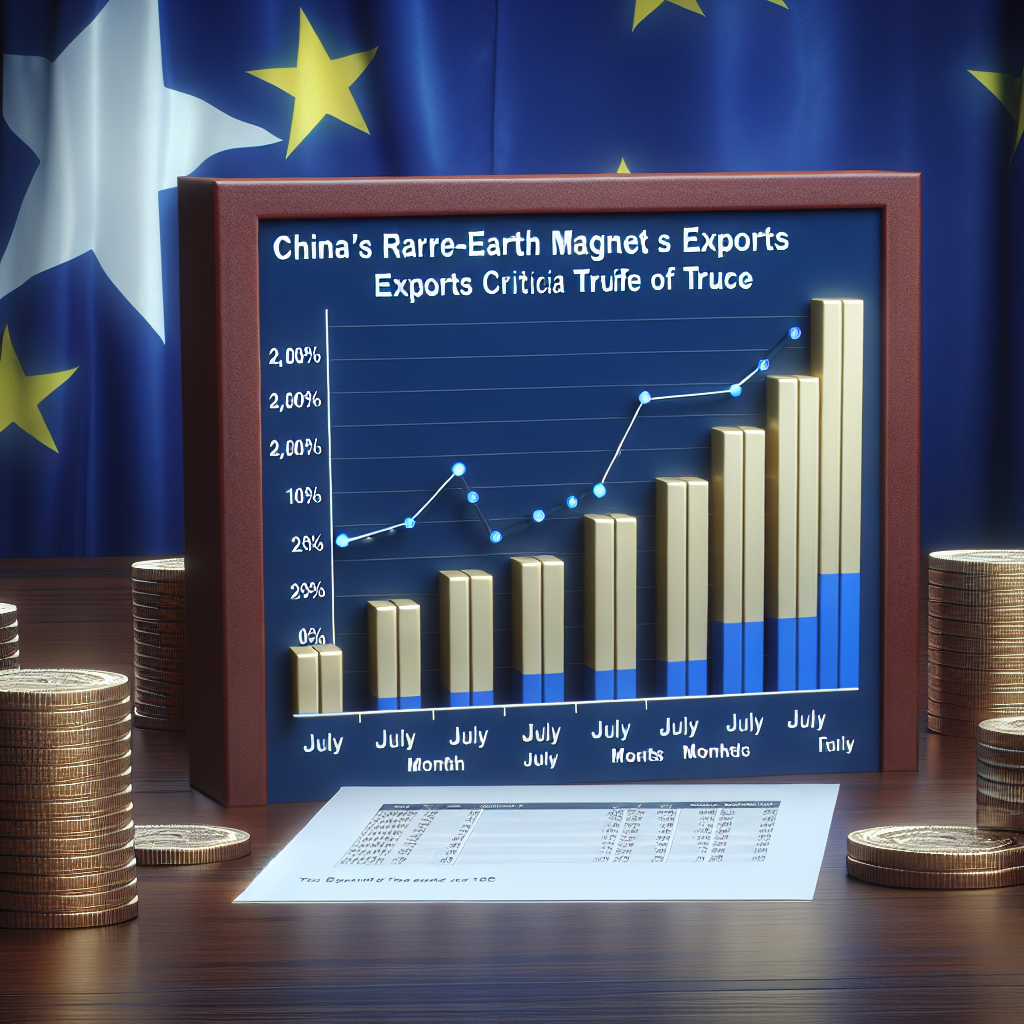
China’s rare-earth magnets exports surged in July, reaching nearly the highest level in almost six months, indicating a gradual recovery in critical mineral supplies following the tariff truce agreement between China and the United States. According to data from the General Administration of Customs of China, the total rare-earth magnets exports in July reached 5,577 tons, marking a second consecutive month of growth and hitting the highest monthly figure since January this year.
Among them, exports to the United States amounted to 619 tons, a sharp increase of 75.5% compared to the previous month and a 4.8% year-on-year growth. Earlier, due to export approval delays, exports to the U.S. dropped to as low as 46 tons in April and May, leading to disruptions in some American manufacturing supply chains.
Following negotiations on May 12 in Geneva, where China pledged to gradually restore the flow of rare earth exports, the two countries met again in London on June 9-10 to discuss related matters. U.S. Trade Representative Jamieson Greer stated in an interview on CBS’ “Face the Nation” earlier this month that the dialogue between the two governments mainly focuses on rare-earth magnets and minerals. The U.S. priority is to ensure the free flow of magnets from China to the United States and that the related supply chains can move freely as they did before the Chinese controls were implemented, stating, “I would say, we have probably achieved about half of our goals at the moment.”
This round of Chinese export controls involves seven of the 17 rare earth elements and magnet products containing restricted materials, affecting the United States and Europe. Despite a significant rebound in U.S. imports, Germany remains the largest buyer, with imports reaching 1,116 tons in July, up by 46% from the previous month.
Overall, China’s rare-earth magnets exports totaled 27,897 tons in the first seven months of this year, with a year-on-year decrease narrowing from nearly 19% in the first half of the year to 15%.
Rare-earth magnets are widely used in electric vehicles, household appliances, and military equipment. Approximately 70% of global rare-earth mining and 90% of refining operations are concentrated in China. During the U.S.-China tariff conflict in April, rare earths were seen by Beijing as the most potent bargaining chip. Their scarcity once forced overseas car manufacturers to halt production and also accelerated the United States’ efforts to establish an independent supply chain.
In July, the U.S. Department of Defense announced a $400 million investment to support domestic rare earth producer MP Materials, signing a supply agreement. Since then, the company’s stock price has risen by over 130%, reflecting the market’s expectations for the U.S. “de-Chinafication” strategy.
Similarly, other regions around the world, including Europe, are also striving to reduce their reliance on imports of rare earths from China. The European Union’s “Critical Raw Materials Initiative” came into effect last year, setting targets to reduce dependence on imported critical raw materials by 2030, covering mining, processing, and recycling sectors.
(This article referenced relevant reports from Reuters and Bloomberg.)