
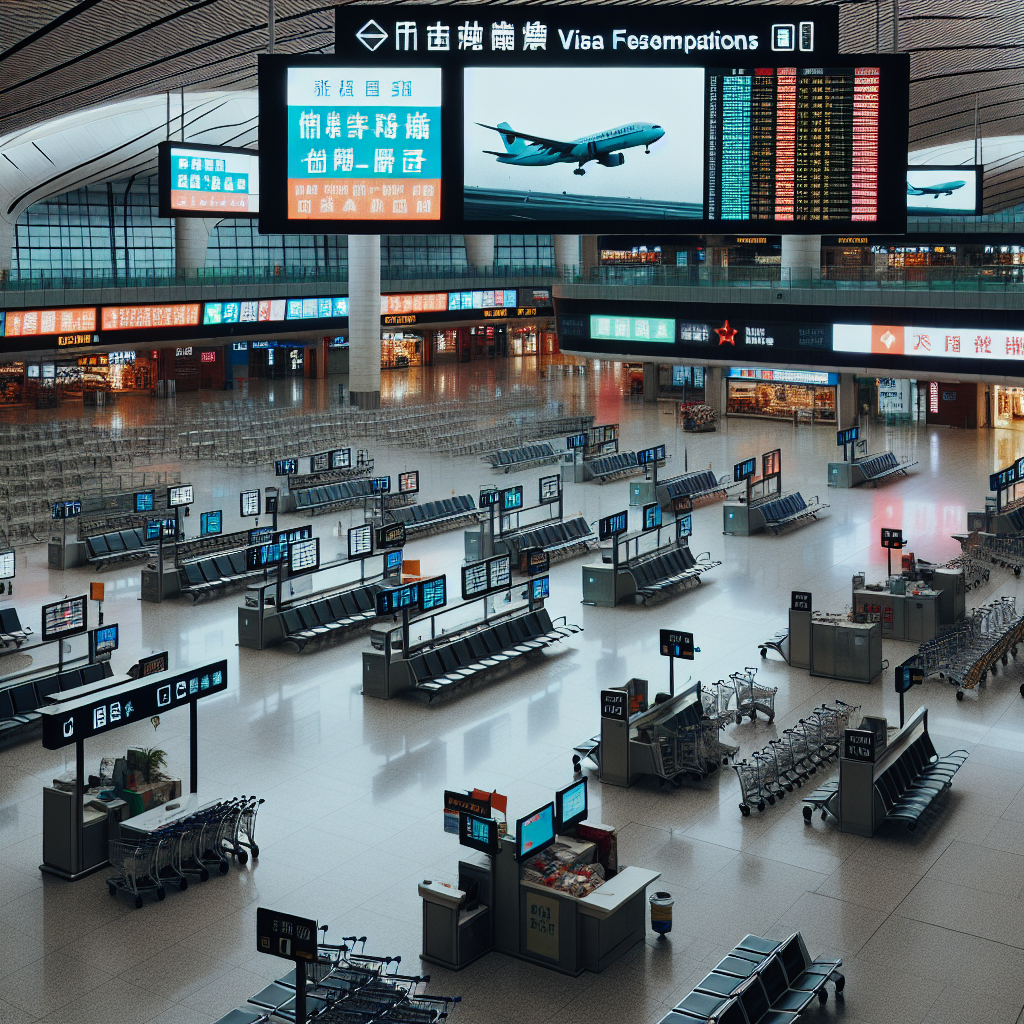
Chinese International Airports Largely Empty Amid Economic Downturn
China’s international airports in various cities appear deserted. On one hand, Chinese consumers are scaling back their spending; on the other hand, despite the Chinese Communist Party unilaterally expanding visa-free policies since last year, the number of foreign tourists has not yet returned to pre-pandemic levels. The Chinese aviation industry is in a slump, with the three major state-owned airlines reporting losses for the fifth consecutive year.
Once bustling Chinese airports now resemble ghost towns. Many bloggers who have personally experienced this situation have expressed shock.
On April 27th, a blogger captured the scene at Shanghai Hongqiao Airport. The once bustling terminal now sits eerily empty.
On April 26th at 2 p.m., another netizen filmed the scene at Shanghai Pudong Airport, showing empty waiting lounges and almost all duty-free shops closed.
One netizen commented, “There were a lot of people at the airport last month, why is it empty now?” Another replied, “This is the international departure area, haven’t you noticed the duty-free shops? Isn’t it normal for there to be few people on international routes? Things have become boring everywhere now. Success in detaching! Close the door and amuse yourself.”
Another netizen filmed a video saying, “It’s so scary, the waiting lounge at Shanghai Pudong Airport, such a large airport, is now so empty, the economic downturn is terrifying!”
On April 24th, the international departure lounge at Xi’an Xianyang International Airport was also deserted.
On April 21st, a blogger filmed a video stating that the current Urumqi Diwopu Airport (Tianshan International Airport) in Xinjiang is extremely deserted, with all shops closed.
On April 11th, a blogger filmed a video saying that the duty-free shop at Beijing Capital Airport was too empty, and it’s unclear why.
Despite the current desolation at international airports in China, the Chinese authorities are still vigorously building new airports.
On April 11th, a netizen filmed the scene at Dalian Zhoushuizi International Airport, showing few passengers. He bluntly stated that in this economic environment, there are not many people at Zhoushuizi International Airport now, and the Dalian authorities are reclaiming land and constructing a new airport (Dalian Jinzhou Bay International Airport) about 18 kilometers away, which is a waste of resources.
In recent years, China’s economy has been on a downward trend, and a nationwide trend of consumer spending downgrade has emerged. Against the backdrop of the US-China trade war, people are cutting back on travel and transportation expenses, with air travel in China facing heightened competition from high-speed rail domestically and geopolitical challenges internationally.
Since 2024, many airlines from various countries have suspended or indefinitely canceled routes to and from China, leading to a wave of flight suspensions. This includes airlines such as Virgin Atlantic, Royal Brunei Airlines, Qantas, LOT Polish Airlines, and Scandinavian Airlines.
Mexican airlines have not resumed flights to China after three years of the pandemic; direct passenger flights between India and China were halted four years ago and have not resumed to this day. Flights between the US and China have only partially resumed since November 2024, when Donald Trump was elected US President, with flight volumes between the US and China not reaching 30% of 2019 levels. The US and China initiated a trade war earlier this year, further impacting business travel between the two countries.
The financial statements of the three major state-owned airlines in China for 2024 show continued losses for the fifth consecutive year.
Air China reported a net loss attributable to shareholders of 230 million yuan in 2024, compared to a loss of 1.04 billion yuan in 2023 and 39 billion yuan in 2022. China Southern Airlines reported a loss of 1.77 billion yuan in 2024, compared to a loss of 4.14 billion yuan in 2023. Eastern Airlines reported a loss of 4.2 billion yuan in 2024, compared to a loss of 8.17 billion yuan in 2023.
Although domestic air capacity in China is higher than in 2019, travel restrictions due to the pandemic were not lifted until early 2023, causing China’s resumption of international flights to lag behind other regions of the world. The global aviation industry returned to profitability in 2023, but China Southern Airlines, Air China, and Eastern Airlines continue to struggle to regain financial balance after the pandemic.
Data from Flight Master and Cirium, aviation schedule analysis companies based in China, show that economic pressures in China and political tensions with other countries have also inhibited international travel, with China’s international air capacity in March 2025 still around 20% lower than the same period in 2019.
Airfare prices in China are gradually returning from historic highs during the pandemic. As a representative of ticket prices, China Southern Airlines saw a 12.7% drop in passenger revenue, while Air China’s revenue decreased by 12.4%. Recent news of “200 yuan capped airfares” and “10% off high-speed rail tickets” have become trending topics.
Leading up to the May Day holiday this year, airlines have been offering special discounts with reductions of up to around 80%.
Flight Master data shows that the average ticket price for domestic business class in China dropped by 12.1% year-on-year to 767 yuan (about 105 US dollars) in 2024, putting pressure on profit margins. According to ForwardKeys data, international airfare prices in China dropped by 32% in 2024 compared to 2023, whereas international airfares in Asia as a whole only dropped by 12%.
Since the lifting of pandemic restrictions in early 2023, foreign visitors have not swiftly returned to China. The Chinese authorities continue to expand the range of unilateral visa-free policies. In November last year, China announced a trial visa-free policy for ordinary passport holders from nine countries, including Bulgaria, Romania, and Japan, extending the stay of ordinary passport holders from 38 visa-free countries from 15 days to 30 days until December 31, 2025.
Despite this, the number of foreign visitors has not yet returned to the pre-pandemic level. According to the latest statistical data from official Chinese institutions, in 2024, the total number of foreign entries and exits was 26.94 million, far lower than the 97.675 million in 2019.
China’s economy has deteriorated over the past two years, and the phenomenon of desolate international airports was evident before the US-China trade war. On March 17th this year, a blogger posted a video stating, “How deserted is Shanghai Pudong International Airport, China’s largest airport? It’s after 7 p.m., which should be the peak of airport traffic. With few international flights, there are very few foreigners. It used to take more than an hour to pass customs, but now it’s done in half an hour, which is unbelievable.”
Flight route approvals for the first quarter of 2025 in China show that traditional popular markets in Europe and the US have seen minimal increases, while regions along the Belt and Road Initiative, such as Russia, the Middle East, Southeast Asia, Africa, and Latin America, have become the focus of new passenger routes.
The reasons for the decline in foreign visitors to China in recent years have sparked discussions, including issues such as the Great Firewall of China preventing many foreign apps from functioning, the disappearance of convenient and affordable accommodation channels like Airbnb in China, and the requirement for foreigners to stay in hotels that accept foreign guests, as well as the registration system demanded by the police. Additionally, the security environment in China has made foreigners feel uneasy, with several malicious incidents targeting foreigners occurring in China last year.
US economist David Huang told the Epoch Times that foreign travelers, especially those from Europe, America, Japan, and South Korea, have become more concerned about China’s security uncertainties, payment barriers (such as WeChat payment thresholds), information censorship, legal opaqueness, and other issues. The international community’s evaluation of China’s human rights and information censorship may continue in the future.