
In recent years, the Chinese economy has been continuously declining, leading to financial strain for local governments of the Chinese Communist Party (CCP) due to a sharp decrease in land sales revenues, impacting various municipal sectors such as sanitation and transportation.
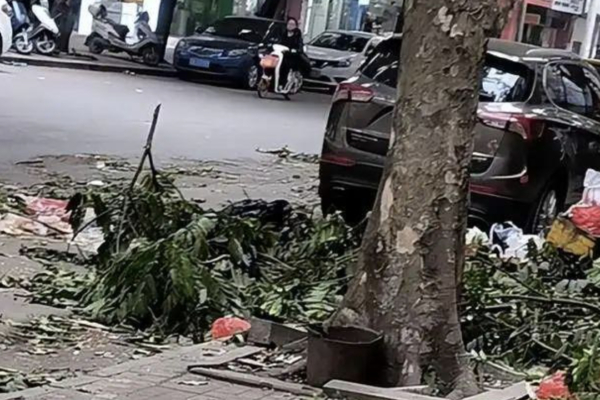
According to reports from Benliu News on December 27th, recently, some netizens posted videos reflecting that sanitation workers in part of Laitang Town, Binyang County, Nanning City, Guangxi Province, went on strike collectively due to unpaid wages from the authorities, resulting in piled up garbage on the streets, affecting the city’s appearance.
In the video, trash including fallen leaves, plastic bags, and foam boxes were seen piled up alongside the road and sidewalks, with some vehicles and electric cars parked among these heaps of garbage.
The video uploader stated that sanitation workers had collectively stopped working for 2 days, resulting in dirty streets. Sources revealed that the scenes were captured on Jindragon Avenue in Laitang Town. The local sanitation workers there earn around 2,000 yuan per month and had stopped working for several days due to unpaid wages for several months.
Information from Laitang Town Environmental Sanitation Management Station indicated that some sanitation workers there had been owed wages for 2 to 3 months. They resorted to collective strikes to express their dissatisfaction. An employee from the station mentioned that the salaries of sanitation workers were not directly paid by the sanitation management station but were allocated by the county’s finance department.
According to a report by Jiangxi TV’s “Urban Scene,” a deputy director of the Laitang Town Environmental Sanitation Management Station in Binyang County, Nanning, confirmed the situation: wages had indeed been overdue for several months as the contracting company had not received payment and thus couldn’t pay the workers.
The deputy director mentioned that currently, they had temporarily persuaded some sanitation workers to come and clean up, including deploying workers from other locations. The workers from the contracting company had not resumed work as of yet. It was further noted that the station has a total of 60-70 sanitation workers, who have not been paid yet, and were only conducting emergency road cleaning for the time being.
A search on the Guangxi government procurement website revealed that in 2022, the government of Binyang County, Laitang Town outsourced urban road cleaning and sanitation services to Guangdong Zhongwang Environmental Technology Co., Ltd.
The outsourcing contract indicated a total contract amount of 16,842,903 yuan for a period of three years with no advance payment. The monthly payment to the contractor was scheduled to be made by the town’s finance department based on the average monthly expenses, with payments to be settled by the 25th of each month based on performance evaluations from the previous month.
Regarding this incident, some netizens commented, “Nowadays, sanitation work is outsourced, with layers of deduction, leading to unpaid wages in the end.” “Sanitation workers earn hard-earned money, which is not much, around 2,000 yuan per month. Being owed wages for several months is extremely shameless.” “Street leaders and party members should take the lead in cleaning before and after work, otherwise, how can a civilized city be achieved as promised?”
In recent years, the CCP’s fiscal revenues have been continuously declining, prompting authorities to issue multiple notices to urge government levels to “tighten their belts” and be prepared to “live frugally,” citing this as a long-term policy direction.
According to data released by the PRC Ministry of Finance on December 27th, by the end of November 2024, the total balance of local government debts nationwide amounted to a staggering 46.5 billion yuan.
Professor Wen Laicheng from the Central University of Finance and Economics previously analyzed to First Finance that Guangxi had set the local government debt-to-GDP ratio warning line at 300%, which may include implicit debts within this debt ratio, falling under the broad local government debt ratio category.
In June of last year, the Guangxi government issued a notice intending to separate local government debts from those of state-owned enterprises, requiring state-owned and state-controlled enterprises to be responsible for their own debts. Local governments were told not to bear the responsibility of repaying debts.