
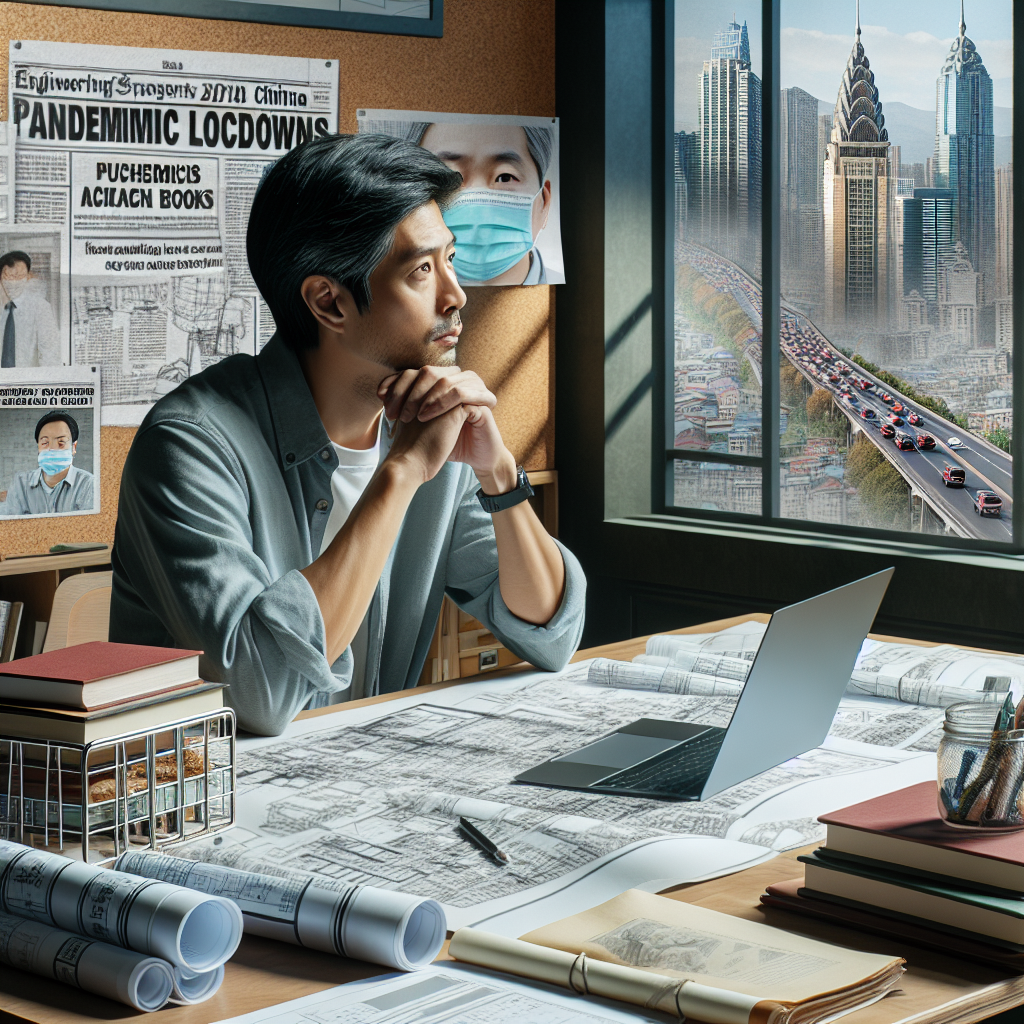
As an engineering manager, Liang Fei has a stable career and job in China, but the combination of pandemic lockdowns, his father’s car accident compensation, and the Chinese Communist Party’s indoctrination of children with hatred pushed him beyond his limits and made him decide to leave China.
Liang Fei’s hometown is in Sichuan, which is not very economically developed. At the age of 22, he left his hometown to seek opportunities elsewhere. He has been working in the elevator industry in China for 20 years, starting from a technical position and working his way up to become an engineering manager and part-time safety officer, reaching a mid-level management position. Both his work and family life were quite good.
“I have always been interested in electrical appliances since I was young, and I chose to major in automation in college. After graduation, I was fortunate to witness the ‘reform and opening up’ era over the past few decades, coinciding with a boom in the real estate market, leading to a peak demand for elevators. It went from nothing to mass adoption, riding the wave of the real estate boom,” he said.
Liang Fei’s mother has been a Christian since he was young, often telling him about the suffering of humanity. Influenced by his mother, he learned to empathize with others. When he was the head of the commissioning department, he treated the 40-plus subordinates as brothers, always lending a helping hand, encouraging and assisting workers.
He also vividly remembers from a young age his mother talking about the persecution faced by people in the church, how they gather in one place today, and another place tomorrow, like being underground. Organizers were arrested, beaten, forced to kneel on long benches and humiliated in front of many believers, making them kneel straight with their backs upright…
Due to his kind nature, Liang Fei found limitations in advancing in his managerial position. In China, whether within the system or within the company, there are kickbacks in engineering, as there is a lot of contracting work, and branch companies want to make some extra money. The engineering manager is the rake that the branch managers use to make money, but Liang Fei felt uncomfortable with this practice.
He explained that elevators in China are considered specialized equipment, belonging to a high-risk industry. Every year there are many safety accidents, such as electrocution, falling from heights, and being crushed to death. “I used to do this job and know the hardship involved. But back then, I was still young. Now there are people in their forties, fifties, sixties installing elevators, and those construction workers also have wives and children to support. Risking their lives to earn money, I can’t bring myself to exploit them further,” he said.
For example, when he was in the Jinan branch company, his annual elevator installation quota was around three to four hundred units, with installation costs per unit approximately thirty to forty thousand yuan. Many people openly offered kickbacks for each unit installed. However, Liang Fei chose installation contractors based on quality, cooperation, and progress. “Many years later, when I visited the project or the customer, the comfort of riding that elevator was excellent,” he said.
On the afternoon of the sixth day of the Chinese New Year in 2019, Liang Fei received a sudden call that his father had been in a car accident. His father was riding a motorcycle with two people on a county-level highway in the county town, making a U-turn. The inexperienced driver of the small sedan did not follow the habit of ‘yield speed, not road,’ causing a collision. One person died on the spot, while another was slightly injured. Liang Fei’s father was seriously injured.
“At that time, he was undergoing emergency treatment in the ICU. The doctor presented two options: either amputate the leg to save money and easily be discharged for tens of thousands of yuan or keep the leg, which might lead to an irreversible condition,” Liang Fei said, choosing to keep the leg and explore other hospital options.
Liang Fei quickly arranged to buy plane tickets with friends but couldn’t purchase them in time due to the urgency of the situation. With his wife and children, he drove more than 1,500 kilometers without eating along the way, driving through the night. By the time he arrived in the county town in the morning, it was just getting light. His legs were trembling when he got out of the car.
His father suffered six fractures, with the thigh bone broken into three segments and an 8cm segment missing from the ankle joint of the lower leg bone, which was later found, but had already developed necrosis, leading to the loss of the ankle joint surface. The medical expenses at the county hospital totaled 80,000 yuan, including tendon and blood vessel repair surgery. Six months later, he underwent bone extension surgery at the Qilu Hospital, followed by bone fusion surgery six months later. The treatment expenses, along with compensation for the two people he had to carry, amounted to over 800,000 yuan. The traffic police ruled that both parties shared 50% of the responsibility, resulting in a total loss of over one million yuan in the accident.
“In my hometown, 99.99% of motorcycle riders do not have licenses and do not have traffic accident insurance. After the accident, I realized that the medical insurance we pay for does not provide compensation for traffic accidents. It couldn’t be reimbursed! We were all clueless then,” Liang Fei said. During his time in the hospital taking care of his father, he witnessed many tearful individuals, suicides, mental illnesses, people giving up treatment due to lack of funds, and the vanishing figures of people hastily leaving without expression on their faces as they faced foot-related problems… Too many instances…
He wanted to loudly question: “As a country that proclaims itself to be the world’s second largest economic power, providing free loans or relief to other smaller countries, why does China treat its own people like this?! Why doesn’t the medical insurance system align with developed countries?”
Misfortune does not come alone. At the end of 2019, China experienced the outbreak of the Wuhan pneumonia pandemic. Being in a post-sales position responsible for equipment maintenance, the lockdowns had a significant impact on Liang Fei’s work. As a managerial position, he faced sales, customers, the headquarters, and his subordinates, experiencing immense pressure every day.
“At that time, the residential compounds were locked down, but people still needed to use elevators to go up and down. When elevators malfunctioned and homeowners couldn’t access their floors, they blamed the property management, who then blamed us. Our maintenance workers had to obtain special passes during the lockdown. They were either confined at home, blocked on the roads, or denied entry into buildings. It was really the most challenging three years for us,” he shared.
Liang Fei himself experienced being confined at home four times, with the entire compound sealed off, even the unit doors locked. During non-lockdown periods, they had to undergo nucleic acid tests every other day, or else the children were not allowed to attend school or kindergarten. In kindergarten, the children also had to undergo nucleic acid tests, lining up to take throat swabs and having photos sent to the group. Liang Fei could not bear such oppressive measures and kept his children at home. Over the three-year pandemic period, his children spent no more than a year in kindergarten.
During the pandemic, Liang Fei’s uncle in Sichuan, who was only in his sixties, passed away due to a lung infection. His grandfather, who was older, was in good spirits before the pandemic, with everyone saying he could easily live to a hundred. However, during the third year of the pandemic, he passed away. Some of the people who worked with Liang Fei also succumbed to infections due to the pandemic.
Liang Fei and his family also contracted the virus, with severe coughing that scared off taxi drivers from giving them rides. “I deeply realized the helplessness of the common people under the iron-fist regime of the Communist Party in China. Even fever medicine was scarce. When Xi Jinping announced the end of the lockdown in 2022, but there was a lack of even a single pill of medication, many people got infected and died in another wave. How many people suffered!” he lamented.
“At that time, the pressure was too much. I had to deal with lockdowns, the pandemic, and my father’s accident. My children were young, my wife couldn’t work, and we couldn’t find jobs during the pandemic… The three years of the pandemic became the darkest period of my life.”
What crossed his bottom line was the CCP beginning military training for kindergarten children, as young as three years old in some cases. Each child received a black T-shirt with a blood flag symbol on the left chest and a special forces tiger emblem with the words ‘special forces’ on the right shoulder. The children were trained all day to mimic Dong Cunrui and Huang Jiguang, practicing with daggers for assassination attempts and carrying explosive bags for training, as well as handling guns to attack forts.
“When I was young, I also had military training, but it was not as extreme as it is now. How is this any different from terrorist attacks in the Middle East? They instill nothing but a culture of hatred in these children. There is no gratitude education in Chinese education, no teachings about being thankful to parents or God for providing us with food. Instead, it’s all about cultivating hatred toward Japan, the US, and anyone else they want to vilify. It’s disturbing,” he noted.
After enduring the first year and then facing the second year of pandemic lockdowns, Liang Fei was determined to leave China. In the third year of the pandemic, he quit his job to have more time to study and obtained an electrician certificate after more than a year of study. He learned that electricians had good prospects in New Zealand, but to work on elevators in New Zealand, an electrician certification was required.
The decline in business at his previous company was severe, with some colleagues being laid off. With the real estate market crash affecting the elevator industry, business decreased by nearly 20%. If overseas business expansion was factored in, the decline was even greater.
“Although I have pension and medical insurance, I have no peace of mind. With the way children are being educated, I cannot see a future for them. As a man, if I can’t guarantee the safety of my family, who else can I protect? I can’t even protect myself,” Liang Fei expressed.
In October 2023, Liang Fei finally arrived in New Zealand as he had longed for. Saying goodbye to the land where he had grown up for decades, he felt forced and helpless but also happy in New Zealand. Every day, he faced the future with enthusiasm and often received help from others. He marveled, saying, “This harmony between people, this is true kindness.”
“In the past, in China, I felt drowsy every day, mentally exhausted, dragging myself to smoke when tired, smoking when annoyed – cigarette always in hand. I even felt that there was something wrong with my mind because the pressure in the country was too high. Many people jumped from buildings during the pandemic. I would summarize a few points: first, people like me indeed experienced mental depression. Secondly, there was the pressure of layoffs and economic stress,” he shared.
In his spare time, he attends church. In June of this year, he participated in a memorial event in Auckland for the June 4 incident. He stated, “I support the conscientious Chinese people. For example, during the pandemic, if it weren’t for the students and the ‘blank slate’ movement, I am sure Xi Jinping would not have lifted the lockdown. Back then, students in Guangzhou, Chongqing, Chengdu, Beijing, Nanjing, Shenzhen were protesting. Later on, ordinary people also started to break through the barrier.”
During the pandemic lockdowns, Liang Fei almost got into a fight with a security guard, but he held back, feeling he had a soft spot now that he had a wife and children. Moreover, at the mid-level management position, he couldn’t afford to have any “blemishes.” “I was out of solutions, but internally, I was deeply frustrated. As a man, I feel really happy when I fight with real swords and spears. But when I have to hold back, it’s even worse than losing a battle; it’s too suffocating, leaving me feeling frustrated for days,” he expressed.
Liang Fei stated that if there were no changes in the CCP system, he would rather not go back. He believes that there is no future under the Communist Party led by Xi Jinping. Without actively embracing Western culture and civilization, there is no place for anyone in the future.