
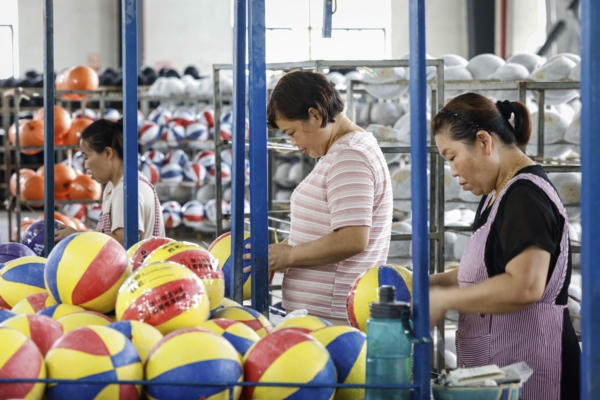
In recent years, a new trend has emerged in Chinese manufacturing industries regarding the employment of workers. Many manufacturing companies are reducing labor costs by hiring temporary workers, promoting “shared gig work,” and employing low-wage college students and older workers. Research data shows that in manufacturing hubs like the Yangtze River Delta and the Pearl River Delta, temporary workers can make up one-third of the workforce for companies, reaching up to two-thirds during peak seasons.
Temporary workers (outsourcing) sign labor contracts with staffing agencies and have no direct labor relationship with the hiring company.
According to a recent report by the Economic Observer, Zhang Liang, who owns a tire company, has been facing losses in the second half of this year. Every additional tire produced by the company now adds to the losses incurred.
Among the various costs in tire manufacturing, natural rubber accounts for over 40%. Since the beginning of the year, the price of natural rubber has gradually increased from around 11,000 yuan/ton to about 18,000 yuan/ton, leading to a 40% increase in tire production costs, completely consuming the company’s profit margins.
The company’s management calculates that shutting down production completely would result in even greater losses; therefore, the best approach is to reduce output, manage cash flow, and wait for market recovery. Currently, the monthly tire shipments have decreased from around 120,000 units last year to about 80,000 units.
Another factor eroding company profits is the difficulty in obtaining financing. Over the past three years, Zhang Liang borrowed from a large state-owned enterprise downstream, which demanded a clause entitling them to “take away about 30% of Zhang Liang’s net profits.” With loan interest and profit deductions over three years, Zhang Liang has paid over 60 million yuan to the state-owned enterprise.
This year, Zhang Liang attempted to suspend the loan cooperation with the state-owned enterprise and sought help from another local state-owned enterprise, which offered a loan with an annual interest rate of 15%.
Zhang Liang said, “The two forms of cooperation are like two bottles of poison now. To survive and secure loan funds, I have to choose one bottle to drink.”
The report mentioned Li Di, who owns an electric grid equipment R&D and manufacturing company, is in a similar situation as Zhang Liang’s tire company, facing losses yet unable to shut down.
In recent years, Li Di has been receiving subcontracting contracts from upstream companies at increasingly reduced prices. The company’s strategy now is to persist and wait for economic conditions to improve.
Another small manufacturing enterprise known to Zhang Liang, mainly supplying cable reels to a local large private cable company, has faced demands to “reduce supply prices by 20%” or risk being replaced by another supplier.
Under the dual pressure of declining orders and profits, some businesses have been “creatively” exploring methods to balance normal operations with reducing labor costs.
In recent years, Li Di and other enterprises in the industrial park have increasingly utilized gig workers in manufacturing. Enterprises can share assembly line workers based on project progress. These shared workers typically only require a day of basic training to work in various factories, usually in non-essential positions that do not impact product quality significantly, such as assembly or warehousing.
Due to decreased order demands, a water meter manufacturing factory in the same industrial park as Li Di’s, has reduced its permanent staff from over 140 people at the end of last year to 100 after the Lunar New Year, and currently down to 40. During peak order periods, the factory resorts to gig workers for production.
With rising demand for gig workers, several labor service companies have emerged locally, leading teams of workers to various factories.
Taking a 20-person work team as an example, Li Di calculated that using permanent workers with social security expenses would cost around 7,000 yuan per worker per month, totaling about 1.68 million yuan annually for a 20-person team. However, with a flexible work arrangement, even if the gig workers’ costs rise to 10,000 yuan per month, the total cost can be reduced to 1.2 million yuan for six months of factory operation.
Apart from “shared gig work,” some enterprises are turning to college students for solutions.
Zhang Liang noticed that in recent years, labor service companies arrange students for internships at multiple factories within their internship period to fulfill temporary labor needs in different factories.
Another small manufacturing enterprise known to Zhang Liang is planning to gradually replace its original workers with older workers who accept lower wages, further reducing labor costs.
Zhang Dandan, the Vice Dean of the National Development Research Institute at Peking University, noted in her research on industrial enterprises in Jiangsu Kunshan over the past two years that due to declining order demands, the wage increase phenomenon seen in previous peak seasons did not occur this year. In fact, many factory workers’ wages are even lower than they were three years ago.
Zhang Dandan emphasized at the “China Finance Forty People Forum” in August that the trend of gig work (temp work) in China’s manufacturing industry has been quietly emerging over the past decade. Influenced by volatile export orders, rising labor costs, and increased labor rights awareness among workers, the gig work trend has expanded over the past two years.
Another factor driving the trend of gig work in China’s manufacturing industry is advances in production technology. Factories using advanced technology do not need to heavily train frontline workers, and the reduced training costs and simplified skills make gig workers capable of meeting the order demands of numerous manufacturing factories.
Based on extensive on-site research, Zhang Dandan estimated that in manufacturing hubs such as the Yangtze River Delta and the Pearl River Delta, temporary workers (workers dispatched by labor service companies to work units) can account for one-third of the workforce for companies, reaching two-thirds during peak seasons.
In June 2024, Zhilian Recruitment released the “2024 Blue-Collar Talent Development Report,” indicating a continuous growth in flexible gig work positions on the platform, with a 35% increase in job postings in the second quarter of this year compared to the same period in 2019.
Dù Jìng, the person in charge of labor outsourcing at a human resources company, mentioned that whether large state-owned enterprises or small and medium-sized private companies, more and more manufacturing companies are adopting labor outsourcing to recruit workers.
Dù Jìng stated that a significant reason why many manufacturing companies opt for labor outsourcing is to outsource non-core, auxiliary, seasonal, irregular production stages, or assembly lines, allowing companies to focus their main energy, manpower, and finances on core or higher value-added businesses.