
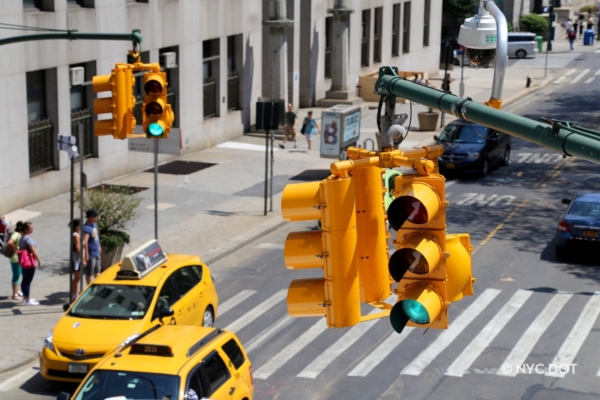
In a recent ruling by the State Supreme Court Appellate Division, both Nassau County and Suffolk County in Long Island, have been found to be in violation of state law for imposing additional administrative fees on drivers who run red lights. The counties had been issuing citations to drivers caught on camera running red lights since 2010, with fines of $50 per violation in Nassau County and an additional $45 public safety fee and $55 driver responsibility fee, totaling $150. Suffolk County also added a $30 administrative fee.
The court’s decision on November 27 deemed that imposing these administrative fees was contrary to the state law established in 2009. This law granted local governments the authority to implement red-light camera programs and capped the fine for each violation at $50, with a maximum of $75 after late fees. The additional administrative fees exceeded the authorization of state law and were deemed invalid.
The Appellate Division has remanded the cases back to the respective State Supreme Courts of the two counties to determine the amount of excess fees collected and to decide on the refunds owed to drivers. According to a report by Newsday, attorney David Raimondo, representing the drivers in both counties, stated that Suffolk County had collected a total of $160 million in excess fees, while Nassau County had collected between $300 to $400 million.
Nassau County Executive Bruce Blakeman’s spokesperson, Chris Boyle, did not respond on December 4 regarding the potential appeal to the Court of Appeals, the state’s highest court. However, the county confirmed to Newsday that they have ceased collecting the public safety fee and driver responsibility fee. Suffolk County had already discontinued collecting the $30 administrative fee back in 2023.
This ruling serves as a significant development in the ongoing debate over red-light camera fines and administrative fees, emphasizing the importance of adhering to state regulations and ensuring fairness in traffic enforcement practices. The decision to halt the collection of these additional fees marks a victory for drivers and underscores the need for local authorities to comply with state laws when implementing traffic enforcement measures.