
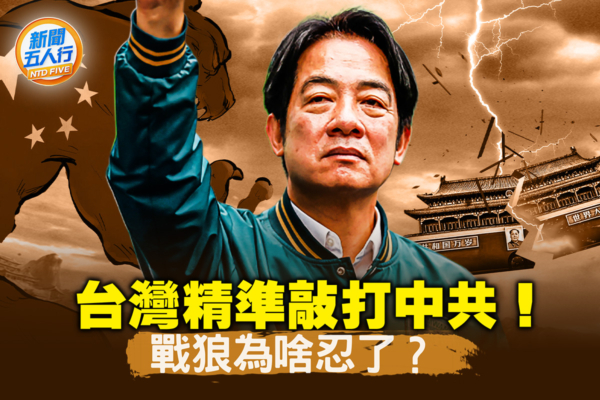
Hello everyone, welcome to “News Five Ways”. Today’s hosts are Tang Hao, Qin Peng, Qin Yue, and Jin Shi. We provide diverse perspectives and in-depth analysis to take you into the rich world of news. Feel free to subscribe to and like our independent channel.
Today’s focus: Russia acknowledges China’s territorial concession! “Lai Ching-te challenges Xi Jinping”, how does the “Wolf Warrior” respond? Not prioritizing land, Taiwan’s president reveals Beijing’s intentions; China’s selling out, with even the Himalayas involved! Instead of focusing on the 1.5 million square kilometers ceded, China sets its sights elsewhere! As the economy worsens, crises are more likely to emerge!
In recent days, the most talked-about statement comes from the President of the Republic of China, Lai Ching-te.
Indeed, do you think President Lai Ching-te’s statement makes sense?
Qin Peng: President Lai Ching-te’s statement is actually incomplete. China has not abandoned historical territorial claims, but has conceded a significant amount of territory.
For example, when North Korea wanted part of Mount Changbai’s Tianchi, China readily agreed, giving away half of Tianchi; when Vietnam sought Bach Long Vi Island and Paracel Islands, China also acquiesced. Many have heard the song “The Glorious Red Flag”, which portrays China defending the Sino-Vietnamese border. However, it was later revealed that in the December 1999 “China-Vietnam Land Border Treaty”, China handed Lao and Fatka Mountains to Vietnam.
In 1960, in a bid for supremacy with India in Asia and Africa, China voluntarily ceded a portion of the Himalayas to Nepal. In 1988, according to “Contemporary Chinese Diplomacy”, Mao Zedong personally made the decision. In 1959, China even relinquished 100,000 square kilometers to India, which resulted in a world-first: winning a war yet surrendering territory.
So, to say China is patriotic, even if you kill me, I won’t admit it.
These remarks were made by President Lai Ching-te during a television interview conducted by host Zhang Yaqin’s program “Yaqin Views the World” on the occasion of his 100th day in office. The latest development is Russia’s Foreign Ministry officially responding, emphasizing that China had renounced territorial claims as early as 2001.
Amidst this ongoing discourse, on the 4th, Chinese Vice President Han Zheng attended the Eastern Economic Forum in Vladivostok, Russia. He expressed a desire for Vladivostok to become an attractive destination for Chinese tourists. Vladivostok was ceded to Russia by the Qing government in 1860.
China’s propaganda department once claimed “not a single inch of Chinese territory can be missing.” However, in practice, it appears they are willing to part with a large chunk.
Qin Yue, China not only dares not demand the return of occupied land from Russia but has also actively relinquished territory to Russia. This fact has been highlighted by the Russian Foreign Ministry. Could you elaborate on how China has transferred land to Russia?
Answer: Historically, the Qing Dynasty signed treaties such as the “Aigun Treaty” and “Beijing Treaty” with Russia, resulting in China losing approximately 1.5 million square kilometers. Some historians even claim the figure to be in the millions or tens of millions, considering all the territories held during the Qing Dynasty’s peak. Therefore, when the Qing Dynasty ceded territory to Russia in its later years, these areas were included in the “lost land.” Regardless of the specifics, one thing is certain: historically, Russia is indeed the country that has occupied Chinese territory the most.
To consolidate these transactions further, on December 9th and 10th, 1999, Jiang Zemin signed the “Agreement between the Government of the People’s Republic of China and the Government of the Russian Federation on the Description of the East and West Sections of the Sino-Russian Boundary” (“Agreement”) with President Yeltsin. Behind the nation’s back, Jiang Zemin handed over more than 1 million square kilometers of land to Russia.
Furthermore, on the 3rd, the Russian Foreign Ministry responded to Lai Ching-te’s inquiries. They mentioned that Russia and China signed the “Treaty of Good-Neighborliness and Friendly Cooperation” on July 16, 2001, where both sides renounced any territorial claims against each other. Subsequently, on October 14, 2004, they signed the “Supplementary Agreement on the Eastern Segment of the Sino-Russian border,” implementing the consensus from the treaty. To sum it up plainly: China has legally affirmed its decision to forgo these territories.
These details do not account for all treaty agreements. Undoubtedly, there are likely confidential agreements not disclosed to the public. In essence, through these high-ranking Chinese officials adhering to these agreements, land has been discreetly surrendered or, as they prefer to call it, transferred.
Qin Peng, Shiban Akio mentioned that Lai Ching-te has checkmated Xi Jinping. Have you played chess before? How could China respond elegantly? Will China respond?
Qin Peng: Yes, I have. The horse moves in an “日” shape, the elephant moves in a “田” shape, the chariot moves in a straight line, the cannon moves over mountains, and the guards protect their respective pieces along the edges, while pawns move forward and do not return. This is the play of chess. China could respond in three ways. Firstly, like Japan, they are not afraid of a powerful Soviet Russia; for over 70 years, they’ve maintained their claim to the Northern Territories, regardless of strength or odds, ancestral territories cannot be relinquished. Secondly, China could exploit Russia’s weaknesses and demand the return of lost territories. For instance, Estonia, a small European country, has repeatedly demanded the return of over 2000 square kilometers from Russia in recent years. Despite its small size, Estonia holds on to these territories as they were part of their ancestral lands and essential for their well-being. Lastly, China could cease aid to Russia or use it as leverage to demand significant concessions in oil and resources, or propose joint development in the Far East region, making it more palatable for Putin to not refuse.
Of course, China will not genuinely respond to Lai Ching-te’s call. None of these options will be chosen or willingly pursued. There are three reasons for this: Firstly, the Chinese Communist Party is a regime that sells out its country and lacks shame; secondly, China has a conflicting sentiment towards Russia – both fondness and fear. They are reluctant to antagonize Soviet Russia due to deep-rooted insecurities and the fear of publicizing various unsavory historical episodes. Therefore, the Chinese public often references Soviet Russia as the father of the Chinese Communist Party. China is reluctant to claim territories because they see Russia as a frontline protector, thereby safeguarding China from democratic societies challenging them. In conclusion, due to the party’s self-interest, they disregard the national interests of China and will not demand these lost territories from Russia.
Jin Shi, why does China not seize the opportunity while Russia is weak to reclaim the 1.5 million square kilometers of lost territory? Instead, they continue to pursue Taiwan for just 36,000 square kilometers? Some argue that China fears Russia, but as Lai mentions, Russia is at its weakest now…
Jin Shi, Qin Peng, Lai Ching-te has been the most daring President of the Republic of China since 2000, challenging the Chinese Communist Party like no other. Not only did he stress mutual independence in his inauguration speech but also invited Xi Jinping for a Taiwan bubble tea, and now he has raised the territorial issue of the “Aigun Treaty”, leaving China speechless. How do you view Lai Ching-te’s cross-strait policy statements? Is he provoking the CCP?
Qin Yue, Jin Shi, Lai Ching-te believes that the CCP cares more about global hegemony than territorial claims. Do you agree with this perspective? Is there a connection between territorial claims and global dominance?
Answer: I agree. Mao Zedong once said, “The Cultural Revolution needs to be repeated every seven or eight years.” The repeated use of violence has been a vital tool for the Communist Party regime to maintain its control.
Deng Xiaoping, in his pursuit of economic development, continuously adjusted his stance and chose to “bide his time, hide his capacities,” when dealing with the Western world. What does it mean to bide one’s time? It’s when you remain silent and accumulate strength when you’re weak, only to strike when you’re strong.
Xi Jinping believes in “a once-in-a-century great change.” He thinks that “the east rises while the west falls,” anticipating the collapse of American dominance.
When reading between the lines, you can see the reality: conflict. The party will not coexist peacefully with the world; this is the essence of the CCP. The Communist Party does not believe in gods and does not respect nature and all creatures unless deemed as enemies by the party; they honor parents but exclude parents who are classified as class enemies; they value righteousness, etiquette, wisdom, and trust unless they choose not to. Universal human nature is thoroughly subverted, and the Communist Party is antithetical to human nature. Therefore, if it becomes powerful, hegemony would be an inevitable path.
The most terrifying scenario would be if one generation of deceived Chinese people passes on, and the next generation remains enamored by the CCP’s lies, causing harm without benefit to the world.
Subscribe to our YouTube channel:
https://www.youtube.com/channel/UCdbvc-yJ4JQjNGTgFiJIZNA
Subscribe to Ganjing World:
https://www.ganjingworld.com/s/l9VpjYwBmw