
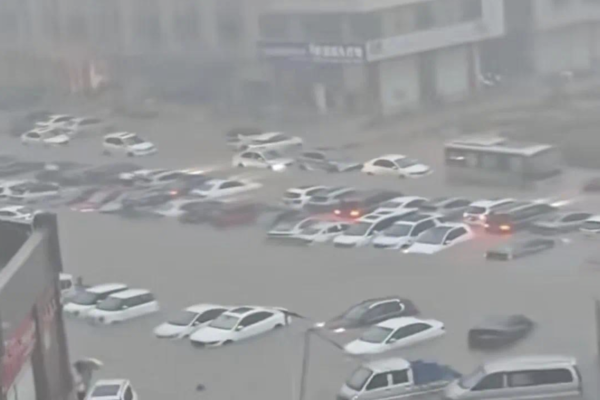
Recently, Qinzhou in Guangxi experienced an extremely rare heavy rainstorm, pouring down the equivalent of “58 West Lakes” in just one day. Over a thousand vehicles soaked in the floodwaters have entered the process of reporting and repairs, making Qinzhou the center of attention across the internet.
From April 26 to 27, Qinzhou was hit by torrential rain. The downpour turned the roads in the city into rivers, leaving low-lying areas submerged and causing severe urban flooding. A large number of vehicles were submerged, turning the city into what locals dubbed as the “Qinzhou Sea”, a sight unprecedented in their memory.
According to China Weather Net, as of 2 p.m. on April 27, Qinzhou had received a total rainfall of 323.4 millimeters within 24 hours. That amount of rainfall equates to about 58 times the water volume of West Lake when calculated based on the area of Qinbei District where the Qinzhou National Meteorological Station is located.
As reported by Southern Morning Post, by 6 p.m. on April 28, the number of local vehicles in Qinzhou accepted for insurance claims and rescue by repair institutions had exceeded 1,000.
On April 29, in the urban area of Qinbei District, Qinzhou, a large number of rescue vehicles were seen transporting flooded cars on the streets. Residents in residential areas either waited for insurance companies to assess the damage or took the initiative to clean their soaked vehicles.
At 7:49 a.m. on April 27, Bao Ying, a resident of Ningyue Garden in Qinbei District of Qinzhou, received a call from relatives in the same building informing her that the underground parking lot was flooding, urging her to quickly move her car. In the video sent by her relatives, nearly ten electric cars were submerged in water, with the tires completely submerged.
Bao Ying and her husband took the elevator down. By the time they reached the first floor, water had started seeping through the elevator ceiling. Feeling uneasy, the elevator suddenly stopped at the first floor and then plunged downwards, with a large amount of water seeping in through the door crack, reaching their lower legs in a short amount of time.
“My drowsiness disappeared instantly. I even worried for a moment that I might leave my last words in the elevator.” Bao Ying recalled feeling scared, but fortunately, the elevator ascended back to the first floor and the door opened.
When the resident Jiang Ming descended the stairs to the parking lot, the water level had reached his thighs. The water had seeped up to the car seams, soaking the floor mats. His wife’s new energy vehicle began showing abnormal signs due to water damage, with the battery light on the screen turning yellow. Jiang Ming moved his wife’s car to higher ground, only to realize that his own gasoline car was beyond saving, with water already reaching the bumper.
“I didn’t dare to start the engine because once started, water would flood in. Another car owner nearby stalled after driving less than 5 meters.”
It wasn’t until around 1 p.m. on April 29 that Jiang Ming’s Audi was finally towed out of the basement. Photos showed the entire front of the car covered in mud and grime, with the grille, license plate frame, front bumper, and hood all retaining thick layers of mud stains. It was estimated that the water had reached at least the front face of the car based on the mud stain traces.
“The water reached the middle of the seats, most likely it’s a total loss. I’ve had the car for over 5 years, the exterior still looks very new, and I’ve always taken good care of it. The loss this time is too great,” Jiang Ming lamented.
Beyond the urban areas, another kind of loss was simultaneously unfolding.
Sun Zhao’s home was in a lower-lying area. On April 27, he was worried about water backflow into his home and his car being soaked, prompting him to relocate his vehicle to a fish seed breeding base about seven to eight kilometers away.
However, the surrounding rainwater was rapidly converging towards the fish pond, turning the once clear water into muddy sludge.
Sun Zhao rushed to the base, finding the water in the pond had risen to nearly a meter high on the steps. The water level in the fish tanks was now level with the pond water, causing some fish fry to leap out of the tanks and escape. “Some of the fish fry escaped, the water turned muddy, and many fish fry died,” Sun Zhao explained. The extent of the losses caused by this heavy rain is difficult to quantify at the moment, he added.
After the rainstorm, the resident Chen Biao and his family were busy replacing the water in the fish ponds, which had become too muddy for fish breeding. “Over a dozen outdoor fish ponds, along with two to three dozen indoor fish ponds, have all been soaked,” Chen Biao estimated that this loss could amount to tens of thousands of fish fry, resulting in heavy economic losses.