
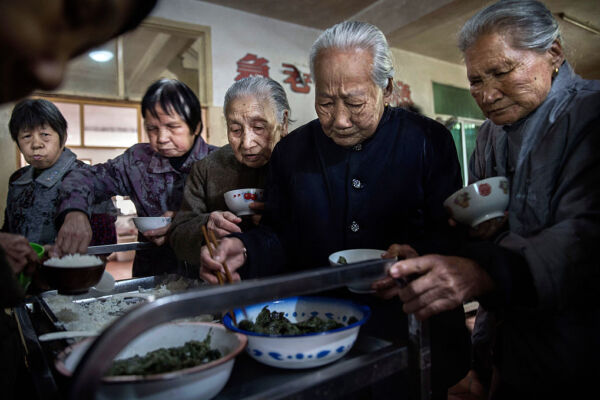
In recent years, there has been a rise in suicide cases among elderly people in rural China, with villagers revealing that the increase is largely due to the inability to afford medical treatment. Official acknowledgment has been made regarding the poor medical conditions and low insurance coverage in rural areas, where the suicide rate among elderly people is about twice as high as in urban areas. Experts point out that the fundamentally unfair system imposed by the Chinese Communist Party on farmers is the root cause of these tragic occurrences.
Regarding the issue of rural medical insurance, a villager named Xiao He from Changsha, Hunan, revealed in a recent interview with Epoch Times that villagers are required to pay 400 RMB (Renminbi, equivalent to Chinese Yuan) annually for insurance, but there are many limitations on actual reimbursements.
Xiao He expressed, “There are many restrictions, which is basically cheating. A lot of my medicines are not covered. I’ve already spent one to two hundred thousand on medical expenses in the past year, and I don’t even know where the next month’s medical expenses will come from.”
Another villager, Xia Yue from Shandong, called rural medical insurance a scam.
“Every year you pay 400 RMB, and they say you can get some reimbursement later. It’s all a trick, a Ponzi scheme. What could have been treated with 50 cents, they ask for 1 RMB from you, reimburse you 40 cents, and you end up spending an extra 10 cents.”
Chinese issues expert Wang He told Epoch Times, “China’s health insurance ranks very low globally. Combined with the fact that rural and urban health insurance systems are different strategies with differing levels of funding: urban health insurance has higher contribution rates and therefore can achieve reimbursement rates of around 70-80%, while rural areas are at around 50-60%.”
According to a report by NetEase on July 10, 2024, the basic pension for elderly farmers in 18 provinces and cities in China is less than 150 RMB per month; provinces with pensions between 150 and 200 RMB include Zhejiang, Qinghai, Ningxia, Shandong, Xinjiang, and Fujian; only Tibet, Hainan, Jiangsu, and Guangdong have pensions above 200 RMB. In March of the same year, Chinese Premier Li Keqiang announced a further increase of 20 RMB in the “basic old-age insurance for urban and rural residents.” Many analysts have pointed out that this reflects massive inequality in urban and rural elderly care.
“Any health insurance system cannot operate on its own; it must rely on national financial subsidies. However, the financial support for officials greatly differs from that for farmers,” said Wang He in elaborating on the disparities in the healthcare system in China. “There are three tiers of people in China, with the rural population being at the bottom in all aspects.”
Villager Xia Yue told Epoch Times that in recent years, life in rural areas has been extremely dire. Elderly people cannot afford medical treatment or retirement, and young people struggle to afford marriage and children. Many are left without food or drink.
Xia Yue stated, “Life in rural areas is very tough now. If you have a serious illness, not only do you burden your children, but before the illness is even cured, the elderly are already thinking this way. They can’t afford treatment, so they give up. For elderly people, seeking medical treatment and retirement is the biggest burden.”
Wang He highlighted the extreme differentiation and unfairness in the Chinese health insurance system. “Firstly, the overall investment made by the state in health insurance is relatively low; secondly, in situations of insufficient funding, the policies favor high-ranking officials and selected individuals within the Chinese Communist Party, who have access to superior medical care and claim a majority of the medical resources. In contrast, ordinary citizens, especially farmers, receive negligible reimbursements, with farmers having very low reimbursement rates,” he explained.
He believes that the unfair system is the fundamental reason for the disparities in health insurance and the high suicide rate among farmers. “Once many farmers suffer from serious illnesses, their families fall into ruin and poverty. What can they do? They have no choice but to stop treatment, leading to a very miserable existence for Chinese farmers.”
With the rigid household registration system for farmers and the implementation of vastly different policies in rural areas compared to cities since the establishment of the Chinese Communist Party, Chinese farmers have continuously remained at the lowest social strata, as Wang He revealed.
“Today, the situation of farmers has not fundamentally changed,” he added sadly.