
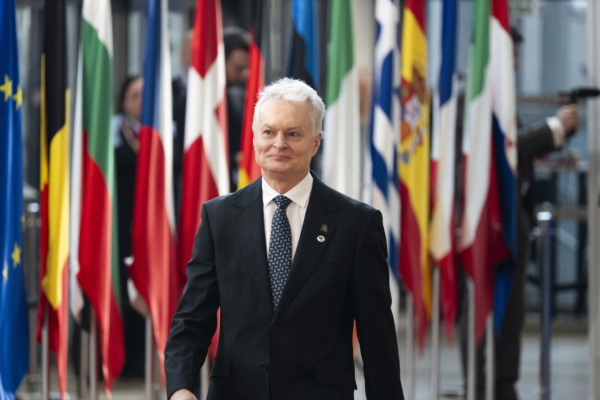
Lithuanian President Gitanas Nausėda stated on Thursday (April 30) that he supports his country’s participation in the United States’ freedom of navigation mission in the Strait of Hormuz, and he plans to submit this proposal to the National Defense Committee.
Lithuania has received a formal invitation from the United States to join the international coalition aimed at restoring commercial shipping in the strait. The strategic waterway is currently blocked following military actions by the United States and Israel against Iran under the codenamed Operation Epic Fury.
“We have received a proposal from the United States to join the alliance to restore navigation in the Strait of Hormuz,” Nausėda told reporters at a press conference in Vilnius, the capital of Lithuania. “I intend to submit this proposal to the National Defense Committee in the near future.”
He added that Lithuania’s participation in such overseas missions requires authorization from the Lithuanian Parliament. Nausėda emphasized that ensuring freedom of navigation in the Strait of Hormuz is fundamentally a “peace mission.”
“We demonstrate unity and understand that we cannot simply demand and receive security guarantees; we must also make contributions,” he said.
The Strait of Hormuz is a crucial artery for global oil trade. In retaliation against strikes by Israel and the United States, Iran has blocked this strategic passage as a bargaining chip. Currently, oil prices have soared to the highest levels in over four years, with widespread concerns in the market about potential long-term disruptions to global fuel supplies.
President Nausėda further pointed out that Iran is an “active helper” to Russia in the aggression against Ukraine. He firmly believes that taking military coordination actions against Iran or applying pressure is essential for maintaining regional stability and security in the Baltic Sea and globally.
According to a cable from the US State Department obtained by Reuters, the United States is actively lobbying allies to join a new alliance called the Maritime Freedom Framework. This framework aims to enhance intelligence sharing and military coordination.
The Wall Street Journal reported that this US-led initiative focuses not only on military escorts but also on diplomatic coordination and ensuring strict compliance with sanctions against Iran.