
【Epoch Times News, April 30, 2026】Audience friends, hello everyone! Welcome to watch “The Century Truth”.
In November 2025, due to the remarks of Japanese Prime Minister Taro Aso regarding Taiwan’s defense, the Chinese Communist Party (CCP) stirred up anti-Japanese sentiments, causing tensions to escalate. For example, the CCP’s official newspaper People’s Daily took a stance that seemed determined to oust Taro Aso, accusing her of “nine sins.” Chinese fighter jets even used radar to illuminate Japanese aircraft, showing clear provocation, almost reaching the point of firing at Japanese aircraft.
Japan has become accustomed to these periodic waves of anti-Japanese behavior from the CCP. The more vigorously the CCP opposes Japan, the higher the support for the Aso cabinet among the Japanese people. On December 22, 2025, a survey by the Nikkei newspaper revealed that the support rate for the Aso cabinet reached 75%.
Rather than directly confronting the CCP’s aggressiveness towards Japan, Japan employed a normalized measure to strike at the CCP’s vulnerability, catching them off guard.
So, what exactly is this normalized action by the Japanese government? In today’s program, we will discuss this topic with you.
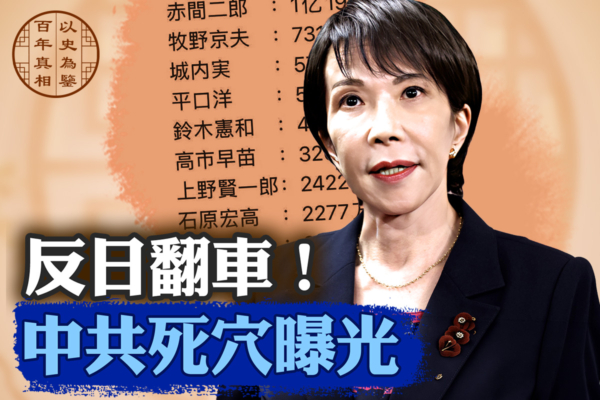
On December 5, 2025, just a month and a half after taking office, Japanese Prime Minister Taro Aso publicly disclosed the assets of 19 cabinet members and their families as required by regulations.
Aso declared total assets of 32.06 million yen (approximately 1.5 million RMB), ranking tenth among the 19 cabinet members.
Topping the list is Defense Minister Shinjiro Koizumi, with total assets of 272.48 million yen (approximately 13 million RMB). Koizumi’s assets are all registered under his wife, including 70 million yen in government bonds, 77.64 million yen in corporate bonds, and other securities worth 124.84 million yen. He also declared ownership of 700 shares in Tokyo Metro.
In second place is Foreign Minister Toshimitsu Motegi. His total assets amount to 193.97 million yen (approximately 10 million RMB), including securities worth 178.94 million yen, real estate in Tochigi Prefecture’s Ashikaga City worth 15.03 million yen, and a total of 243,300 shares in five companies.
Ranked third is Minister of General Affairs Yoshihide Suga, with total assets of 150.88 million yen (approximately 7 million RMB), consisting of real estate worth 137.88 million yen, deposits totaling 13 million yen, and memberships in golf clubs and stocks.
Now, why did the Aso cabinet choose to publicly disclose their assets?
To understand this, we need to go back to 1984 when then Japanese Prime Minister Yasuhiro Nakasone, to combat corruption, publicly disclosed the assets of the Prime Minister and Cabinet Ministers for the first time in accordance with the “Ministerial Standards.” During the Uno cabinet period, the system of disclosing officials’ assets expanded to include their spouses and children.
In 1992, Japan passed the “Disclosure of Assets by Members of Parliament Act,” extending the scope of asset disclosure to all members of parliament.
By 2001, the Japanese Cabinet passed the “Ministerial Standards,” which stipulated that the Prime Minister, Ministers, and Vice Ministers must disclose the financial status of all family members, including spouses and children, upon taking office and leaving office.
The members of the Aso cabinet followed the requirements under the “Ministerial Standards” by publicly disclosing all their assets.
In fact, according to Japanese law, not only cabinet members but all politicians and principal public officials are required to declare their assets publicly, and they cannot refuse on grounds of personal privacy.
To ensure the authenticity of officials’ disclosed assets, Japan has established a dual verification system that includes investigation and verification by the Cabinet Office and scrutiny by the citizens with voting rights.
It is this dual oversight mechanism that prevents Japanese politicians from intentionally falsifying or concealing their assets, leading to a generally clean political environment in Japan with lower corruption costs and fewer corrupt officials.
The act of the Aso cabinet publicly disclosing their assets sparked strong reactions among Chinese netizens.
Some netizens commented, “Starting to play for real, much more powerful than battleships and aircraft carriers. In fact, foreigners have a clear understanding of us, it’s all about how it ends here.”
“The simplest, most common, and easiest move is an insurmountable gap, scaring the opponent to the point where they dare not look up.”
Others said, “This is going straight for our weak spot at such a sensitive time. How should we respond? With composure or scrambling? This is even more impactful than intervening in the Taiwan Strait!”
Another netizen remarked, “Playing out of the ordinary without following the usual patterns; this move hits (the CCP’s) weak spot and leaves them no defense.”
Why do netizens claim that “Japan’s move directly hits the CCP’s weak spot”? The reason is simple: none of the seven members of the CCP Politburo Standing Committee, including Xi Jinping himself, dare to disclose their assets or those of their family members under any circumstances.
What’s particularly noteworthy is that the Xi regime not only refrains from disclosing their assets, they also shy away from revealing the corrupt amounts of “certain big shots” who have been investigated.
For example, in 2013, during the anti-corruption campaign launched by Xi, former Politburo Standing Committee members and Vice Chairmen of the Central Military Commission, Xu Caihou and Guo Boxiong, and former members of the Central Military Commission and Director of the Political Work Department of the Commission, Zhang Yang, and former members of the Central Military Commission and Chief of the Joint Staff Department Fang Fenghui, were investigated.
When announcing the crimes of these individuals, the CCP authorities did not specify the exact embezzled amounts, only vaguely claiming the sums were “particularly large.” But how large exactly? All CCP party media, including CCTV, People’s Daily, PLA Daily, Qiushi Magazine, and others, chose to remain silent. Some bolder media only dared to hint at the figures indirectly but avoided directly touching upon the specific numbers.
For instance, Phoenix Weekly once reported that just from the basement of Xu Caihou’s luxury mansion on Fucheng Road in Beijing, diverse currencies such as US dollars, Euros, and Chinese Renminbi were confiscated, amounting to more than one ton! There were countless kinds of gold and silver jewelry as well.
Against this backdrop, a high-ranking CCP military official revealed that before his death, Xu Caihou had said to the investigators, “Guo Boxiong’s problem is much more serious than mine.”
Additionally, Liu Yuan, the son of former CCP state chairman Liu Shaoqi, remarked to a reporter of the Beijing News, “Zhang Yang’s issue is even more severe than that of Guo Boxiong and Xu Caihou. Zhang Yang’s embezzlement amount is enormous, and as the Director of the Political Department, he was ‘fully poisonous.'”
Moreover, in 2022, following Xi Jinping’s “triple re-election” at the CCP’s 20th Congress, a major scandal involving the Rocket Force emerged. Subsequently, a wave of purges swept through the CCP military, leading to the investigation of numerous generals, junior generals, and colonels. Among them were former Politburo Standing Committee member and Vice-Chairman of the Central Military Commission He Weidong, former Central Military Commission member and Director of the Political Work Department Miao Hua, former Central Military Commission member, State Councillor, and Minister of National Defense Li Shangfu, former Central Military Commission member, State Councillor, and Minister of National Defense Wei Fenghe.
Given that these were corruption scandals within the military, how much money exactly did these individuals embezzle? The CCP authorities provided no precise figures, merely stating that the amounts were “particularly large.” How large exactly? Probably astronomical figures that many ordinary Chinese citizens would not even dare to imagine.
Why are Japanese Prime Minister Taro Aso and her cabinet members, described as “extremely guilty” by the CCP, boldly leading the way in openly disclosing their own and their families’ assets, while the CCP, which claims to represent “justice and conscience,” dares not even reveal the embezzled amounts of seriously corrupt individuals who have already been investigated?
The answer is simple: disclosing assets is tantamount to seeking the CCP’s downfall. Everyone knows that today’s CCP is the most corrupt party in the world, with almost every official, from top to bottom, being corrupt. What’s most terrifying is that the CCP has broken the tradition of “big officials, big corruption; small officials, small corruption.”
In the CCP’s official anti-corruption reports, many lower-ranking officials have been involved in massive corruption cases.
For instance, Luo Yaping, former female director of the Land and Resources Bureau in Fushun City, Liaoning Province, only a division level officer, embezzled over 140 million RMB.
Yu Fuxiang, the then-party secretary of the Party General Branch in Shuguang Village, Hongqi Manchu Township, Nangang District, Harbin City, who couldn’t even be considered a minor official, embezzled over 200 million RMB.
Yu Fan, former director of Dongtan Community in Zhangba Street, Zhenba District, Xi’an City, a regular community cadre, embezzled up to 120 million RMB.
Many people wonder, why, despite Xi Jinping’s anti-graft campaign since taking office, are there still numerous corrupt officials?
In the words of former Singapore Prime Minister Lee Kuan Yew: “A country that does not establish a system of public servants’ asset disclosure can only combat corruption with smoke and mirrors.”
In other words, the declaration and public disclosure of officials’ assets are crucial to combating corruption at its roots. Many countries have recognized this. According to World Bank statistics, as early as 2016, 153 countries and regions worldwide had established systems for public servants to declare and disclose their assets.
Does the CCP know about this system? Of course, they do. As early as the CCP’s “Two Sessions” in 1988, a National People’s Congress delegate proposed legislative motions regarding public servants’ asset declaration. In 1994, the CCP’s 8th National People’s Congress Standing Committee formally included the “Declaration of Asset Law” in the legislative plan.
However, even after more than thirty years, as of the end of 2025, the CCP has yet to enact a law on the declaration and public disclosure of officials’ assets.
On December 22, 2019, Peking University Professor Zheng Yefu published an article titled “Asset Declaration, Please Start with the Standing Committee.” In the article, he suggested, “Please let the seven Standing Committee members be the first to declare their assets. As the saying goes: ‘Lead by example.’ Starting with declaring assets is a way of proving integrity and setting an example for the political arena. If done so, there is nothing to fear about implementing asset declaration and disclosure.”
By the end of 2025, Professor Zheng Yefu’s suggestion had been put forth for a full six years, but Xi Jinping and the other seven members of the CCP Politburo Standing Committee turned a blind eye and deaf ear to his proposal. The reason is simple: having the seven Standing Committee members disclose their assets would be akin to signing their own death warrants.
That’s it for today’s program, thank you for watching. If you enjoyed our show, don’t forget to like, subscribe, and share. See you in the next episode.
Production Team of “The Century Truth”