
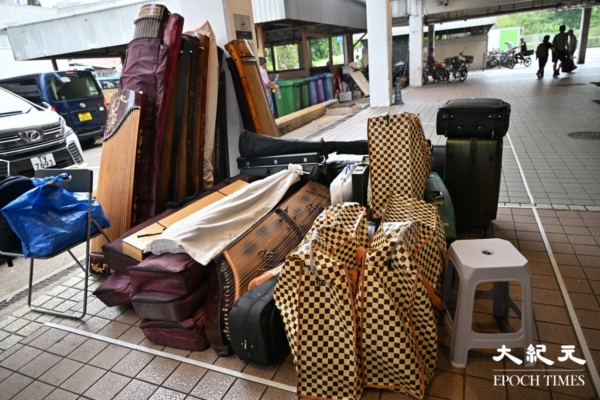
On April 28th, residents of Hong Kong Tai Po Wang Fuk Court continued to return to their homes to collect their belongings. Ma Zhongju, a guzheng musician residing on the 31st floor of Wang Fuk Court, successfully moved 18 guzhengs out of his home.
With over 30 years of experience in teaching and playing guzheng, Ma Zhongju started collecting Chinese musical instruments in his twenties and accumulated over 40 guzhengs at home. Mr. Ma initially thought he could only take a few items with him. However, upon returning to his old residence, he found that although the unit was affected by the disaster, his guzhengs were in good condition without any smoke damage, which pleasantly surprised him.
With the assistance of the civilian rescue team, he managed to carry away the 18 guzhengs, with some instruments being stored in the orchestra he belongs to in preparation for a performance in June. Ma Zhongju expressed that he is most concerned about the “Butterfly Guzheng” invented by his mentor He Baoquan and brought back to Hong Kong from Shanghai in the 1980s. He introduced that this guzheng has 49 strings, making it the first in Hong Kong and holds significant artistic and academic value.
Seeing his collection of musical instruments that he had cherished for decades still in good condition after the fire, Mr. Ma described it as a feeling of recovering what was lost. Due to the limited three-hour access on-site and the heavy weight of music scores and books, Ma could only take about a third of his collection with him. He expressed regret, feeling that there was insufficient time for everyone.
He mentioned that two-thirds of the instruments were left behind, likening losing musical instruments to “losing a hand” for musicians. He hoped that the authorities would provide more opportunities for residents to reclaim their belongings rather than watching their hard work end up in a landfill.
Regarding the remarks by the Deputy Secretary for Home Affairs, Jack Cheuk Wing-hing, suggesting that victims of the disaster should learn to “let go,” Ma Zhongju harshly criticized such remarks as “nonsense.” He explained that the wood and sound quality of traditional guzhengs differ significantly from modern products, and their artistic essence is irreplaceable. He questioned, “Why should I ‘let go’?” and reaffirmed that forcing musicians to discard mementos is highly unreasonable.
Another resident, Mr. Cui, living on the 30th floor of Wang Cheung Court, has been living in Wang Fuk Court since birth and purchased another unit in Wang Cheung Court as they grew older to take care of his parents conveniently. His parents resided in Wing Kin Court, and while their unit was undamaged, Mr. Cui’s unit suffered severe damage.
Mr. Cui said that originally only two people were allowed to enter the unit, but he attempted to negotiate for four people to enter together to care for each other. Although he was confident in his physical abilities, he worried his wife would find it difficult. He prepared basic equipment such as flashlights, metal detectors, gloves, and eye masks to help search for gold items lost among the debris.
He noted that the unit was severely damaged, especially with the kitchen only accommodating one person at a time. He didn’t hold much hope for retrieving most of the daily necessities because the extensive collection inside the house, including models, computers, cameras, and other electronics, were believed to be completely destroyed. His main goal during this visit was to find the wedding ring his wife left behind on the evacuation day, acknowledging the high difficulty of finding jewelry in the disaster aftermath but still hoping to search for the lost ring.
Discussing his emotions about returning to their old residence, Mr. Cui described the feeling as extremely complex. He grew up in Wang Fuk Court and has a deep affection for the community. However, the disaster caused immense damage, especially as neighbors on his floor tragically lost their lives, with many familiar faces no longer present.
Mr. Cui estimated that there were few items left inside his unit to retrieve, yet he still hoped to have one last look at his home before relocating, anticipating that this visit would be his final entry into the unit.
After returning, Mr. Cui only took two small bags of items, including the wedding ring left by his wife on the evacuation day, commemorative rings, souvenirs purchased during their travels, and second-generation iPhones and camera, all of which were burnt. He explained that most items in the house had turned to ashes, and the cluttered debris made it impossible to use the prepared shovel as the metal detector kept beeping in various areas, only being able to take solid items.
Mr. Cui showed photographs to reporters showing cup noodle packaging, cigarette boxes, and pointed out that none of his family members smoked. He questioned whether workers used his unit for breaks, meals, or even as a makeshift rubbish bin, feeling disrespected in his own home.
The government announced that 5 floors of the high-rise Wang Cheung Court and 10 floors of the high-rise Wang Dao Court were opened today, with 129 households and 458 individuals registered to go upstairs, with 130 households and 498 individuals in attendance.
The average time for residents who went upstairs today was 2 hours and 33 minutes, with the shortest time being 29 minutes and the longest being 3 hours and 43 minutes. About 65% of residents stayed for less than 3 hours, 25% stayed for less than 2 hours, and approximately 2% stayed less than 1 hour. A total of 54 households and 106 people went upstairs more than once.
The inquiry office received one case of a citizen feeling unwell physically. There were 7 cases where residents sought police assistance, involving suspicions of lost valuables including watches, jewelry, cash, and gold items. The police assisted in recovering items related to one case; in 4 cases, no evidence of theft was found, and residents could not provide detailed information about the missing belongings, while the remaining 2 cases are under further investigation.
Furthermore, multiple government officials spoke to reporters yesterday. When asked about speculation online that workers could use the elevators for repairs after the fire but residents were not allowed, Secretary for Home Affairs Jack Cheuk Wing-hing explained that the seven buildings affected by the fire were soaked in water during firefighting, generating a lot of steam. The main tracks and components of the elevators are metal, and these metal components, cables, if corroded or pose safety risks. Electronic parts, control panels, etc., would be damaged after experiencing high temperatures and water spray.
Jack Cheuk Wing-hing understood that residents wanted the elevators to be operational for their convenience but emphasized that residents’ safety was paramount and precautions needed to be taken.
Regarding residents finding their units in disarray after going upstairs, suspecting sabotage and finding cigarette butts and packs, Secretary for Home Affairs Jack Cheuk Wing-hing responded, “We need to look into it.”