
The United States and Indonesia have issued a joint statement announcing the establishment of a major defense partnership between the US and Indonesia on April 13, which was implemented almost simultaneously with the US military blockade of Iranian ports.
Amidst the tense situation in the Iranian battlefield, the United States and Indonesia have signed a defense cooperation agreement. While on the surface, it may seem like routine military cooperation, there is a significant detail: the two countries have agreed to jointly develop maritime surveillance, underwater detection, drone technology, and enhance asymmetric warfare capabilities. Importantly, another unofficial agreement mentioned allows for a blanket approval for US military aircraft to fly over Indonesian airspace. This means that if the agreement is successfully signed, US fighter jets, reconnaissance aircraft, and drones would only need to notify Indonesia in advance to fly directly over Indonesian airspace without the need for individual applications.
With a large number of US troops being sent to Iran, US Secretary of Defense, Haggis, received the Indonesian Minister of Defense at the Pentagon to discuss defense agreements. What considerations lie behind such timing? The answer lies in the Malacca Strait.
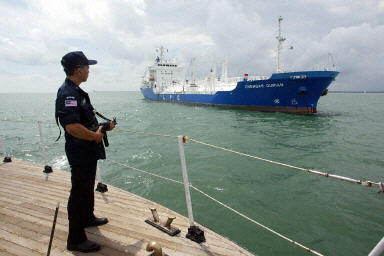
According to data from the US Energy Information Administration (EIA) for the first half of 2025, 23.2 million barrels of oil pass through the Malacca Strait daily, accounting for nearly one-third of global maritime oil trade, whereas the Hormuz Strait only sees about 20.9 million barrels per day.
China is the largest oil-consuming country in the Malacca Strait, with an estimated half of the tankers there bound for China, as per the EIA. Ships exiting the Hormuz Strait, including those from Africa, often pass through the Malacca Strait en route to the South China Sea.
The article also quotes a Chinese energy expert to explain that China is unable to control the Malacca Strait due to its strength. The Malacca Strait has become one of the 16 strategic chokepoints globally that the US must control. Once US influence is exerted, no country can do much about it. It is said that whoever controls the Malacca Strait controls China’s energy lifeline. The 16 strategic chokepoints include the Panama Canal, Greenland, the Hormuz and Malacca Straits.
In the case of the Malacca Strait being blocked, ResearchGate, the world’s largest academic exchange platform, revealed that China would have only one detour sea route. This route passes through the Sunda Strait between Sumatra and Java, then enters the Lombok Strait between Bali and Lombok, and continues through the Makassar Strait, a route that stretches vertically upwards across the southern Philippines. While suitable for supertankers due to its depth, this route adds over 1000 kilometers to the journey, significantly raising transportation costs. Furthermore, these three straits – Sunda, Lombok, and Makassar – are all within Indonesia’s sovereign jurisdiction.
Apart from this maritime route, there are two land transport routes: the China-Myanmar Economic Corridor’s oil and gas pipeline directly delivers to Yunnan, avoiding the need to traverse the Malacca Strait, albeit with an annual transportation capacity of about 220 million tons. Typically, one ton of oil equals around 7.0 to 7.8 barrels (depending on oil density), translating to approximately 440,000 barrels per day. The other route is the Central Asian and Central Russian pipelines, transporting oil and gas by land routes from Kazakhstan and Russia. However, combined, all these land routes cannot compete with maritime tanker transportation.
If the Malacca Strait were indeed blocked, how long could China’s oil reserves sustain them? According to data from the French energy consulting firm Enerdata, China’s current strategic oil reserves total around 450 to 500 million barrels. Enerdata estimates that given a complete cut-off of maritime imports, with land transportation still feasible, this reserve could last for three months, equivalent to three times its net import volume. If only the supply through the Hormuz Strait were disrupted and other suppliers like Malacca, Russia, and Africa could still provide oil as usual, this reserve could last over 200 days.
On April 13, the United States and Indonesia announced the establishment of a major defense partnership, potentially bringing the Malacca Strait, as well as the Sunda, Lombok, and Makassar Straits into the controlled area.
Subsequently, on April 15 to 16, the US signed a 2026-2036 defense cooperation roadmap with Morocco in Washington, further strengthening its strategic posture in Gibraltar. Gibraltar guards the entrance to the Mediterranean and the Pacific, serving as one of the narrowest straits globally and the key route for goods and oil transportation between Europe and Africa, and the only passage for Atlantic vessels into the Mediterranean.
On April 16, a Twitter post by Lawrence stated that with the defense agreement between the US and Morocco signed, concerning the Gibraltar Strait (the entrance and exit point between the Mediterranean and the Pacific), the US has now completely controlled four global maritime chokepoints in just over a year: Gibraltar, Malacca, Hormuz, and Panama. This strategic layout seems more reliable than the proposed Belt and Road Initiative.
From Panama, Greenland, Venezuela, the Hormuz Strait in Iran, to the Malacca Strait, and later the Gibraltar Strait, it is clear that the US’s global strategy is targeted towards China. Many are gradually understanding this.