
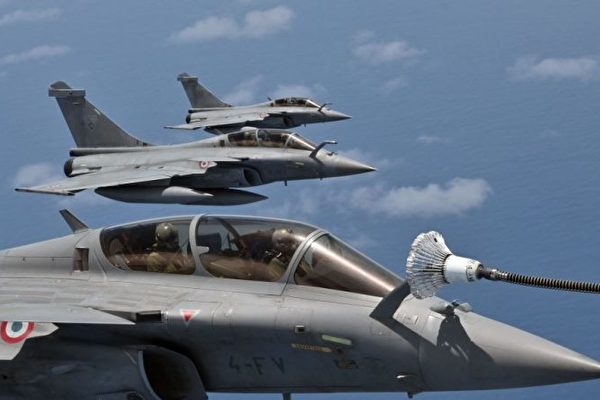
As global attention focuses on the Middle East, NATO scrambled multiple aircraft on Monday (April 20) to intercept Russian strategic bombers and fighter jets flying over the Baltic Sea. This operation showcased the alliance’s strong air power and deterrence posture on its eastern flank.
According to reports from the Associated Press, on that day, the French Rafale fighter jets deployed at Šiauliai Air Base in Lithuania took off urgently. Subsequently, aircraft from Sweden, Finland, Poland, Denmark, and Romania also joined in, collectively identifying and tracking the Russian aircraft group.
The French detachment reported that the Russian mission involved a large-scale deployment, including two Tu-22M3 supersonic strategic bombers, as well as around 10 Su-30 and Su-35 fighter jets taking turns to escort them. The Russian aircraft group took off from a base near St. Petersburg, flying past the coastlines of several NATO member countries like Finland and Poland, before turning back near Denmark.
The Russian Ministry of Defense responded on Telegram saying that the long-range bomber flight over the Baltic Sea’s international waters was part of a “pre-planned activity,” lasting over four hours, and acknowledged being accompanied by “foreign fighter jets” at certain stages. Russia emphasized that its flight strictly adhered to international airspace regulations.
However, NATO countered, stating that the intercepted Russian aircraft usually do not activate their transponders, refuse to communicate with air traffic controllers, or submit flight plans, posing potential risks to other users of the airspace. The French detachment confirmed this point.
Colonel Alexandre, the commander of the French detachment, said, “We don’t know if this is due to a lack of professionalism or a means of testing us. But what is certain is that we must respond every time and not consider it as ‘routine’ to let them pass.”
Journalists from the Associated Press witnessed the French response action at Šiauliai Air Base. Once the Rafale fighter jets received the orders, the crew swiftly moved from the headquarters to the hangars. Being on high alert, the pilots were already suited up, and amidst the roaring of engines, the jets took off within minutes.
Video footage from the scene revealed close confrontations between the pilots in the open sea airspace. Despite the clear visibility of missiles mounted on the aircraft, both sides maintained a professional distance, akin to “cats baring their claws,” watching each other closely to ensure the tense situation did not escalate into open conflict.