
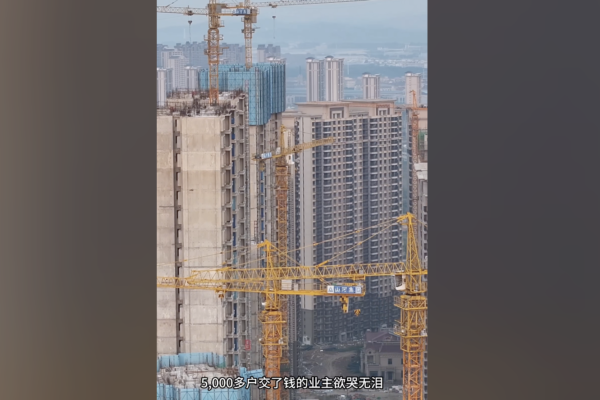
Recently in Shenzhen, the trial of the Evergrande case took place earlier this month. Xu Jiayin, the founder of Evergrande Group, is accused of committing 8 crimes including fundraising fraud. With the collapse of Evergrande, unfinished buildings are left abandoned everywhere. In recent days, the current status of these abandoned buildings has once again drawn attention.
On April 24, a reporter from Dajiyuan found a plethora of videos related to Evergrande’s unfinished projects on the Chinese internet. One video released on April 20 purportedly showed the tallest unfinished building project of Evergrande in China – Wuhan Evergrande Times New City. Dozens of high-rise buildings remained unfinished for years with no takers.
In Wuhan’s Evergrande Times New City, homeowners paid tens of thousands of yuan as down payment, with loans extending indefinitely. The project opened in 2019, but homeowners faced issues such as delayed handovers. A resident tearfully lamented, “When we bought it, we thought there was a high-ranking official backing it. In the end, we bought into a ‘government-business unfinished project’ (worse than an unfinished project)!”
Many of Evergrande’s projects in Wuhan, Hubei province, are left unfinished. Among them is the Evergrande Science and Technology Tourism City in Wuhan, the first project of Evergrande Travel in Hubei. Acquired in 2017 with billions of investment, the construction was abandoned midway and labeled as the “largest unfinished project in Central China.”
Moreover, at Xiangyang Evergrande Hotel, the largest abandoned hotel in Hubei, the plan to establish a high-end urban hotel was abandoned for years before completion.
In a report on April 24, Hong Kong’s “Sing Tao Daily” revealed that during a visit by their reporter last week to the Evergrande “Dream City” in Zhaoqing, Guangdong, they found that the public facilities of the third phase, which was handed over last year, remained unfinished. Nearly 200 abandoned villas and rarely occupied high-rise villas were observed. While the first and second phases were clean and well-maintained, lacking supporting facilities led residents to raise chickens in the mall and cultivate vegetable gardens along the riverbank.
The Evergrande Dream City in Zhaoqing, Guangdong, is considered the largest unfinished project in the region, covering approximately 8,600 mu.
Many Chinese netizens on videos related to Evergrande’s unfinished buildings left comments expressing deep sighs over the real estate mess Xu Jiayin has left behind. “I visited the Dream Fun Park once, and oh my, I had to pass through a desolate area before arriving. I thought I’d taken the wrong route.” “Xu Jiayin has destroyed many good lands. Even if he dies ten times, he can’t absolve himself of his crimes.” “Sometimes, seeing these unfinished buildings evokes mixed feelings. Some people strive their whole lives for a house, yet these unfinished buildings are treated as trash by some. It’s quite sad!” “Wasting money and land resources.” “My friend bought one for HKD 580,000 in Tsim Sha Tsui, Hong Kong back then! Sold it for CNY 80,000 last year and moved to Australia – a true story.”
“A real estate enterprise famous for acquiring unfinished buildings, who would have thought that in the end, they themselves would become infamous for leaving unfinished buildings!”
At the end of 2023, mainland media listed the number of Evergrande’s unfinished projects: 8 in Ningxia, 8 in Shanghai, 14 in Gansu, 15 in Beijing, 15 in Hainan, 18 in Yunnan, 19 in Tianjin, 21 in Jilin, 25 in Xinjiang, 25 in Shaanxi, 27 in Inner Mongolia, 28 in Guizhou, 29 in Heilongjiang, 35 in Shanxi, 37 in Jiangxi, 41 in Fujian, 45 in Guangxi, 49 in Henan, and 50 in Anhui.
Additionally, there are provinces with over 50 Evergrande’s unfinished projects: 58 in Zhejiang, 59 in Hubei, 60 in Liaoning, 64 in Hunan, 67 in Shandong, 70 in Hebei, 74 in Chongqing, and 85 in Sichuan; Jiangsu has over a hundred with 115, and Guangdong with 157.
At that time, the number of Evergrande’s unfinished buildings was estimated to have reached 1.62 million units, involving 6 million homeowners.
After the announcement of Xu Jiayin’s trial, netizens discussed the phrase, “Saw him rise to great heights, saw him feasting with guests, saw his building collapse.” The role of the Chinese Communist government behind Xu Jiayin’s creation of unfinished projects also drew attention.
For decades, the Chinese Communist Party has been aggressively promoting infrastructure and urbanization, turning the country into a hotbed of construction. During these decades, China’s real estate sector has flourished. Relying on reclaimed state-owned land, the government nationwide pursued land finance, ultimately resulting in a nationwide phenomenon of unfinished buildings. Nomura Securities estimated in 2023 that there were 20 million units of unfinished buildings where developers had received payment but had not delivered.
Online, some videos can be found of Evergrande’s unfinished building homeowners fighting for their rights. On May 24, 2025, in Xingtai, Hebei, homeowners of Evergrande Yuet Fu gathered to appeal at the Xingtai Petitions Bureau (video link). On May 27, 2025, homeowners of Evergrande Yuet Fu in Zhoukou, Henan, blocked roads to fight for their rights, shouting slogans like “Heartless developers, return our homes, return our hard-earned money” (video link).
Many analysts believe that Xu Jiayin’s accumulation of wealth was built on the foundation of the Chinese Communist government’s blatant negligence, cooperation from banks, and the draining of ordinary people’s savings.
Mainland independent economist Gong Shengli once told Dajiyuan that China’s real estate sector has always had flaws in policies and institutional systems. It is not a market economy but a product of autocracy. In what country is the pricing of real estate determined by the state, and restrictions like not allowing the purchase of second or third homes imposed? This is fundamentally not a market economy, and this erroneous mechanism has led to this real estate disaster.
Former Chief Compliance Officer of a mainland asset management company, Lawyer Liang Shaohua, told Dajiyuan that the main culprit was the Chinese Communist government’s presale policy. The biggest victims are ordinary people, as most of their funds have disappeared. Ultimately, the government benefits because they collect taxes and land transfer fees.
Taiwanese economist Huang Shicong believes that behind these real estate developers are many political and business relationships. The real estate issues in China are the result of the authorities prioritizing economic development at all costs and allowing real estate developers to expand recklessly.